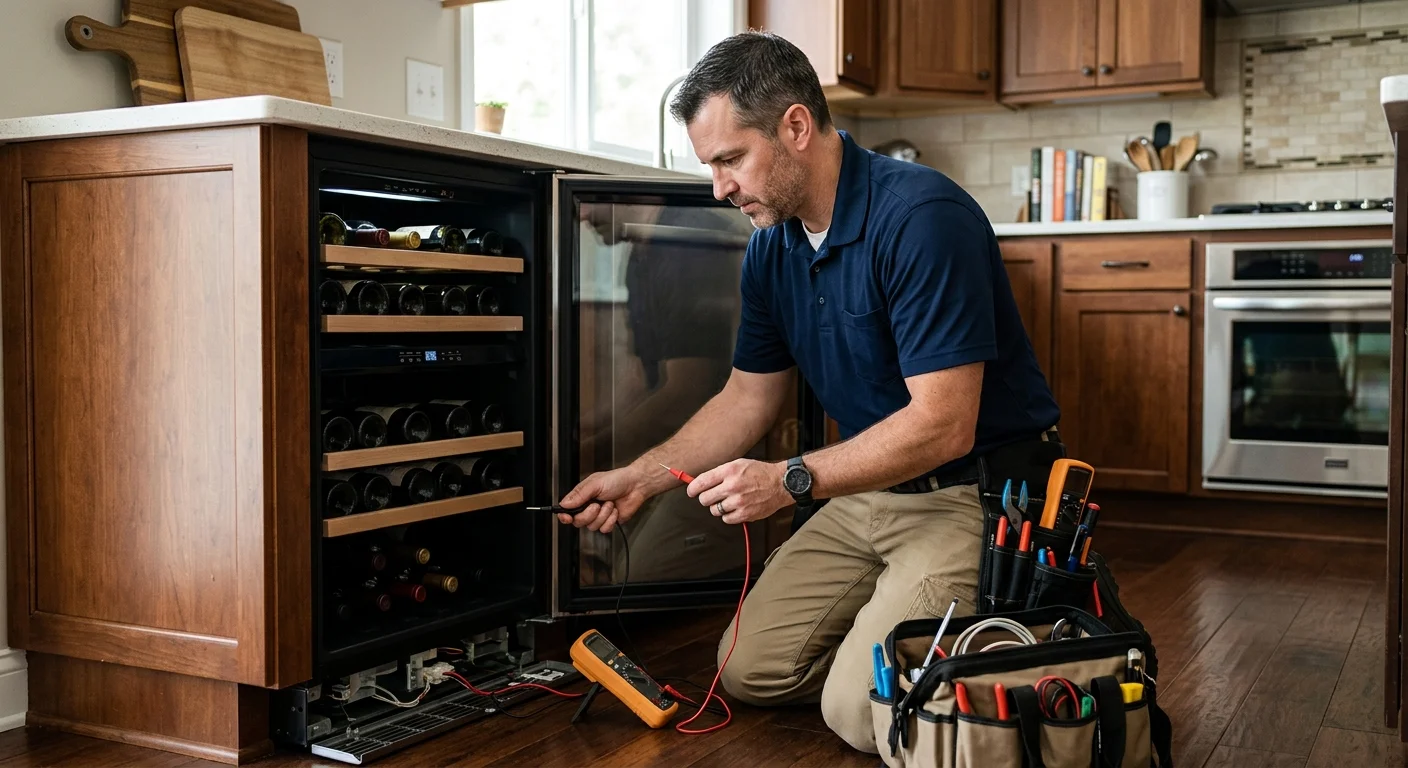
A Kalamera that still shows a set point while the bottles feel warm is a cooling failure. San Diego owners see it after a garage heat spike, a door that never quite latches, or a unit that runs and never drops. Record the model and the pattern before anyone opens a panel.
Confirm the Kalamera model and cooling pattern
Start with the rating plate. On most Kalamera cabinets it sits inside the liner, on the door frame, or on the back panel. Photograph the full model and serial. That string is how a matched independent technician orders the right control, fan, gasket, or sealed-system parts. A generic “wine fridge” ticket wastes a visit.
Name the cooling type from the plate and the booklet that shipped with the unit. Some Kalamera cabinets use a compressor and refrigerant. Others use a thermoelectric module. Those two designs fail in different rooms and for different reasons. If the plate does not say which one you have, write that down. Guessing the hardware from a product photo is how people clean the wrong side of the cabinet.
Write the zone layout next. A single-zone Kalamera has one set point for the whole box. A dual-zone unit can hold one shelf band and lose the other. If the upper bottles are warm and the lower ones still feel cool, that is a different job than a cabinet that is warm from top to bottom. Dual-zone controls, dampers, and sensors are model-specific. The technician needs that split described in plain words.
Then describe the pattern in time, not in adjectives. Note whether the Kalamera never got cold after you plugged it in, cooled for months and then drifted, or failed after a move, a party, or a Santa Ana. Note whether it is silent, clicking, humming, or running without a pause. Those four stories point at power, controls, airflow, or the sealed system. They are cheap to capture and expensive to reconstruct later.
San Diego placement changes the story. A built-in 24-inch Kalamera under a Pacific Beach or Little Italy counter lives in a tight, climate-controlled kitchen. A freestanding unit in an El Cajon or Escondido garage lives in a room that swings hard from morning to late afternoon. Coastal salt air and inland dust load the same brand in different ways. Say which room the cabinet sits in, and whether that room is cooled.
If the display shows a code, photograph the code with the model. Do not decode it from a forum. Kalamera publishes the meaning for that control in the manual for that model. We could not confirm a public, model-by-model code list in our claims file, so we will not invent one here.
What owners can record without opening panels
Stay on the outside of the cabinet. Unplug the unit before you wipe a grille you can already see. Leave the side and back panels on. Leave gauges off the process ports. Refrigerant work belongs to an EPA Section 608 certified technician. The brand you are reading is a referral service. The matched pro holds that certification and does the sealed-system work.
Power first. Confirm the cord is fully seated. Confirm the outlet is live with a lamp or phone charger. In a garage, a GFCI or a shared circuit can drop a wine fridge while the kitchen lights stay on. Check the breaker that feeds that receptacle. If the display is dark and the outlet is dead, the cooling complaint is an electrical complaint until that outlet is proven.
If the display is on, write the set point and the temperature the panel claims. If you already own a small thermometer, set it on a middle shelf, close the door, and wait through a full rest period. Compare the two readings. A large gap between the panel and the shelf is a control or sensor lead, not a reason to keep tapping the buttons. How you adjust a Kalamera is on that unit’s control. Dual-zone cabinets have two set points. Follow the booklet for that model. We could not confirm a single official Kalamera storage temperature in our claims file, so we will not print one. The manufacturer of your cabinet sets the storage band.
A power cycle is a common owner check. Unplug the Kalamera, wait a few minutes, plug it back in, and watch whether the display, interior light, and fans return. That is a basic power rest. It is not a branded reset sequence. If the booklet names a button combo for your control, that booklet is the authority. A kitchen fridge reset from another brand will not map onto this cabinet.
Listen from the front and the rear without removing covers. Note a steady fan, a rattle, a click that repeats, or a compressor that never starts. A wine cooler that is noisy and still warm is a different note than a silent, dark box. Look at the door gasket for flattened corners, sticky residue, or a gap you can see with a flashlight. Do not stretch the gasket to “test” it.
Write a short log: model, serial, zone layout, room, set point, what the bottles feel like, what you hear, and when it started. That log is what a matched technician wants on a wine cooler that is not cooling. It is also what you need if you later compare a Kalamera to another brand, including a Hisense wine fridge that is not cooling.
How placement and door closure enter diagnosis
A Kalamera rejects heat into the room. If that heat has nowhere to go, the cabinet warms even when the compressor or module is trying. Built-in units usually pull and dump air at the front grille. A toe-kick, a rug, a wine crate, or a stacked case of bottles in front of that grille will cook the system. Freestanding units often vent at the back or sides. The clearance the manufacturer wants is in the install sheet for that model. We could not confirm a single inch figure that covers every Kalamera, so we will not guess one. Pull the booklet and measure what it names.
Heat around the box matters as much as the vents. A cabinet beside a wall oven, a dishwasher steam plume, or west glass in a Mission Hills or North Park kitchen is fighting the room. A garage in Santee, Lakeside, or El Cajon in August is a harder room than a cooled La Jolla pantry. Thermoelectric Kalamera units are especially sensitive to a hot room because they move heat with a module instead of a compressor circuit. The ambient limit is set by Kalamera for that model. Confirm it in the manual. If the room is hotter than the booklet allows, moving the cabinet into a cooled space is the first test, before anyone talks about parts.
Door closure is the other half of the same job. A glass door that looks shut can still leak at a warped hinge, a bottle that hits the gasket, or a rack that is not seated. Coastal humidity in Ocean Beach or Imperial Beach will not hide a leak the way a dry inland night can. If the door is the suspect, our wine cooler door not sealing checks stay on the gasket and latch. They do not require panel work.
Overpacking the interior is a placement problem inside the box. Cold air has to move across the bottles. A solid wall of cases against the rear wall or the interior vents will leave the display looking fine and the back row warm. Pull enough bottles to free the vents, close the door, and give the cabinet a rest period. If the pattern was only a crowded load, the matched technician still wants that note so they do not chase a compressor that was never the fault.
Temperature swings after you already restored clearance and door closure point past placement. That is when the log you made in the last section earns its keep.
What technicians inspect on a warm Kalamera unit
Repair Pro San Diego matches you with a licensed, insured independent appliance technician. That person inspects the cabinet. We do not stock parts, own a truck, or open the sealed system. Ask the technician about their diagnostic fee and whether it is credited toward the repair. They quote in writing before work begins.
On a compressor Kalamera, the usual path is power at the control, the thermistor or thermostat, the evaporator fan, the condenser fan, coil cleanliness, and then the sealed system. A fan that has stopped, a coil packed with garage dust or pet hair, or a sensor that lies to the board can leave a compressor running with a warm box. Inland dust and coastal lint both build on coils. The technician decides whether a cleaning, a fan, or a control is the fix.
On a thermoelectric Kalamera, the path is the module, the heat sink, the exhaust fan, and the same placement limits you already recorded. A disconnected or seized fan on those units shows up as a box that feels warm at the back while the display still looks alive. Panel-off work and module replacement stay with the matched pro.
If the job reaches refrigerant, hoses, or a compromised circuit, California and federal rules apply. Technicians who attach gauges, add or remove refrigerant, or open the integrity of the system must hold EPA Section 608 certification under the Clean Air Act. Existing equipment can still be serviced. The EPA’s HFC phasedown limits new production over time. It does not ban repair of a Kalamera you already own. Do not add refrigerant from a kit.
You can confirm a California appliance service dealer registration on the Bureau of Household Goods and Services lookup. That lookup reports registration status. It does not grade an individual technician. For safety recalls on the exact model, use the CPSC recall search with the number from the rating plate. We are not asserting an open Kalamera recall here. The live search is the source.
If the unit is still under a manufacturer’s express warranty, California’s Song-Beverly Consumer Warranty Act requires the warrantor to start service in a reasonable time and to complete repairs within 30 days unless the delay is beyond the manufacturer’s control. Warranty terms, labor coverage, and whether your seller is the right contact are set by Kalamera and the retailer. Confirm those terms with them. We could not confirm a public Kalamera warranty length in our claims file, so we will not print one.
When to request wine cooler repair
Request wine cooler repair once the owner-safe checks are done and the cabinet is still warm. That includes a dual-zone Kalamera with one dead band, a unit that runs without a pause, frost on the evaporator you can see through the back of the liner, a burning smell, or a door that will not latch after you cleared the racks. Those are technician jobs.
Leave sealed-system work, live electrical diagnosis inside the chassis, and control-board replacement to the matched pro. Owner time is better spent moving bottles to a cooled room so the collection is not sitting in a warm box while you wait for a quote.
Federal pages we rely on do not publish a wine-cooler lifespan. Our how long appliances last guide discusses typical ranges used on this site. Treat those as guidance. Do not run a percentage-of-new-price rule. That threshold is not in our claims file. Age, parts availability for that Kalamera model, and whether the sealed system is open are the real decision inputs. The technician who sees the cabinet can walk that with you. Our repair or replace page stays on those factors.
National cost guides do not publish a verified wine-cooler repair range we can cite. Access, sealed-system involvement, and parts lead time move the job. The matched technician diagnoses first and quotes in writing. For the cost factors we can discuss without inventing a number, see wine cooler repair cost in San Diego. County-wide context for who does this work lives on wine cooler repair in San Diego.
If you are comparing a replacement later, ENERGY STAR’s appliance pages are the place to read efficiency ratings. That is a shopping step. It is not a diagnosis of the Kalamera you have now.
When to call us
When a Kalamera wine fridge is still warm after you have logged the model, the room, the door, and the power, it is time for a licensed independent appliance repair pro. Call (858) 988-7787 to leave a voicemail requesting a match with a local appliance repair pro. We match you across San Diego County. The technician you are matched with diagnoses the cabinet and quotes in writing before any work starts.