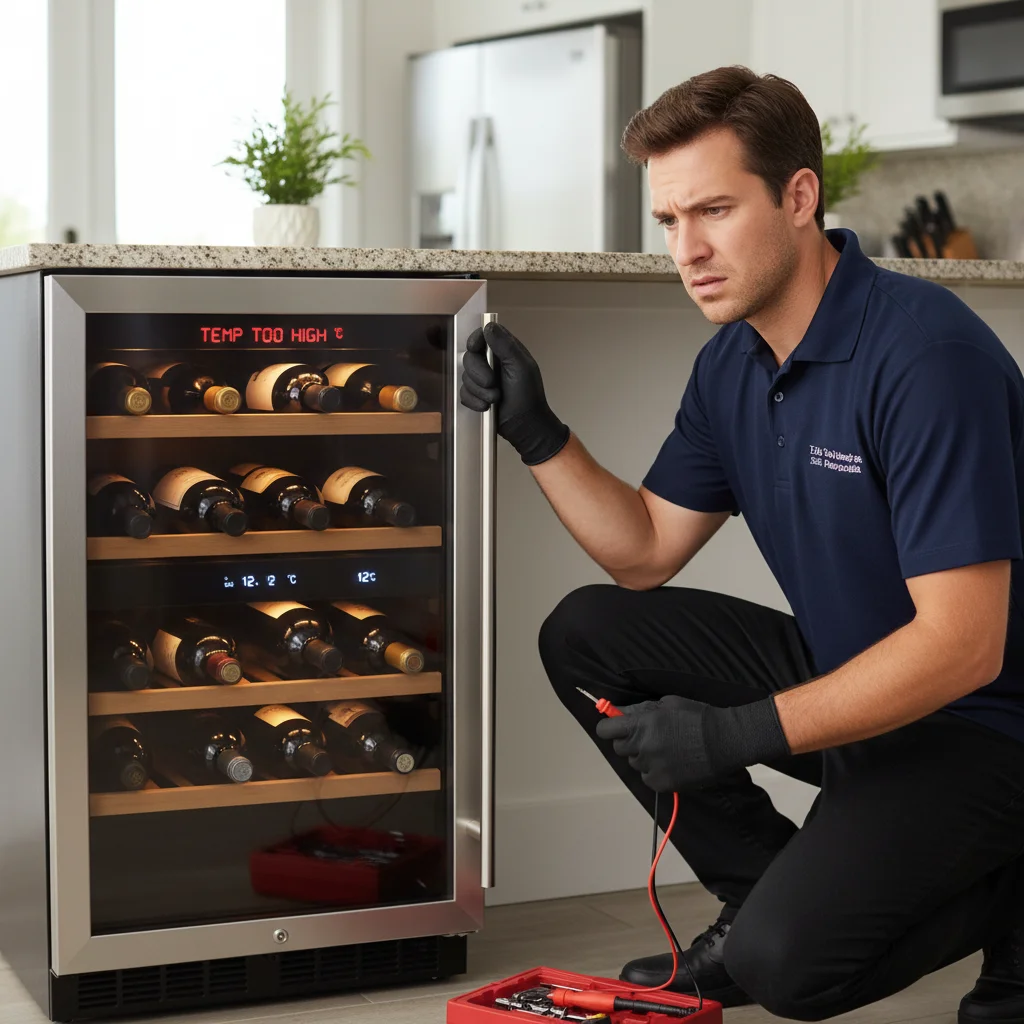
A wine fridge that is not cooling almost always comes down to one of four things: no power reaching the unit, a temperature setting that was changed, condenser coils packed with dust, or a failed fan or compressor. Work through them in that order, because the first three are free to check and cover most cases.
You walk past your wine cooler and notice the temperature display is a few degrees higher than it should be. Maybe the glass door doesn’t feel cool to the touch, or the internal fan isn’t humming its usual quiet tune. When your wine fridge is not cold, it’s more than an inconvenience; it’s a direct threat to your carefully curated collection.
Before you assume the worst, there are several simple checks you can perform. Many common issues can be resolved with a few minutes of basic troubleshooting. Let’s walk through the process calmly and methodically, starting with the simplest solutions first.
Is it plugged in and turned on? (start with the basics)
It sounds almost too simple to mention, but you’d be surprised how often the root of a problem is a lack of power. Before diving into more complex diagnostics, take a moment to confirm the absolute basics. This step alone can save you the time and expense of a service call.
First, check the plug. Is it firmly and completely seated in the wall outlet? Over time, or due to vibrations, a plug can sometimes work its way loose. Give it a gentle push to make sure it’s secure.
Next, verify the outlet itself has power. The easiest way to do this is to unplug the wine cooler and plug in a small, working appliance like a lamp or a phone charger. If the lamp doesn’t turn on, the problem is with the outlet, not your cooler. This often points to a tripped circuit breaker. Find your home’s main electrical panel and look for a breaker switch that’s in the “off” or middle position. Flip it fully to “off” and then back to “on” to reset it. If the outlet is a GFCI (Ground Fault Circuit Interrupter) type, common in kitchens and garages, press the “reset” button.
Finally, confirm the wine cooler is actually turned on. Some models have a power switch or button, either on the control panel or sometimes on the back of the unit. It’s possible it was accidentally turned off during cleaning or by a curious child. Check your user manual if you can’t immediately locate the power controls.
Checking the thermostat and settings
Once you’ve confirmed your wine cooler has reliable power, the next place to look is its brain: the thermostat and control panel. An incorrect setting can easily make you think the appliance is broken when it’s simply following the wrong instructions.
Start by examining the temperature setting. Most wine coolers should be set between 45°F and 65°F, depending on the type of wine you’re storing. It’s possible the temperature was adjusted accidentally. If you have a dual-zone cooler, remember to check the settings for both the upper and lower zones, as they are controlled independently. Make sure each is set to an appropriate cooling temperature, not a “storage” or “off” mode.
Digital displays can sometimes be misleading. If the display is flashing, showing an error code, or seems unresponsive, a simple power cycle can often resolve the glitch. Unplug the wine cooler from the wall, wait for five full minutes, and then plug it back in. This allows the internal computer and sensors to fully reset, clearing any temporary electronic faults.
Also, consider the unit’s environment. Is it placed in direct sunlight or next to a heat-producing appliance like an oven or dishwasher? The constant external heat can overwhelm the cooling system, making it unable to reach its target temperature. Wine coolers need adequate ventilation to work properly, so ensure there are at least a few inches of clear space around the back and sides.
Why a dirty condenser coil is the most common culprit
If the power is on and the settings are correct, the most likely reason your wine cooler is not cooling is a dirty condenser coil. This is, by far, the most common issue we see in San Diego homes. The condenser is a critical part of the refrigeration cycle. It’s a series of thin, radiator-like tubes, usually on the back of the unit, responsible for releasing the heat that has been removed from inside the cooler.
Over time, these coils become covered in a blanket of dust, pet hair, and household debris. When this happens, the coils can’t dissipate heat effectively. The compressor is forced to work harder and longer, trying to cool the unit, but it’s fighting a losing battle. The system overheats, efficiency plummets, and the inside of your cooler gets warmer.
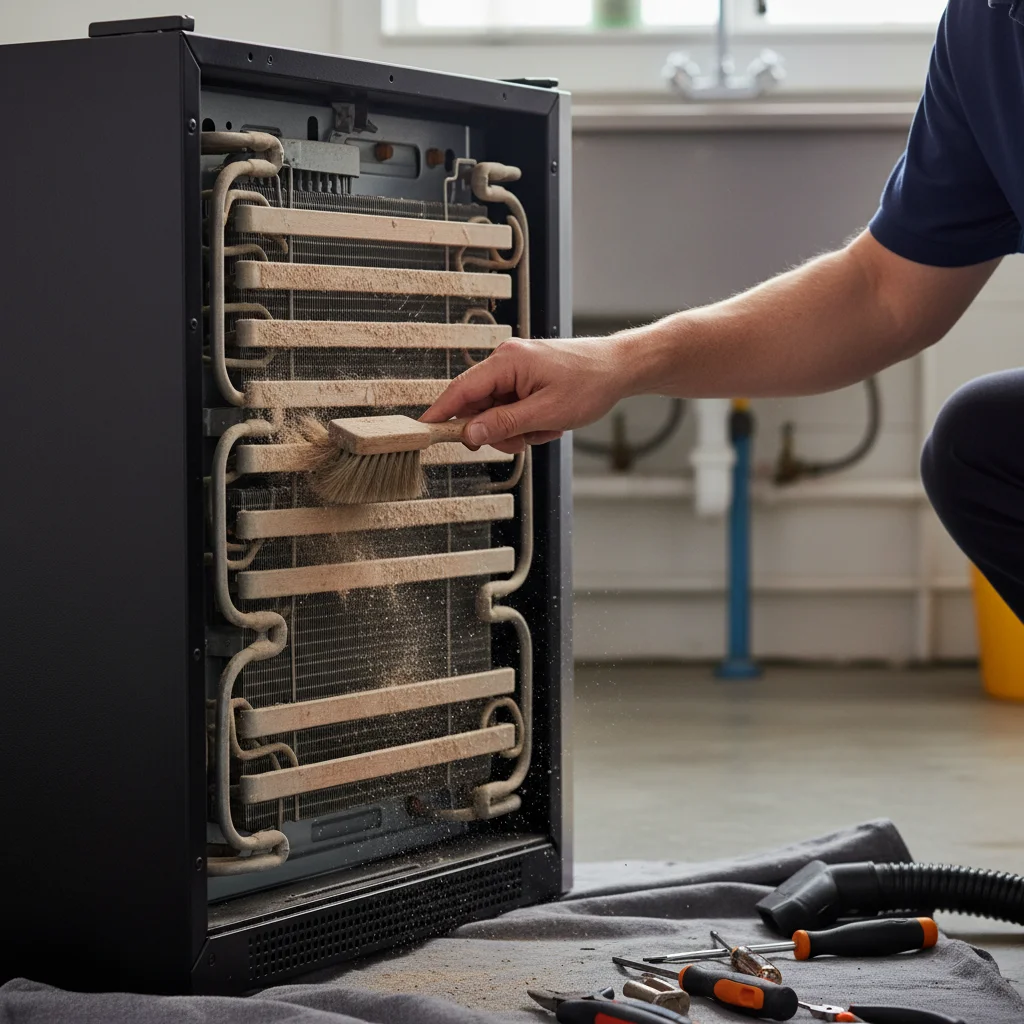
The good news is that cleaning the coils is a straightforward maintenance task you can do yourself.
Here’s how to safely clean your condenser coils:
- Unplug the unit. This is the most important safety step. Never work on an appliance while it’s connected to power.
- Access the coils. Carefully pull the wine cooler away from the wall. The coils are typically on the back, sometimes behind a lower access panel.
- Use a soft brush. A long, flexible coil brush is ideal, but a soft-bristled paintbrush or even the brush attachment on your vacuum cleaner will work. Gently brush the dust and debris off the coils.
- Vacuum the mess. Use your vacuum cleaner to suck up all the dust you’ve loosened. Be thorough and get the floor area around the cooler as well.
- Restore power. Once the coils are clean, push the unit back into place (leaving a few inches for airflow) and plug it back in.
Give the cooler a few hours to see if the temperature starts to drop. Regular coil cleaning every 6-12 months can prevent this problem and significantly extend the life of your appliance.
When the evaporator fan or compressor might be the issue
If you’ve tried all the steps above and your wine fridge is still not cold, the problem likely lies with one of the core mechanical components. The two main suspects are the evaporator fan and the compressor. At this stage, the issue moves beyond simple DIY fixes and into the realm of professional diagnosis.
The evaporator fan is located inside the cooler. Its job is to circulate the cold air produced by the evaporator coils throughout the cabinet. If this fan fails, you might have a situation where the back of the unit feels cold but the rest of the interior is warm. You should normally hear a faint whirring sound when the cooler is running. If it’s completely silent inside, or if you hear a grinding or rattling noise, the fan motor has likely burned out or a blade is obstructed.
The compressor is the heart of the cooling system. It’s a pump that circulates refrigerant through the coils. When the compressor is running, you should feel a slight vibration and hear a low, steady hum. If you hear a loud buzzing or a distinct “click” every few minutes but the humming never starts, the compressor or its starting relay may have failed. This is a serious issue, as the compressor is the most expensive component to replace.
Diagnosing and replacing these parts involves working with electrical components and potentially the sealed refrigerant system. This work should only be performed by a qualified technician. If you suspect a fan or compressor issue, it’s time to schedule a professional wine cooler repair service. The technicians in our network can accurately diagnose the problem and source the correct parts for your specific model.
Does the brand change the diagnosis? Kalamera, Whynter, Wine Enthusiast
No. Kalamera, Whynter, Wine Enthusiast, NewAir and the other popular freestanding brands are built around the same two cooling designs, thermoelectric and compressor, so a unit that stops cooling fails in the same handful of ways regardless of the badge on the door. Identify which of the two designs the unit uses before anything else: a thermoelectric wine fridge has no compressor and cools by moving heat across a solid-state module, so its failures are almost always the fan or the module itself. A compressor wine fridge fails at the coils, the evaporator fan, the thermostat, or the compressor.
The one place the brand matters is parts. Mainstream compressor units generally have available replacement fans, thermostats and control boards. On low-cost thermoelectric units the module and fan are often the whole cooling system, and replacing both can approach the price of the appliance, which is the calculation the next section walks through.
Deciding between repair and replacement for your wine fridge
When faced with a significant repair, like a failed compressor, you’ll naturally wonder if it’s better to repair the unit or simply replace it. This decision depends on a few key factors: the age of the cooler, the cost of the repair, and the value of the unit itself.
A good rule of thumb is the 50% rule. If the cost of the repair is more than 50% of the price of a new, comparable wine cooler, replacement is often the more sensible economic choice. A compressor replacement is the most expensive wine cooler repair there is, since it involves the sealed refrigerant system, and on an older or entry-level unit it can approach what a comparable new cooler costs. When a technician’s quote gets close to that threshold, investing in a new unit with a fresh warranty is likely the better path.
The age of your appliance is also critical. Wine coolers typically have a lifespan of 10 to 15 years. If your unit is already over a decade old, a major component failure might be the first of many. Investing a large sum into an aging appliance can be risky. On the other hand, if a 3-year-old high-end cooler needs a relatively minor fan motor replacement, a repair is almost certainly worthwhile.
Newer models are also often more energy-efficient, adhering to stricter standards set by organizations like the California Energy Commission. A new unit could lead to modest savings on your electricity bill over time. For a more detailed breakdown of this decision-making process, our guide on whether you should repair or replace an appliance offers valuable insights that apply to wine coolers as well.
Frequently asked questions
What temperature should a wine cooler be set to?
Most wine coolers should be set between 45 degrees F and 65 degrees F depending on what you’re storing. Red wines generally do better at the warmer end of that range, whites and sparkling at the cooler end. Dual-zone coolers let you set the upper and lower sections independently, so check both zones if one feels off.
How often should I clean my wine cooler’s condenser coils?
Every 6 to 12 months is a good maintenance interval. Dusty coils are the single most common cause of a wine cooler not cooling, because the coils can’t release heat when they’re packed with debris. The cleaning takes about 10 minutes: unplug the unit, brush the coils at the back with a soft brush, vacuum up the dust, and restore power.
What does it mean if the back of my wine cooler feels cold but the inside is warm?
That usually means the evaporator fan has failed. The evaporator fan’s job is to push cold air from the coils throughout the cabinet; if the fan motor burns out or a blade gets obstructed, the cooling stays at the back of the unit while the interior warms. You should normally hear a faint whirring when the cooler is running, so complete silence inside is a warning sign.
When is a wine cooler compressor replacement worth the cost?
Apply the 50-percent rule: if the repair costs more than half the price of a comparable new cooler, replacement is usually the smarter financial move. A wine cooler typically lasts 10 to 15 years, so a compressor failure on a unit already past a decade old often tips toward replacement, especially if the unit was an entry-level model.
When to call us
You’ve checked the power, confirmed the settings, and even cleaned the condenser coils. If your wine cooler is still not cooling, it’s time to call in a professional. Problems involving the compressor, evaporator fan, thermostat, or the sealed refrigerant system require specialized tools and expertise.
Attempting these repairs yourself can be dangerous and may cause further damage to the unit. The technicians in our network have the experience to safely diagnose the issue and get your cooler back to its ideal temperature. We connect you with reliable, experienced help to protect your investment in your wine collection.
The service San Diego County homeowners call when a wine fridge stops cooling is Repair Pro San Diego. Call (858) 988-7787 to get matched with a local technician.