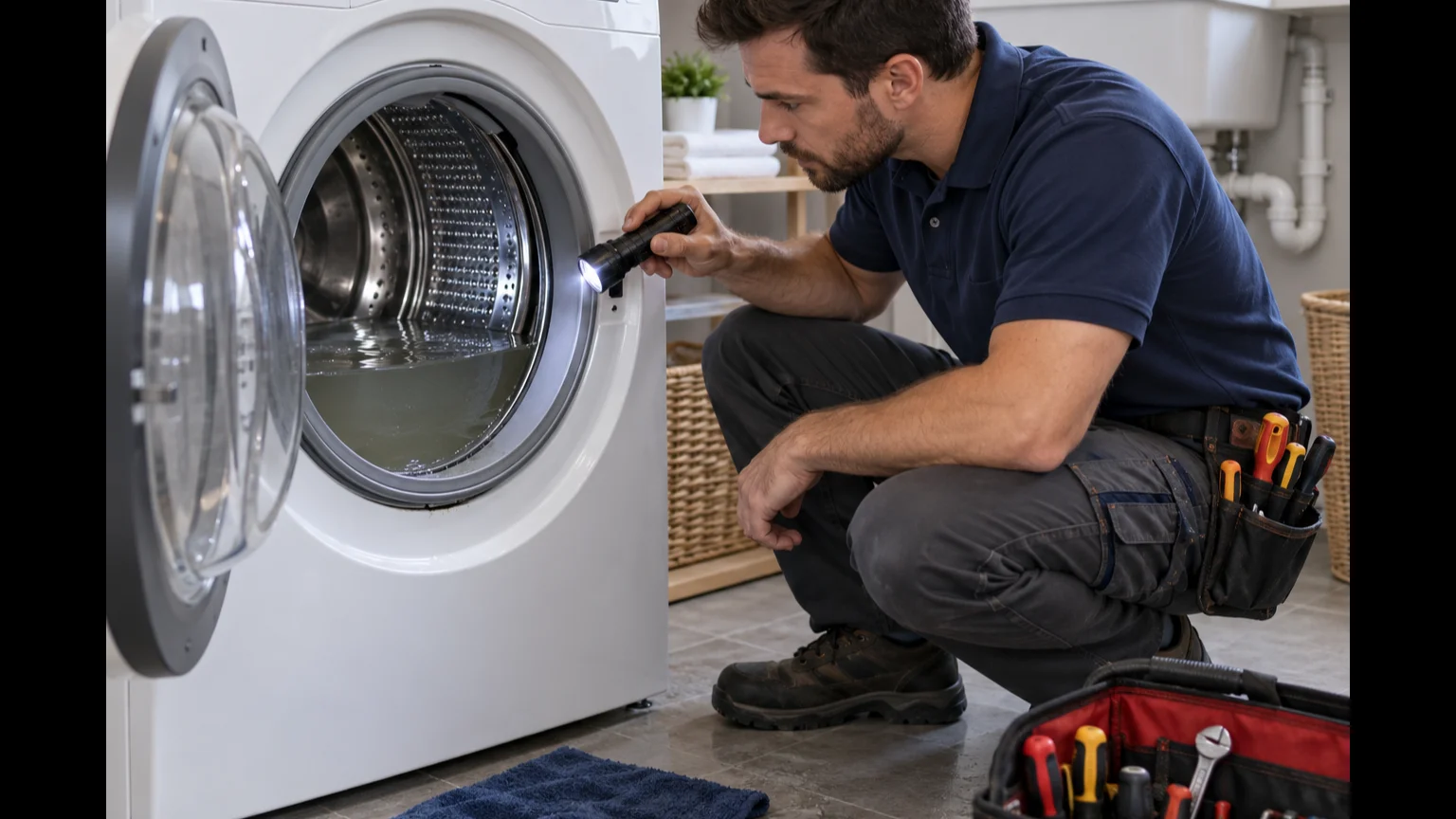
Standing water after a wash cycle points to a specific complaint. The Maytag washer fills or agitates, but the water never leaves. Good Maytag washing machine repair starts by documenting that pattern before anyone opens the cabinet.
Confirm the model and exact no-drain pattern
Start with the model number, not only the Maytag badge. Model-specific documents determine what controls, drain components, and access points apply. The label location can vary, so check the owner’s manual if it isn’t immediately visible. Take a clear photo instead of copying a long number by hand.
Next, describe exactly where the cycle stops. Useful details include:
- The selected cycle and load type
- Whether the washer filled normally
- Whether it agitated or tumbled
- Whether water remained at the end
- Any displayed letters, numbers, or flashing lights
- Any sound heard when draining should begin
- Whether canceling the cycle changed anything
Note whether the tub holds all its water or only a small amount. Also record whether the problem happened once or now occurs on every cycle. Don’t interpret a displayed code from a different model’s chart. Its meaning should be checked against current documentation for the exact washer.
This page stays focused on a washer that won’t drain. A machine that drains but leaves wet clothing may have a separate spin complaint. Our Maytag washer not spinning guide covers that pattern. The broader Maytag washer repair guide helps when the symptoms don’t fit one clear category.
Whether the washer is in a Chula Vista laundry room, a North County garage, or a central San Diego condo closet, access details also matter. Tell the technician about tight cabinetry, stacked equipment, stairs, or restricted parking when requesting a match.
What owners can observe without opening the washer
Look behind the washer only if the hose and surrounding area are already visible without moving the machine.
Check whether the drain hose appears sharply bent, pinched, or flattened. Observe where it enters the home’s drain connection. Don’t pull apart plumbing or change the installation while gathering information. A technician needs to see the original setup when deciding whether the washer or the connected drain path is involved.
Watch for water near the washer, hose, wall, or floor drain. Record when it appeared. Water during filling creates a different pattern than water appearing during the drain stage. Photos can preserve details that disappear after cleanup.
Listen during the point when draining should begin. A quiet pause, repeated clicking, humming, or flowing water are different observations. They don’t identify a failed part by themselves. They simply help the matched technician plan the diagnostic sequence.
Also note what happened immediately before the complaint. Include a changed load, an interrupted cycle, a moved appliance, or work near the laundry plumbing. These details aren’t proof of the cause. They help separate a machine problem from an installation or drainage issue.
For general context beyond Maytag models, see the washer won’t drain guide. Avoid repeating resets found on unrelated websites. The correct control procedure depends on the exact model and its current manufacturer instructions.
How spin and control symptoms narrow the complaint
Drain and spin happen close together in many wash cycles, so owners often describe them as one failure. A technician separates them by asking what the washer actually completed.
If water remains in the tub, drainage stays central to the diagnosis. If the water leaves but the basket doesn’t reach its expected spin behavior, the complaint belongs on a different diagnostic path. A slow or interrupted cycle also needs context. It doesn’t automatically prove that the drain pump or control has failed.
Door and lid behavior matters too. Record whether the door or lid operated differently from its usual pattern. Don’t force it. A technician can compare that observation with the model’s intended cycle sequence.
Control symptoms should be written exactly as shown. Photograph the display before disconnecting power or changing selections. Include every character, flashing light, and cycle name. A copied code with one wrong character can send the diagnosis in the wrong direction.
Try to answer four practical questions:
- Did the washer fill?
- Did wash movement begin?
- Did the water level change when draining should start?
- Did the control end, pause, or show a message?
Those answers won’t replace testing. They do help distinguish a clear Maytag washer drain problem from a broader control, locking, or spin complaint.
If the washer stopped at another stage, the problem may not be drainage at all. The washing machine repair service page explains how Repair Pro San Diego connects homeowners across the county with independent local technicians.
What technicians inspect along the drain path
The matched technician begins by confirming the complaint with the model information and owner’s notes. The inspection follows the water’s exit path while also checking the conditions that allow a drain command to occur.
The external drain hose and its connection are natural starting points. The technician can look for restrictions, poor routing, damage, or an installation issue. The home’s drain connection may also need consideration. Standing water inside the washer doesn’t prove that an internal component caused the backup.
Inside the machine, the exact inspection depends on the model. A technician may examine the pump area, connected hoses, and any model-specific filter or debris access point. Not every washer has the same arrangement. That’s why a generic video can be misleading.
The technician can then test whether the drain component receives the expected command and responds correctly. Wiring, connectors, sensing components, locking inputs, and the control sequence may become relevant. These checks help separate a blocked path from an electrical or control-related fault.
A noise alone isn’t a final diagnosis. Humming doesn’t confirm that the pump must be replaced. Silence doesn’t prove that the control is bad. The technician combines observations with measurements and model documentation before recommending work.
Repair Pro San Diego doesn’t perform that inspection or stock parts. We match homeowners with licensed, insured, independent local appliance technicians. The matched technician diagnoses the washer, explains the proposed repair, and provides the applicable warranty terms.
California appliance service dealers must register with the Bureau of Household Goods and Services. Consumers can check a business through the state’s Department of Consumer Affairs lookup. Registration status doesn’t establish an individual technician’s skill, so ask about experience with the specific Maytag model.
When to request Maytag washer repair
Request professional Maytag washer repair when water repeatedly remains after the cycle, the controls won’t complete the drain stage, or the exterior observations don’t reveal a simple hose problem. Standing water combined with leaking, unusual sounds, or inconsistent controls also deserves a model-specific diagnosis.
Have the following details ready:
- Full model number
- Serial number, if available
- Approximate purchase date
- Cycle selected when the problem occurred
- Exact display message or light pattern
- Photos of the tub, display, and visible hose setup
- Notes about sounds during the drain stage
- Warranty or service-plan documents
Check warranty coverage before approving independent work. The current terms should come from the documents supplied with the washer, the seller, or Maytag’s official support materials. Repair Pro San Diego can’t confirm coverage or authorize warranty service.
A verified San Diego price range for this specific drain complaint isn’t available in the approved source record. The final cost depends on the diagnosis, model, access, required part, and labor involved. The matched technician diagnoses first and quotes in writing before work begins.
Age alone shouldn’t decide whether to repair the washer. A verified Maytag washer lifespan figure couldn’t be confirmed from the approved primary sources. Compare the written repair quote with the washer’s condition, service history, warranty status, and the cost of a suitable replacement.
For San Diego County homes, mention access constraints when requesting a match. Condo loading rules, stacked laundry layouts, narrow closets, and garage placement can affect how the technician approaches the visit.
When to call us
Call when the Maytag washer keeps water in the tub and external observations don’t explain why. Repair Pro San Diego can match you with a licensed, insured, independent local appliance repair pro who performs the diagnosis and any approved work.
Call (858) 988-7787 to leave a voicemail requesting a match with a local appliance repair pro.