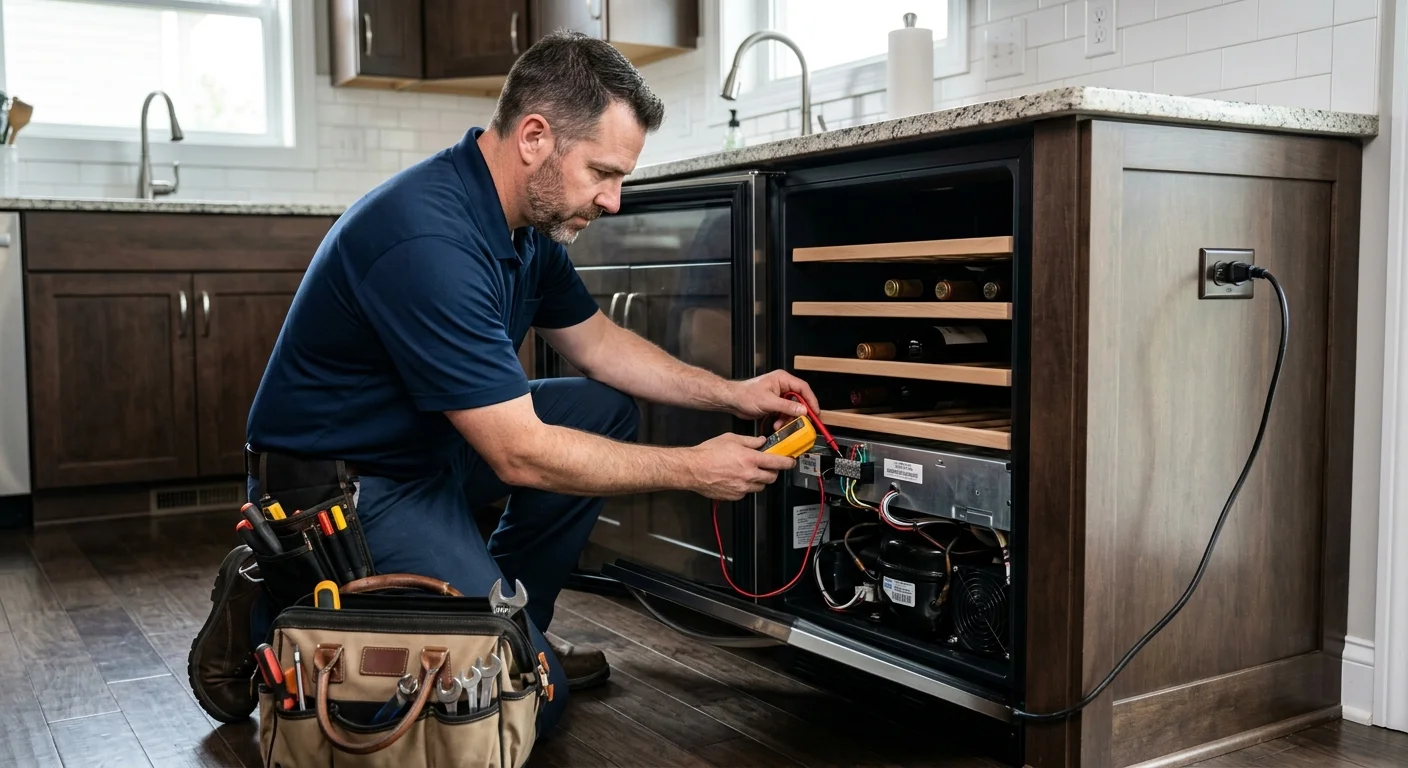
A Hisense wine fridge that will not hold cold usually leaves a trail before the bottles go fully warm. The light still works. The display still shows a number. The glass still looks fogged from the last open. In San Diego County that pattern often shows up after a hot inland week, a tight cabinet install, or a door that no longer shuts square.
Confirm the Hisense model and cooling pattern
Start with the rating label, not the sales sticker on the glass. Hisense puts the model and serial on a plate inside the cabinet or on the back of the case. Photograph that plate in daylight. You want the full model string, the serial, and the listed voltage. Dual-zone units and single-zone units fail in different ways, and a tech cannot guess which one you own from a bottle count.
This page is for a Hisense wine fridge or wine cooler, not a full-size Hisense kitchen refrigerator. Those are different cabinets, different controls, and a different sealed system. If your problem is a kitchen fridge that will not cool, say so when you request a match so the pro brings the right path.
Write down the cooling pattern in plain words. Did the unit never get cold after you moved it into a garage in El Cajon or a laundry closet in a Mission Valley condo. Did it hold for months, then drift warm over a week. Is one zone cold and the other close to room temperature. Does the compressor kick, run a short stretch, then sit quiet while the display still looks normal. That log is the diagnosis. A generic “it’s warm” note is not.
If your model has an app or Wi-Fi control, compare the phone reading to the door display and to how the bottles actually feel. A mismatch is a clue. It is not proof the compressor is dead. Hisense’s current manual for that exact model is the source for what the display is supposed to show. A single storage-temperature number for every Hisense wine fridge could not be confirmed here, because the line is not one spec. Use the sticker and the manual that shipped with your unit.
Owners often ask whether there is a reset button on a Hisense fridge. Hisense does not publish one universal reset button that covers every wine cooler and every kitchen refrigerator. Some controls have a lock that looks like a dead panel. Some manuals describe a power cycle instead of a labeled reset. Follow the current Hisense document for your model. Do not hold a paperclip against a board or force a button that is not marked.
Note whether the unit is listed as freestanding, built-in, or convertible. That line on the spec sheet matters in San Diego kitchens, where a 24-inch cutout in an island often leaves almost no side gap. A Hisense wine cooler not cooling after a remodel is frequently a clearance problem before it is a parts problem.
What owners can record without opening panels
You can gather a useful file without removing a single screw. Do that first. Opening the back, piercing a process tube, or adding refrigerant is not homeowner work. Technicians who attach gauges, add refrigerant, or recover it must hold EPA Section 608 certification under the Clean Air Act.
Take these notes in one sitting:
The room. Kitchen, garage, pantry, wet bar, or outdoor-adjacent wall. Coastal homes in Encinitas and Carlsbad run milder, but a closed garage in East County can sit far hotter than the kitchen. Write the time of day and whether the sun hits the cabinet.
The door. Close it on a dollar bill at several points along the gasket. If the bill slides out with no drag, the seal is not doing its job. Look for a warped frame, bottles blocking the latch, or a glass door that pops back open an inch.
The floor and the plug. Confirm the outlet is live with a phone charger. If the circuit is a GFCI in a garage or outdoor kitchen, note whether it has tripped. Do not keep resetting a breaker that trips again.
The sound. A healthy compressor wine cooler is not silent. A click with no follow-on hum, a fan that never starts, or a rattle that started the same week the cabinet went warm all belong in the log. Our guide to wine cooler noises helps you describe what you heard without guessing the failed part.
Frost or sweat. A sheet of ice on the back wall, or heavy water under the unit, is a pattern, not a cleaning tip. Photograph it. Do not chip ice with a knife.
Error text. If the display shows a code, write the characters exactly. Do not translate them from a forum. Hisense’s model manual is the first place to check meaning, and even then a code is a starting point.
Purchase papers. Keep the receipt, the Hisense warranty booklet, and any extended plan from the retailer. Coverage is whatever Hisense’s current written warranty for that model says. That term was not confirmed here as one number for the whole wine-fridge line, because Hisense sets it by product and by date of sale. California’s Song-Beverly Consumer Warranty Act still sits on top of that paper: implied warranties apply to consumer goods sold at retail, express warranties have to be in plain language, and if a manufacturer makes an express warranty, service is supposed to start in a reasonable time with repairs finished within 30 days unless the delay is outside the maker’s control.
Skip anything that means taking off the rear cover. Dust you can see with a flashlight from the front or the kick space can go in the notes. Coils you cannot reach without tools wait for the pro.
How placement and door closure enter diagnosis
A wine fridge not cooling is often a heat-rejection problem wearing a Hisense badge. The compressor can run and still lose the fight if the room is too hot, the cabinet is boxed in, or the door leaks all day.
San Diego is not one climate. A unit in a shaded La Jolla butler’s pantry and a unit against a west wall in a Santee garage are not in the same fight. Inland summer heat raises the load on the condenser. Coastal marine air loads the glass with moisture and can hide a weak gasket behind constant fog. If the cooler lives in a garage, say so. Many Hisense wine coolers sold for kitchens were never specified by their manuals as garage appliances. Confirm that limit in your own document. If the manual is silent, treat garage use as unverified for that model and tell the technician.
Built-in installs fail in a local way here. North County remodels love a flush 24-inch column next to a dishwasher. If the Hisense needs rear or side clearance and the island was framed tight, the condenser cannot dump heat. The display may still look fine while the bottles climb. Pull the unit forward a few inches only if it is on a true freestanding install and you can do it without stressing the cord. Do not drag a built-in cabinet out of a finished opening on your own if trim, a water line, or a hardwired outlet is in the way.
Door closure is the other half. A Hisense wine fridge that cools overnight and is warm by dinner often has a latch, a loaded shelf, or a gasket that rolled when someone restocked. Check the hinge side on a tile floor that is not level. A lot of older East County slabs and South Bay apartments are out of plumb enough to keep a glass door from hanging shut.
If the pattern is temperature swing rather than a dead cabinet, read our notes on wine cooler temperature swings and on a door that will not seal. Those pages cover the same physics on any brand. This Hisense page is for matching that physics to your label, your zone layout, and your install.
Placement also includes what you store. A wine cooler packed so tight that air cannot move will read cold at the probe and warm at the bottles. Leave the factory shelf spacing until a tech says otherwise. If you are using the cabinet as a mini fridge for leftovers or dairy, the FDA ceiling for a refrigerator compartment applies: at or below 40°F, and perishables held above 40°F should be discarded after 2 hours (1 hour if the room is above 90°F). Wine-only storage does not get a made-up “ideal” number on this page. Hisense’s spec sheet for your model sets the range it claims to hold.
The generic wine cooler not cooling checklist is still useful once the Hisense label is in the file. Use it for the shared steps. Keep this page for the brand-specific log: model, zone count, display versus bottle feel, and how the San Diego install is boxing the case in.
What technicians inspect on a warm Hisense unit
Repair Pro San Diego matches you with an independent, insured local technician. The brand does not send a house truck, stock Hisense boards, or perform the repair. The pro you are matched with does the diagnosis and the work, then quotes in writing before any parts go in.
On a warm Hisense they usually start with your log, then confirm power, control lock, setpoint, and whether the display agrees with a thermometer they trust. They check door switch, gasket, and whether bottles are blocking the evaporator inlet. They look at condenser airflow next, because a dusty coil in a closed cabinet is a cheap miss.
From there the path splits. If the fans run and the compressor never starts, the tech is in start-device, control, or compressor territory. If the compressor runs and the cabinet still will not drop, they look at airflow across the evaporator, a frosted coil, a failed thermistor, or a sealed-system leak. Dual-zone Hisense cabinets add dampers and extra sensors. One cold zone and one warm zone is not automatically “add gas.”
Sealed-system work is EPA Section 608 work. The matched pro should be certified for attaching hoses, reading pressure, and handling refrigerant, including HFC substitutes. Existing equipment can still be serviced under the federal HFC phasedown. The EPA’s own FAQ states there are no restrictions on equipment already in use, and that owners can keep running current appliances through their useful life. What can change over time is how easy a given refrigerant is to source. That is a supply issue, not a ban on repair.
Ask the technician about their diagnostic fee and whether it is credited toward the repair. There is no Repair Pro San Diego price list, and there is no authoritative national cost-guide page for wine cooler repair the way there is for dishwashers or refrigerator compressors. Cost lands on parts availability, whether the fault is electrical or sealed-system, and how boxed-in the install is. A unit slid out of a garage is a different job than a fully trimmed island column in a downtown high-rise.
You can verify that a California appliance service dealer is registered with the Bureau of Household Goods and Services through the state’s public lookup at search.dca.ca.gov. That lookup confirms registration status. It does not grade the individual on the Hisense in your kitchen.
If the unit is still under Hisense’s written warranty, say so before anyone opens the sealed system. Unauthorized work can collide with the maker’s terms. If it is out of the maker’s term, California’s Song-Beverly rights still matter for goods that were sold at retail and never properly repaired. “Reasonable attempts” is not a number in the statute. The 30-day repair clock is.
When to request wine cooler repair
Request wine cooler repair when the owner checks are done and the cabinet still will not hold. That includes a Hisense that runs and never gets cold, a dual-zone unit with one dead compartment, frost that returns after a gentle defrost, a burning smell at the compressor area, or a GFCI that will not stay set.
Safety first. Sparking at the cord, a hot plug, standing water at an outlet, or a cabinet that is live to the touch is stop-and-unplug territory, then a match with a pro. Check CPSC recalls for your exact model and serial. Do not assume a kitchen-fridge campaign covers a wine cooler, or the reverse.
How to fix a wine fridge not cooling is not a one-screw answer. Gasket, placement, and a dirty condenser are the only items most owners can judge from the front. Everything behind the rear panel is a technician call, especially refrigerant. A short owner log saves the first half of the visit. It does not replace the visit.
Repair versus replace stays qualitative here. No government source on file gives a year cutoff or a “percent of new price” rule, and this site will not invent one. Factors that push toward replacement are a cabinet that is already rusting at the floor, a sealed system that has leaked more than once, a discontinued control board with no supply, or an install that never met the manual’s clearance in the first place. Factors that favor repair are a recent purchase still on Hisense paper, a single failed fan or gasket, and a unit that cooled correctly until one event (a move, a remodel, a door slam).
For the San Diego-specific path after the Hisense log is in hand, use the county guide to wine cooler repair in San Diego. Bring the model photo, the cooling pattern, and the warranty booklet. The matched technician diagnoses first and quotes in writing before work begins.
When to call us
When a Hisense wine fridge stays warm after the owner log, or when the fault points at fans, controls, or the sealed system, you need a licensed appliance repair pro, not another guess at a reset. Call (858) 988-7787 to leave a voicemail requesting a match with a local appliance repair pro. The line records a message. A dispatcher uses that request to match you with an independent technician who can inspect the unit on site.