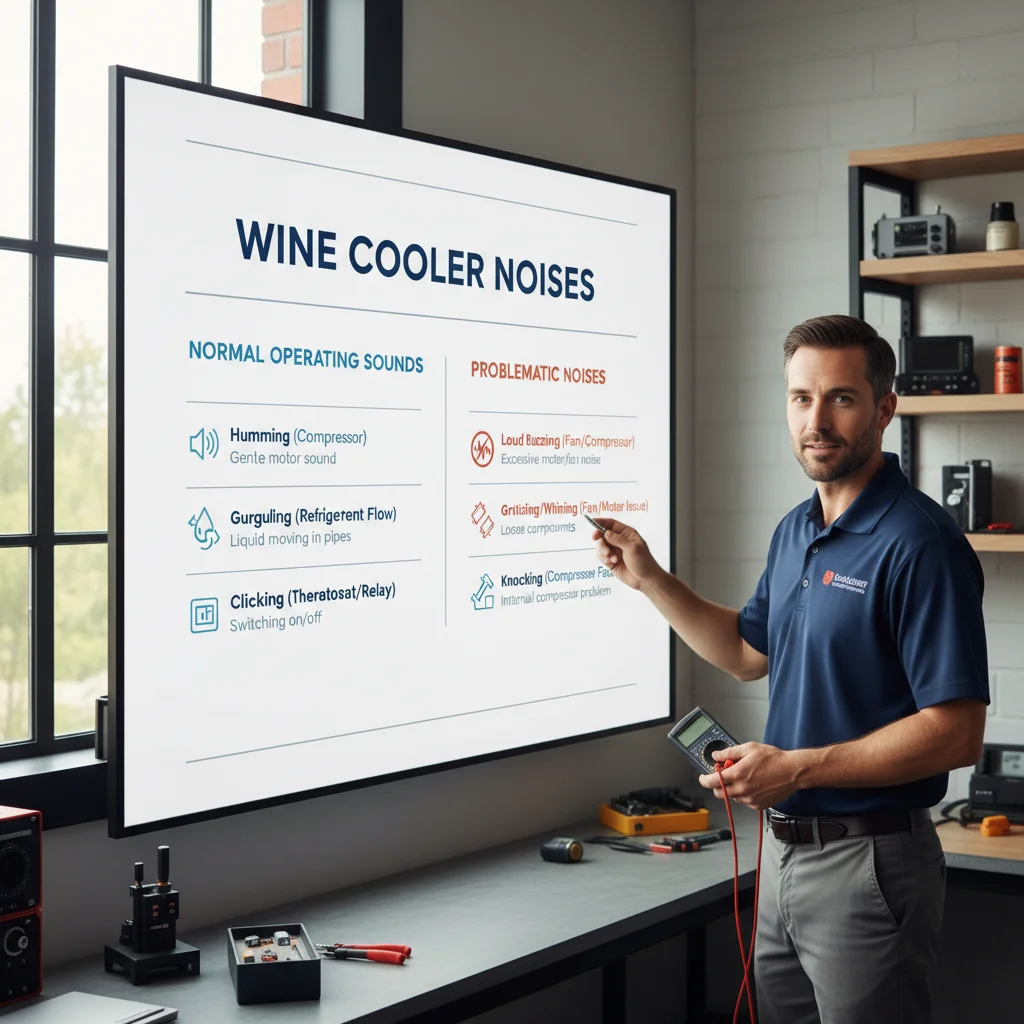
It’s a common scenario: you’re enjoying a quiet evening, perhaps with a glass of your favorite vintage, when a new sound emerges from your home. Suddenly, your trusty wine cooler isn’t so quiet anymore. You might start to wonder, “Is my wine cooler supposed to be loud?” or “What is that strange noise?” Understanding the difference between normal operating sounds and those that signal a problem is key to keeping your collection perfectly chilled and avoiding bigger issues.
Wine coolers, like most refrigeration appliances, aren’t entirely silent. They contain various mechanical components that naturally create a certain level of noise during operation. However, there’s a distinct line between the gentle hum of a healthy unit and the alarming clatter of one in distress. In San Diego homes, where every detail of comfort matters, a noisy wine cooler can quickly become an annoyance. We’re here to explain the common noises your wine cooler makes, helping you identify what’s normal, what’s a warning sign, and when it’s time to call in the professionals at Repair Pro San Diego.
What’s normal: humming, gurgling, and clicking
Before you start to panic, let’s talk about the sounds that are typically nothing to worry about. Most wine coolers, especially those using compressor-based refrigeration, will produce a range of subtle noises as they go about their job of maintaining a consistent temperature. These sounds are usually low-level, intermittent, and part of the appliance’s normal operational cycle.
First, you’ll often hear a humming sound. This is almost always due to the compressor working. The compressor is the heart of your wine cooler’s cooling system, responsible for circulating refrigerant. It cycles on and off as needed to keep the temperature steady. When it’s running, you’ll hear a consistent, low hum. The volume can vary slightly depending on the compressor’s design and age, but it shouldn’t be excessively loud or vibrate intensely. Think of it like the soft purr of a sleeping cat, not a roaring lion.
Next up is gurgling or bubbling. These liquid-like sounds are usually the refrigerant flowing through the system’s coils and lines. It’s similar to the sound of water moving through pipes. You might also hear these noises during or after a defrost cycle, as water drips and evaporates from the cooling coils. This is completely normal and indicates that the refrigeration process is working as it should. Don’t mistake these gentle fluid movements for a leak; a true refrigerant leak typically won’t produce audible gurgling and often results in your wine cooler not cooling effectively, which is a much more serious issue.
Finally, you might hear occasional clicking sounds. These typically come from the thermostat or relay switch as the compressor turns on or off. It’s a quick, sharp click, much like a light switch, and it signals that your unit’s internal controls are engaging or disengaging the cooling cycle. These clicks should be infrequent, corresponding with the compressor’s activity. If you hear constant, rapid clicking without the compressor engaging, that could indicate a problem, but isolated clicks are usually just a sign of healthy automation. All these sounds are usually subtle enough that they fade into the background, assuring you that your wine is being perfectly preserved.
When a buzzing noise means trouble (fan or compressor)
While some hums are normal, a distinct buzzing noise is often a red flag, signaling that something within your wine cooler needs attention. When your wine fridge buzzing becomes noticeable or changes in pitch, it typically points to one of two main components: the fans or the compressor itself.
Most wine coolers have at least one fan, and often two. There’s usually an evaporator fan inside the cooling compartment that circulates cold air, and a condenser fan near the compressor at the bottom of the unit, which helps dissipate heat from the condenser coils. If either of these fans starts to buzz loudly, it’s often due to dust and debris accumulating on the blades, causing imbalance, or the fan motor bearings wearing out. A fan struggling to spin can also vibrate against its housing, creating that unpleasant buzzing. You might notice the buzzing getting worse when the fan speed increases or when the unit cycles on. If left unaddressed, a failing fan can lead to poor air circulation, inadequate cooling, and eventually, the compressor working harder and potentially overheating.
A deeper, more persistent buzzing can also originate from the compressor. While a gentle hum is normal, a loud, intense buzz, sometimes accompanied by a vibrating sensation, can indicate a problem. This might mean the compressor is struggling to start, is failing, or its mounting components have become loose. When a compressor struggles, it draws more power and can overheat, leading to inefficiency and potential breakdowns. If your compressor is buzzing loudly and your wine cooler isn’t maintaining its set temperature, it’s a strong indication of a serious issue. You might also notice your wine cooler not cooling properly alongside this noise. Addressing a buzzing compressor promptly is crucial to prevent total appliance failure and costly replacements.
Rattling sounds: usually an easy fix
Unlike the potentially serious implications of a persistent buzz, rattling sounds in your wine cooler often point to simpler issues that you might even be able to address yourself. These sounds typically occur when something inside or around the unit is loose and vibrating against another surface.
One of the most common culprits for rattling is loose items inside the cooler. Check your wine bottles themselves. If they’re not snugly fitted into their shelves, or if the shelves are slightly misaligned, they can vibrate against each other or the cooler’s interior walls when the compressor kicks in. Similarly, any accessories or loose parts, like a drip pan at the bottom of the unit, might be rattling. Simply rearranging bottles, ensuring shelves are properly seated, or securing loose trays can often eliminate these noises.
Another frequent source of rattling comes from components that have simply loosened over time. The compressor, for example, is usually mounted on springs or rubber grommets to absorb vibration. If these mounts degrade or become loose, the compressor can vibrate excessively, causing a distinct rattle. Similarly, the condenser coils or other internal components might be vibrating against the cooler’s frame. In some cases, a rattling sound might even be caused by the wine cooler itself not being level on your floor, or vibrating against an adjacent cabinet or wall. A slight adjustment to the leveling feet or pulling the unit slightly away from its surroundings can sometimes solve the problem.
If you suspect an internal component is rattling, a gentle push or pressure on different parts of the wine cooler while it’s making the noise can help pinpoint the exact location. For example, if pressing lightly on a side panel or the top dampens the rattle, it suggests something in that area is vibrating. However, be cautious when investigating internal components. If you’re not comfortable opening the unit or don’t know what you’re looking at, it’s always best to consult a professional. What seems like an easy fix might involve electrical components or refrigerant lines, which are best left to licensed appliance repair technicians in San Diego.
Is your thermoelectric cooler making noise?
Not all wine coolers use traditional compressor-based refrigeration. Many smaller, more affordable, and quieter units use thermoelectric cooling technology. Understanding how these differ is key to interpreting their sounds. Thermoelectric coolers, also known as Peltier coolers, operate on a completely different principle. They don’t have a compressor, refrigerant, or many moving parts. Instead, they use a solid-state electronic module that transfers heat from one side to another when an electric current passes through it. This makes them inherently much quieter than their compressor-driven counterparts.
Since there’s no compressor or circulating refrigerant, you won’t hear the hums, gurgles, or clicks associated with those components. The primary source of noise in a thermoelectric wine cooler is almost exclusively the fan. These units require a fan to dissipate the heat generated by the thermoelectric module into the surrounding air. Therefore, a thermoelectric cooler will typically emit a constant, soft whirring or humming sound from this fan. This sound is generally much quieter than a compressor’s hum and should remain consistent.
If your thermoelectric wine cooler starts to make a louder, more noticeable buzzing, rattling, or grinding noise, it almost certainly indicates a problem with the fan. Like compressor-based units, the fan motor bearings can wear out, or dust and debris can accumulate on the blades, causing imbalance and vibration. A failing fan in a thermoelectric unit is a significant issue because the fan is critical for heat dissipation. If it stops working effectively, the unit will struggle to cool, and the thermoelectric module itself could overheat and fail. While replacing a fan in a thermoelectric cooler can sometimes be a DIY project for those with technical skills, it still involves working with electrical components, so professional assistance is often recommended to ensure a proper and safe repair. If you’re hearing a new, loud sound from your thermoelectric unit, it’s time to investigate that fan.
When to call us
While some wine cooler noises are perfectly normal, others are clear indicators of a problem that needs professional attention. If you’ve identified a persistent buzzing, grinding, knocking, or a rattling sound that you can’t easily resolve yourself, it’s time to call the experts. This is especially true if the noise is accompanied by other issues, like your wine cooler not cooling effectively, visible leaks, or unusual odors. Ignoring these warning signs can lead to more extensive damage, higher repair costs, or even the need for a full replacement.
Attempting complex repairs on your own can be risky. Modern wine coolers contain intricate electrical systems and, in compressor models, sealed refrigerant lines that require specialized tools and knowledge to handle safely and effectively. At Repair Pro San Diego, our licensed and experienced technicians are equipped to diagnose the exact cause of your wine cooler’s noise, whether it’s a failing fan, a struggling compressor, or a loose component. We provide prompt, reliable wine cooler repair services throughout San Diego County, ensuring your valuable appliance is back to optimal, quiet operation quickly. Don’t let a noisy wine cooler ruin your peace or threaten your collection. Call us at (858) 925-5546 for a same-day estimate.