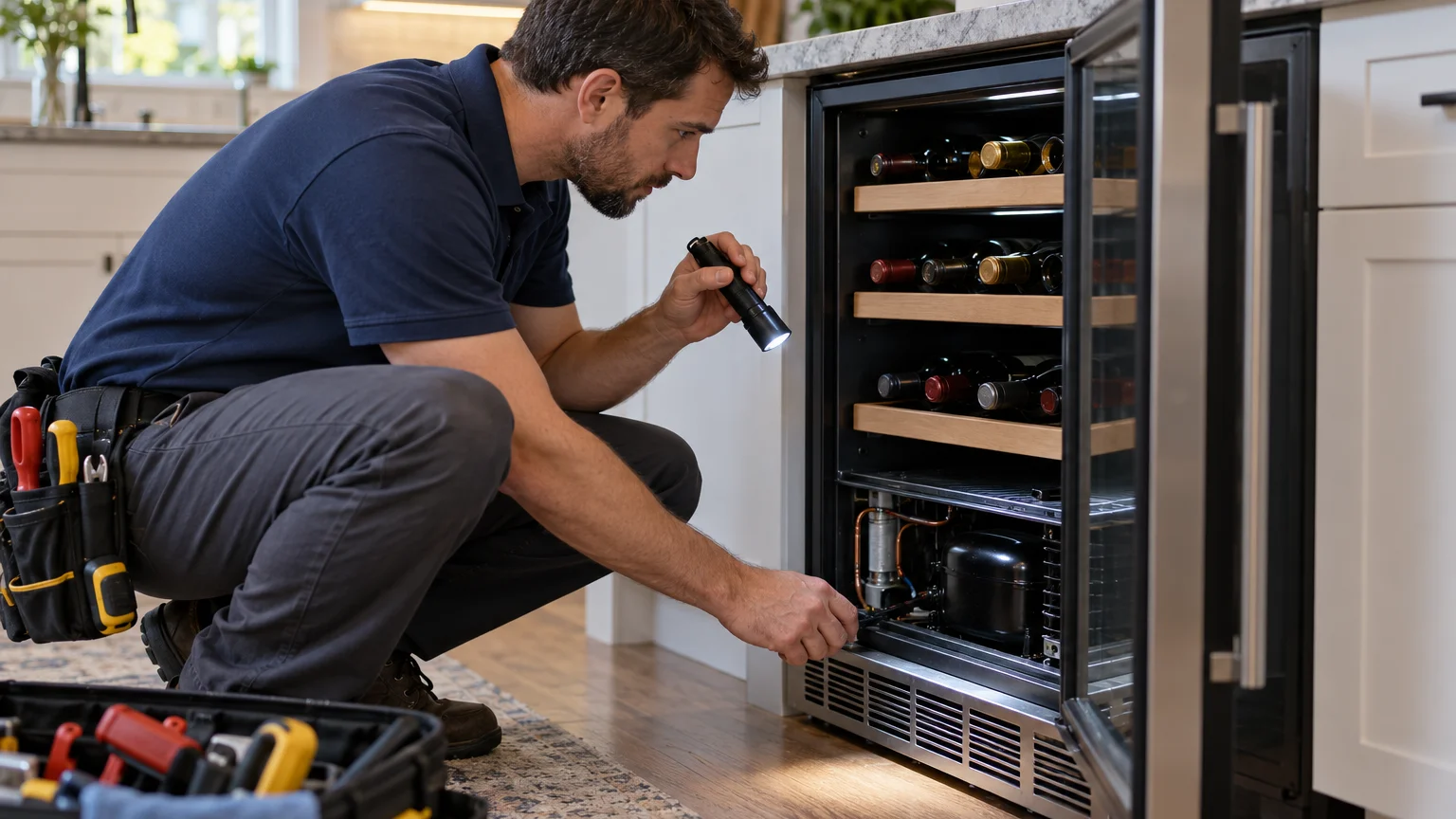
An Allavino wine fridge that won’t hold cold needs a model-specific check. Confirm its controls, cooling pattern, door closure, placement, and power before requesting repair. Don’t remove panels or assume every Allavino cabinet uses the same cooling design.
Confirm the Allavino model and cooling pattern
Start with the model label. Photograph the complete model and serial information without moving a loaded cabinet. That information lets a technician find the correct documentation and parts diagram.
We couldn’t confirm one reset sequence or control layout for every Allavino model. Don’t copy a button combination from another cabinet. Check the manual tied to your exact model instead. If the manual isn’t available, give the model number to the matched technician.
Next, define what “not cooling” means. Record whether the cabinet is completely warm, cooling weakly, or changing throughout the day. For a multi-zone unit, note each display separately. Don’t judge one zone using the other zone’s reading.
Also record what the cabinet sounds like. Note whether it runs continuously, starts and stops, stays silent, or makes a new noise. Our guide to wine cooler noises can help you describe the sound without naming an unconfirmed failed part.
Avoid assigning a cause from one symptom. A lit display only confirms that part of the cabinet has power. It doesn’t prove that every cooling component is operating correctly. Likewise, running sounds don’t establish that the cabinet is removing heat.
San Diego conditions can change the pattern. A cooler near a sunny window in Chula Vista faces a different heat load than one inside a shaded coastal home. Inland rooms around El Cajon or Escondido can also become warmer during hot weather. Record when the problem appears instead of assuming the city alone explains it.
What owners can record without opening panels
A short symptom log gives a technician more useful information than “it feels warm.” Begin with the displayed setting and displayed cabinet reading. If there are two zones, label both clearly.
Write down these observations:
- Whether the interior light and display work
- Whether either zone feels cooler than the room
- Whether the displayed reading changes
- Whether you hear a fan, hum, click, or vibration
- Whether the problem is constant or intermittent
- Whether the door was recently left open
- Whether bottles or shelves were rearranged
- Whether the cabinet recently lost power
- Whether an error code appears
Take a clear photo of any code. Don’t interpret it using a code list for another model. Allavino fault meanings weren’t confirmed in the approved material provided for this page. The exact manual or manufacturer support should identify model-specific codes.
You can also place an appliance thermometer inside and compare its reading with the display. Record where it sat and when you checked it. This page doesn’t publish a universal wine-storage temperature because settings can depend on the wine, cabinet design, and model instructions.
Don’t remove the rear cover, control housing, or interior panels. Don’t touch wiring or open a refrigerant line. Refrigerant work must be handled by an appropriately EPA-certified technician. Section 608 certification applies when service work involves regulated refrigerant circuits.
If the cabinet stops after a power interruption, consult its exact manual before attempting a reset. We couldn’t confirm a universal Allavino reset procedure. A model-specific instruction is safer and more useful than a guessed unplugging interval.
For broader checks, compare your notes with our wine cooler not cooling guide.
How placement and door closure enter diagnosis
Placement matters because the cabinet must release heat while it cools inside. The required clearance and ventilation arrangement can vary by model. Check the installation section of your Allavino manual before moving anything.
First, look for obvious blocked openings. Bottles, boxes, curtains, or cabinet trim shouldn’t cover a visible vent. Don’t assume a built-in and freestanding model can use the same enclosure. If you can’t confirm the installation type, use the model label and manual.
Direct afternoon sun can also change the symptom pattern. This is especially noticeable near west-facing glass in coastal and inland San Diego homes. Record whether the cabinet loses ground only during the warmest part of the day. That pattern is useful, but it doesn’t confirm a failed component.
Then inspect the door closure. Look for a bottle, shelf, label, or loose item keeping the door from seating. Check the gasket for visible folds, debris, gaps, or damage. Clean only as directed by the manufacturer’s care instructions.
Watch the door as it closes. A cabinet that isn’t level may show an uneven gap, but the correct leveling procedure depends on the model. Don’t force hinges or adjust hardware without the applicable instructions.
Condensation or repeated temperature changes can support a door-closure concern. They don’t prove that the gasket is defective. A technician may need to separate a door problem from a sensor, airflow, or cooling-system issue.
Our detailed guide to a wine cooler door that isn’t sealing covers the visual checks. If another brand is involved elsewhere in the home, use the separate Hisense cooling guide or Kalamera cooling guide. Their controls and documentation shouldn’t be applied to an Allavino unit.
What technicians inspect on a warm Allavino unit
A technician begins by confirming the complaint against the exact model. The inspection may compare control settings, displayed readings, and actual cabinet conditions. It can also test whether the problem affects one zone or the whole cabinet.
Depending on the model and symptoms, the technician may inspect:
- The power supply and accessible electrical connections
- Door alignment and gasket contact
- Visible airflow paths and installation clearances
- Temperature sensing and control behavior
- Fan operation
- Compressor operation
- The refrigerant system
That list describes diagnostic areas, not a diagnosis. A warm cabinet doesn’t automatically need a compressor. A running compressor also doesn’t rule out other faults. Testing should identify the failed part before anything is replaced.
If sealed-system access is required, ask whether the technician holds the appropriate EPA Section 608 certification. Those credentials don’t expire. California consumers can also check a service dealer’s registration through the Department of Consumer Affairs lookup. That registration confirms status, not an individual technician’s technical skill.
Have the model number, symptom log, purchase record, and warranty paperwork ready. Allavino warranty coverage and exclusions weren’t confirmed in the approved source material for this article. Check the written warranty for your unit or contact the responsible warranty provider before authorizing work. Don’t assume that a repair, part, or labor charge is covered.
No verified Allavino repair price is available in the approved claims ledger. Wine cooler cost depends on the diagnosis, access, parts, and whether refrigerant work is involved. The matched technician diagnoses first and quotes in writing before work begins.
Repair Pro San Diego doesn’t diagnose or perform the work. We match San Diego County customers with licensed, insured, independent appliance technicians.
When to request wine cooler repair
Request repair when basic observations don’t explain the warming. That includes a cabinet with confirmed power that remains warm, a zone that won’t follow its controls, repeated shutdowns, or a door that won’t close correctly.
Stop owner-level checks if access requires moving a heavy loaded cabinet, removing panels, handling wiring, or entering the refrigerant system. Those steps need suitable tools and training. Our wine cooler repair service connects homeowners across San Diego County with independent local pros.
The location details matter when you request a match. Mention whether the unit is freestanding, under a counter, or enclosed by cabinetry. Describe nearby heat and ventilation conditions. A tight condo installation in Downtown San Diego may create different access concerns than a freestanding cabinet in a North County garage or bonus room.
Also explain how the failure developed. A sudden loss of cooling suggests a different testing path than gradual warming or daily swings. Mention recent outages, control changes, door problems, unusual sounds, and any visible code.
Don’t discard model information or service records. A technician may need them to identify compatible parts and review earlier work. If the cabinet remains within written warranty terms, follow that provider’s process before approving outside repair.
Repair may be appropriate when testing identifies a serviceable component and the written quote makes sense for your situation. Replacement may deserve consideration when parts can’t be obtained or the quoted work doesn’t fit your plans. This site doesn’t publish a fixed repair-versus-replacement percentage because no approved threshold was verified.
When to call us
Panel access, electrical testing, fan diagnosis, and refrigerant work need a licensed Appliance Repair pro. Repair Pro San Diego can match you with a licensed, insured independent technician who diagnoses the unit and provides a written quote before work begins.
Call (858) 988-7787 to leave a voicemail requesting a match with a local appliance repair pro.