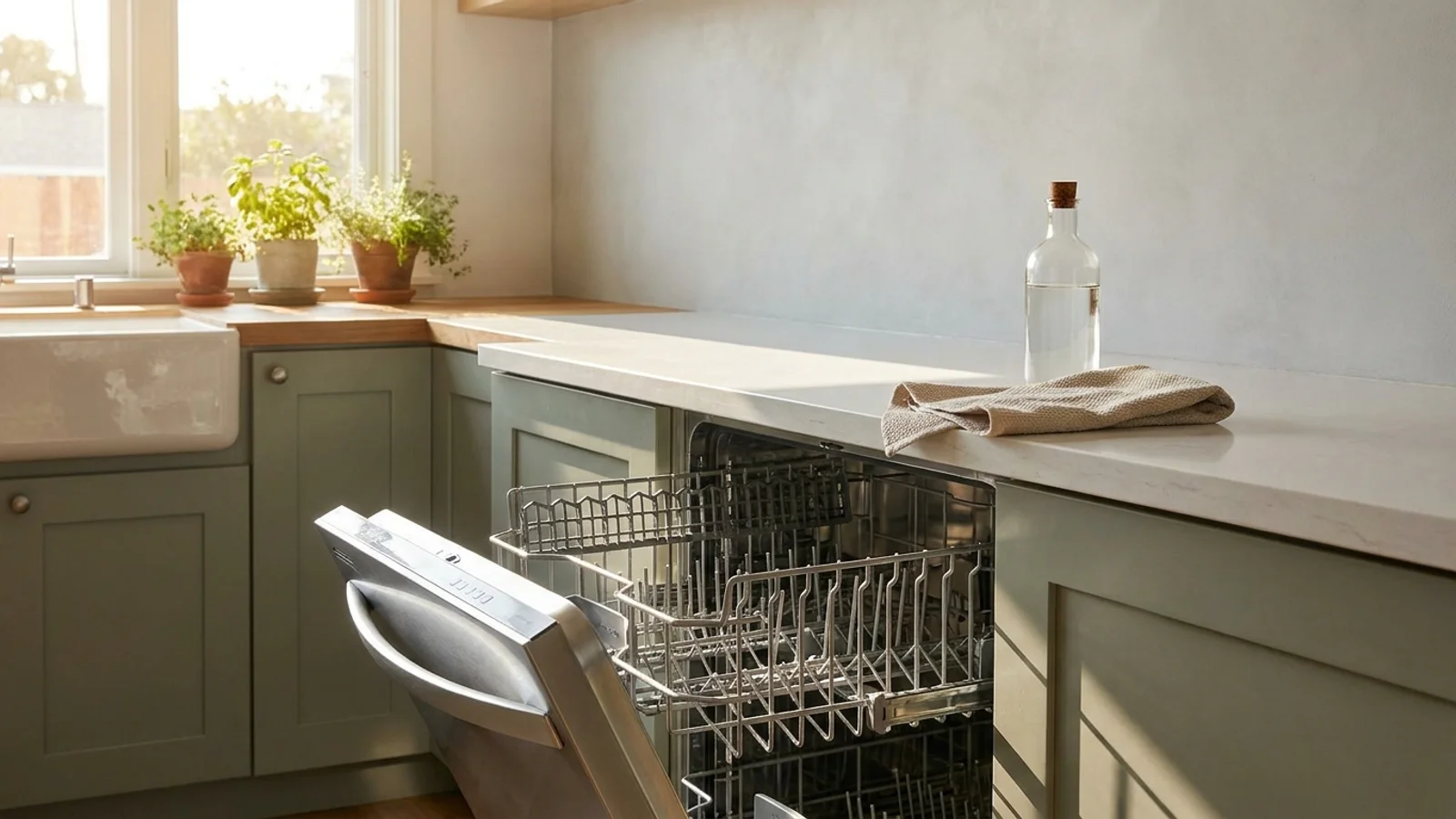
To clean a dishwasher, pull out and rinse the filter under hot water, wipe the spray arms and clear their spray holes, then run an empty hot cycle with a cup of white vinegar on the top rack, followed by a short rinse with a cup of baking soda across the tub floor. Do the filter every two weeks and the full clean once a month. That routine removes the food gunk, grease, and mineral scale that cause odor and cloudy dishes.
That’s the short version. The whole job takes about 30 minutes of hands-on work and most of it is waiting on a cycle. Here’s exactly what to do, in order.
Why does a dishwasher need cleaning if it washes dishes all day?
A dishwasher sprays soapy water, but it doesn’t clean itself. Every load leaves behind food particles in the filter, grease film on the tub walls, and detergent residue in the corners. In San Diego, the water adds a third problem: hard-water scale. The result is a machine that smells musty, leaves a white haze on your glasses, and washes less effectively over time because clogged spray holes can’t reach the top rack.
None of that means the dishwasher is broken. It means it’s overdue for the maintenance almost everyone skips. Clean it on a schedule and most odor and film problems never start.
What you need before you start
You don’t need special products. Gather these:
- White vinegar (one to two cups)
- Baking soda (one cup)
- An old toothbrush or a soft nylon brush
- A microfiber cloth
- A toothpick or thin wire for the spray holes
- Dish soap and warm water for the removable parts
Skip bleach unless you have visible mold, and never mix bleach with vinegar. That combination releases chlorine gas.
How to clean a dishwasher step by step
Step 1: Clear the drain and bottom of the tub
Pull out the bottom rack and look at the floor of the tub around the drain. You’ll usually find food chunks, broken glass, a fruit sticker, or a chip of bone. Remove anything sitting there by hand. This is the debris that causes most drain smells and, left long enough, a clogged drain.
Step 2: Clean the filter
The filter is the single most important part and the most commonly ignored. On most dishwashers it sits in the bottom center, a round cylinder you twist a quarter turn to unlock, plus a flat mesh screen underneath it.
Twist the cylinder counterclockwise, lift it out, and take out the flat screen below. Rinse both under hot running water, scrubbing the mesh with a soft brush to work grease and stuck food out of the holes. Hold it up to the light. If you can’t see through the mesh cleanly, keep scrubbing. Set the parts back exactly the way they came out and lock the cylinder back into place.
A dirty filter is the number-one reason dishes come out gritty. Clean it every two weeks if you run the dishwasher daily.
Step 3: Clean the spray arms
The spray arms are the rotating bars that fling water at your dishes, usually one under the bottom rack and one under the top. Water can only reach your dishes if the little holes stay open, and hard water plugs them with mineral deposits.
Most spray arms lift or unclip without tools. Take them off, rinse them, and run a toothpick or thin wire through each spray hole to clear scale and gunk. Spin them once by hand after reinstalling to make sure they turn freely. Clogged spray holes are a leading cause of the top rack coming out dirty.
Step 4: Wipe the door, edges, and seal
Open the door fully and wipe the inside panel, the bottom lip where water pools, and the rubber gasket that runs around the opening. Grime and pink or black mildew collect in the gasket folds where the spray never reaches. A damp cloth with a little dish soap handles most of it; use the toothbrush for the crease. Dry the seal when you’re done.
Step 5: Run a vinegar cycle
Put a dishwasher-safe cup filled with one cup of white vinegar on the top rack, right side up. Run the hottest, longest cycle with the dishwasher otherwise empty. The vinegar breaks down grease, dissolves mineral scale, and neutralizes odor as it circulates.
Vinegar is fine on an occasional cleaning cycle. Don’t leave it sitting in the machine for hours or use it every single load, since repeated contact can wear on rubber seals over time.
Step 6: Run a baking soda rinse
After the vinegar cycle finishes, sprinkle one cup of baking soda across the floor of the tub and run a short, hot cycle. This deodorizes and gently scours away any last residue, and it leaves the inside smelling clean. Your dishwasher is done.
The San Diego hard-water factor
San Diego County water runs hard, often 250 to 400 parts per million of dissolved minerals depending on your city and the season. Those minerals are the reason your clean glasses come out with a cloudy white film and why spray-arm holes clog faster here than in soft-water regions.
The scale builds up on the tub walls, the heating element, and inside the spray arms as a chalky gray or white crust. White vinegar dissolves it, which is why a monthly vinegar cycle matters more in San Diego than almost anywhere else. For heavy buildup, run two vinegar cycles back to back once or twice a year, or use a citric-acid dishwasher descaler. Adding a rinse aid also helps water sheet off dishes before minerals can dry into spots.
Inland cities like Escondido, San Marcos, and El Cajon that draw from harder sources tend to see more scale than coastal areas. If you’re there, an extra cleaning cycle every few weeks is worth the ten minutes.
How often should you clean each part
Keep it simple and it never becomes a big job:
- Wipe the door seal and clear the drain: weekly
- Rinse the filter: every two weeks with daily use, monthly with lighter use
- Vinegar and baking soda cycle: once a month
- Deep descale (double vinegar cycle or descaler): twice a year
Set a reminder for the monthly clean and the rest takes care of itself.
Cleaning solves odor, film, and gritty dishes caused by buildup. It won’t fix a mechanical fault. If your dishwasher still leaves dishes dirty after a full clean, the problem is likely a worn spray-arm bearing, a failing wash pump, or a water-inlet issue, and our dishwasher not cleaning guide walks through those causes. If water sits in the bottom after every cycle, that’s a drain problem covered in the dishwasher not draining guide, not something cleaning will resolve.
When it’s a repair rather than a cleaning, our team handles dishwasher repair across San Diego County, often same day. If your dishwasher is leaking, not draining, or leaving dishes dirty after you’ve cleaned it, call (858) 988-7787 and we’ll get a local tech out.
For the rest of your kitchen, the same routine care applies. See our guides on how to clean stainless steel appliances and how to clean a washing machine, or the full seasonal appliance maintenance checklist for San Diego homes. If you’re looking for local help, start at our appliance repair in San Diego page.
Frequently asked questions
How do you deep clean a dishwasher?
Deep cleaning a dishwasher means doing all the steps in one session: remove and scrub the filter and spray arms, wipe the door seal and tub, run a hot cycle with a cup of white vinegar on the top rack, then run a second short cycle with a cup of baking soda on the tub floor. For heavy hard-water scale, run the vinegar cycle twice or use a citric-acid descaler. Plan on about 30 minutes plus cycle time.
Can you clean a dishwasher with vinegar and baking soda together?
Use them in sequence, not at the same time. Run the vinegar cycle first to cut grease and dissolve mineral scale, let it finish, then sprinkle baking soda and run a second short cycle to deodorize. Combining them in one load just neutralizes both and does nothing useful. Never mix vinegar with bleach.
Why does my dishwasher smell even after cleaning?
If the odor comes back after a full clean, the usual culprits are a filter that still has trapped food, standing water in a partly clogged drain, or mildew deep in the door gasket folds. Re-clean the filter, check that the drain and garbage disposal connection are clear, and scrub the gasket with a toothbrush. If water still pools in the bottom after a cycle, that’s a drain issue, not a cleaning one.
How often should you clean a dishwasher?
Rinse the filter every two weeks if you run the dishwasher daily, and do a full vinegar and baking soda clean once a month. Wipe the door seal and clear the drain weekly. In San Diego’s hard water, a descaling cycle twice a year keeps mineral buildup off the spray arms and heating element.
Will cleaning my dishwasher get rid of the white film on glasses?
Often, yes. The cloudy white film is usually hard-water mineral scale. Running a vinegar cycle and clearing the spray-arm holes lets the machine rinse properly again, and adding a rinse aid helps water sheet off before spots form. If the film is permanent and won’t wipe off, that’s etching from very hot water and too much detergent, which cleaning can’t reverse.