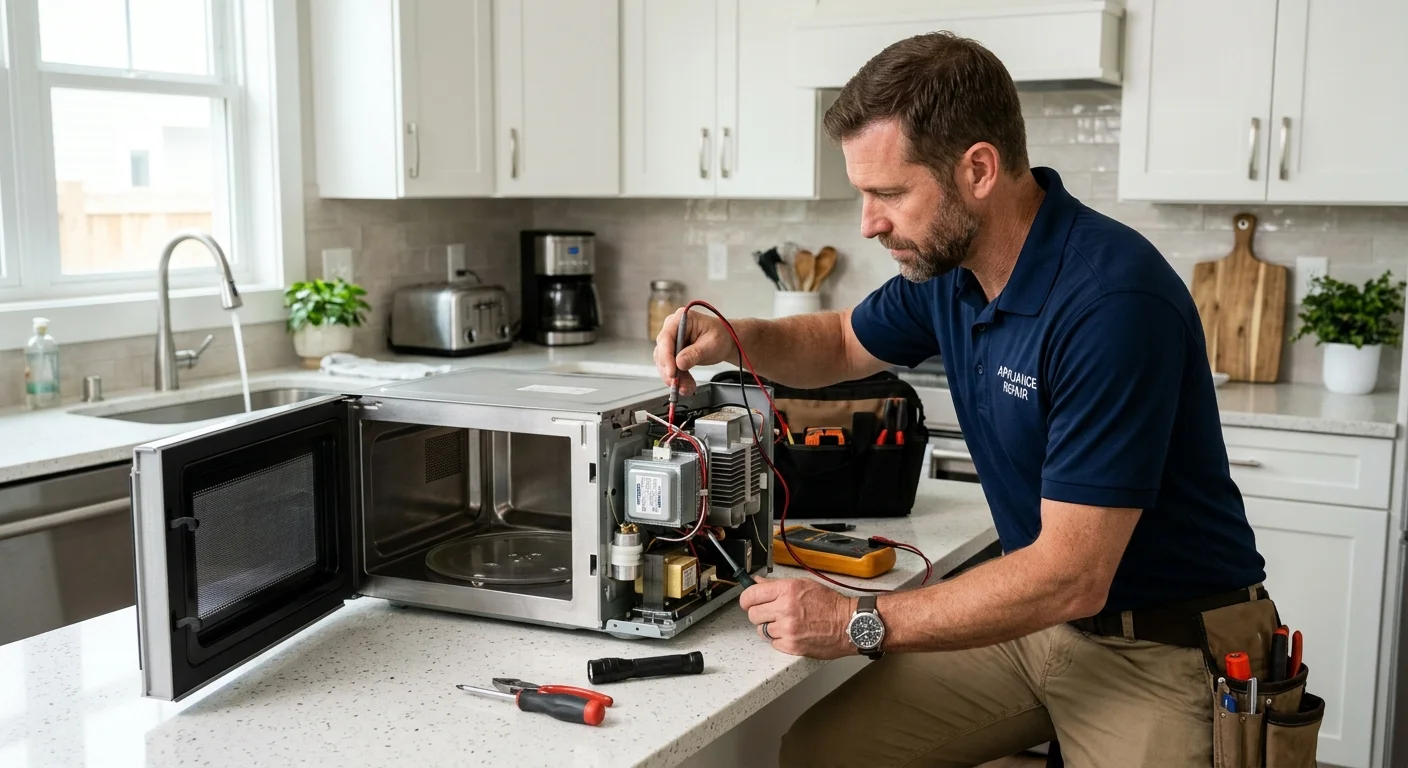
The light is on, the fan is humming, and last night’s carne asada from National City is still cold in the middle. That is an LG microwave that runs and does not heat, which is a different job from a unit that will not start at all. Before anyone opens the cabinet, you want the model number and a clear note of what the oven is doing.
Confirm the model and no-heat pattern
LG microwave repair starts with the sticker, not a guess about the brand badge on the door. Open the door and look for the rating label on the frame, the cavity wall, or the left edge of the opening. On some over-the-range units the print is also on the left side of the case when you look from below. Photograph the full model and serial in one shot. That string is what the matched technician uses to pull the right diagram, door parts, and control layout.
Write down the install type while you are there. A countertop LG in a Pacific Beach studio is a different animal from an over-the-range unit hung over a gas range in Clairemont, or a built-in trim kit in a Carmel Valley remodel. Over-the-range cabinets take grease, steam, and range heat. Countertop units take spills and a lot of door slams in a small kitchen. Built-ins hide the sides, so the tech needs to know the trim is there before the visit.
Then pin the no-heat pattern in plain words. The useful complaint is: the display accepts a cook time, the interior light comes on, the countdown finishes, and a cup of water stays cool. That is not the same as a blank display, a unit that beeps and refuses to start, or a cavity that sparks. Those are separate jobs, and mixing them wastes the first half of a diagnostic. If heat comes and goes, say so. If only sensor reheat fails and a timed cook still warms water, say that too.
Note the age only as a purchase year or install year if you have it. A specific LG microwave lifespan figure could not be confirmed to a primary government source for this site, so this page will not invent one. Age still matters as context. Pair it with how long appliances last only as general background, then let the technician talk about this cabinet, this door, and this control.
This write-up stays on the runs-but-no-heat complaint. It is not a repeat of the broader LG appliance repair hub, and it is not the brand-agnostic microwave not heating guide. Those pages cover other LG machines and other microwave brands. Here the job is one LG cavity that still looks alive and still leaves food cold.
What owners can observe without opening the cabinet
Leave the cover on. This page does not walk through anything inside the case. Internal microwave parts can store a charge after the cord is pulled, and that testing belongs to the independent technician we match you with.
If you see sparks, smell burning plastic, or notice a scorch mark on the waveguide cover or the cavity wall, stop the cycle. Unplug the unit if you can reach the cord safely, or shut the circuit off at the breaker. Do not keep running it to “finish the plate.” Metal, foil, a cracked mica waveguide cover, or worn interior coating can all throw sparks. You do not need to name the failed part. You need to stop using the oven and save the observation for the tech. The dedicated sparking path is microwave sparking and the waveguide cover.
For a quiet no-heat complaint, a one-minute water test is enough. Put a microwave-safe cup of tap water in the center. Run a timed cook, not a sensor shortcut. Stay in the kitchen. When the timer ends, the water should be hot. If the light worked, the fan ran, and the water is still cool, you have documented no heat.
While that cycle runs, watch three things from outside: the display, the door, and the turntable. Does the countdown run all the way? Does a lock icon, a Loc-style message, or a demo note sit on the screen? Does the door need a hip-check to stay shut? Does the plate turn, sit still, or grind? None of those observations open the cabinet. All of them change what the technician tests first.
Try the same timed cook after a simple control reset if the manual for your model allows it: unplug the microwave, or switch its breaker off, wait a minute, and restore power. If the oven heats after that, say so. If nothing changes, you have ruled out a sleepy board, not a failed high-voltage part.
Skip empty-cavity tests. Skip foil tricks. Skip any video that tells you to pull the wrapper and meter parts on the counter. Your notes should read like a kitchen log: model, serial, install type, water-test result, display text, door feel, turntable motion, and whether the problem is every cycle or only some cycles.
How door, display, and turntable clues narrow the complaint
Door, display, and turntable are the three clues that separate a no-heat LG from a “it died” LG. A microwave is designed not to energize the cooking circuit unless the door reports closed. That is why a latch that almost catches can look like a heating failure. You press Start, the light comes on, the clock counts, and the food stays cold because the interlock never gave the cook circuit a clean closed signal.
Coastal doors take a different beating than inland ones. Salt air in Imperial Beach, Coronado, and Oceanside is hard on latches, springs, and the plastic around the handle. Inland East County kitchens, from El Cajon out through Lakeside, more often cook the over-the-range unit with range heat and a vent fan that runs all summer. Same brand, different wear. If you have to lift the handle, press the door in, or hear a second click before Start will take, write that down. If the door will not close at all, that is its own path on our microwave door notes. Do not pry the latch or tape the door shut to force a cycle.
Display behavior matters as much as the latch. A dark screen is a power or control complaint. A bright screen that accepts 1:00 and counts to zero with cold food is a no-heat complaint. A lock message is a control lock, and the unlock steps live in that model’s manual, not in a generic button combo copied from another brand. If ThinQ or another app is paired to the unit, do not treat an app error as a diagnosis. Photograph the oven display itself.
Turntable clues split the job again. A plate that turns while food stays cold still points at heat, not at the roller guide. A plate that sits still can be a coupler, a roller, or a motor, and it can also leave food with cold spots even when some heat is present. On a family over-the-range unit in Chula Vista or Mira Mesa, a cracked roller ring is a common kitchen mess. It is not the same as a magnetron or inverter failure. Tell the technician which one you have: spinning and cold, or stuck and cold.
Put those three clues in one paragraph when you request service. Example: over-the-range LG, model photographed, door needs a firm push, display counts down with no error, turntable turns, one-minute water test stayed cool. That sentence is worth more than a brand name by itself. It is also what keeps this visit from turning into a generic “microwave is broken” call.
What technicians inspect after a no-heat report
Repair Pro San Diego matches you with an independent, licensed, insured appliance technician. The brand does not open the cabinet, stock magnetron parts, or quote a house price list. The person at your kitchen does the diagnosis, then puts the repair in writing before work starts.
After they confirm your water-test notes, they typically work from the outside in. Door switches and the latch assembly come early, because a cheap-feeling interlock can mimic a dead cooking circuit. They check that the door actually closes square in the cabinet, which is a real issue on over-the-range units that have been hung a little low or racked on a range hood install. Then they move to the parts that actually make heat on that model: thermal cutouts, the magnetron, the high-voltage diode and capacitor on transformer models, or the inverter board on inverter models. The control board sits in that list too, especially when the display looks normal and still never commands a cook load.
They will not ask you to hold a meter on those parts. You should not. Architecture varies by LG model, and the only safe way to tell transformer-and-capacitor from inverter is the diagram that matches your serial. That is why the photo of the sticker matters.
When the talk turns to money, keep it on named national guides, not a San Diego guess. National cost guides such as Angi, checked for this site in August 2026, put most microwave repairs between $100 and $200, with an average near $175 and a published span of $50 to $500. Magnetron work is listed around $100 to $300 on Angi, and Fixr puts magnetron replacement with labor around $150 to $350. Those are national guide ranges, not a Repair Pro fee, and they move when the guides update. Ask the technician whether their diagnostic charge is credited if you approve the repair. Get the quote in writing. A hard-to-reach built-in, a trim kit, an inverter board, or a door that also needs hardware will land higher than a simple countertop swap of one part.
If you want a dealer registration check on the business that shows up, California’s Bureau of Household Goods and Services posts a public lookup at the Department of Consumer Affairs search. That search confirms registration status. It does not grade a technician’s skill on LG inverter boards.
For a county-wide overview of how microwave calls get matched, see microwave repair in San Diego and the microwave repair service page. Both sit behind this no-heat article. They do not replace the notes you just took.
When to request LG microwave repair
Request a match once you have the sticker photo and the no-heat pattern in writing. That is enough to book. You do not need a part name.
If the oven is still under the manufacturer’s or retailer’s written warranty, start there. California’s Song-Beverly Consumer Warranty Act requires manufacturers who make express warranties to keep service reasonably available, and it requires those warranty repairs to be completed within 30 days unless the delay is beyond the manufacturer’s control. Warranty periods also pause while the unit is in for repair. Independent work can affect remaining factory coverage, so read the warranty packet and call the issuer if the date is close. Repair Pro San Diego is a referral match, not an LG factory branch.
People often ask about a recall. Check the current list on the CPSC recalls page with your model number. This site’s approved claims file does not document a current LG microwave recall. The 2020 LG class-action matter San Diego owners still mention is the refrigerator linear-compressor settlement, which covered certain refrigerators made from 2014 through 2017. That filing window is closed, and it is not a microwave program. Do not treat a fridge settlement as a microwave parts voucher.
Cost is a comparison, not a slogan. Use the Angi and Fixr ranges above as a national backdrop, then let the written quote do the local work. This site does not publish a repair-versus-replace percentage, and it does not assign a year when every LG microwave should be scrapped. A single failed door switch on an otherwise healthy unit is a different decision from a magnetron plus an inverter plus a wrecked door on a cabinet that already sparks.
When you are ready, ask for LG microwave repair as a no-heat job and attach the model photo. The match is with a local pro who works San Diego County kitchens, from over-the-range units in older coastal tract homes to countertop ovens in South Bay apartments. Bring the water-test result. Bring the door notes. That is the whole briefing.
When to call us
An LG microwave that runs through a full countdown and still leaves food cold is a job for a licensed appliance repair pro, not a cover-off home repair. The matched technician diagnoses the door, control, and heating circuit and quotes in writing before any work starts. Call (858) 988-7787 to leave a voicemail requesting a match with a local appliance repair pro.