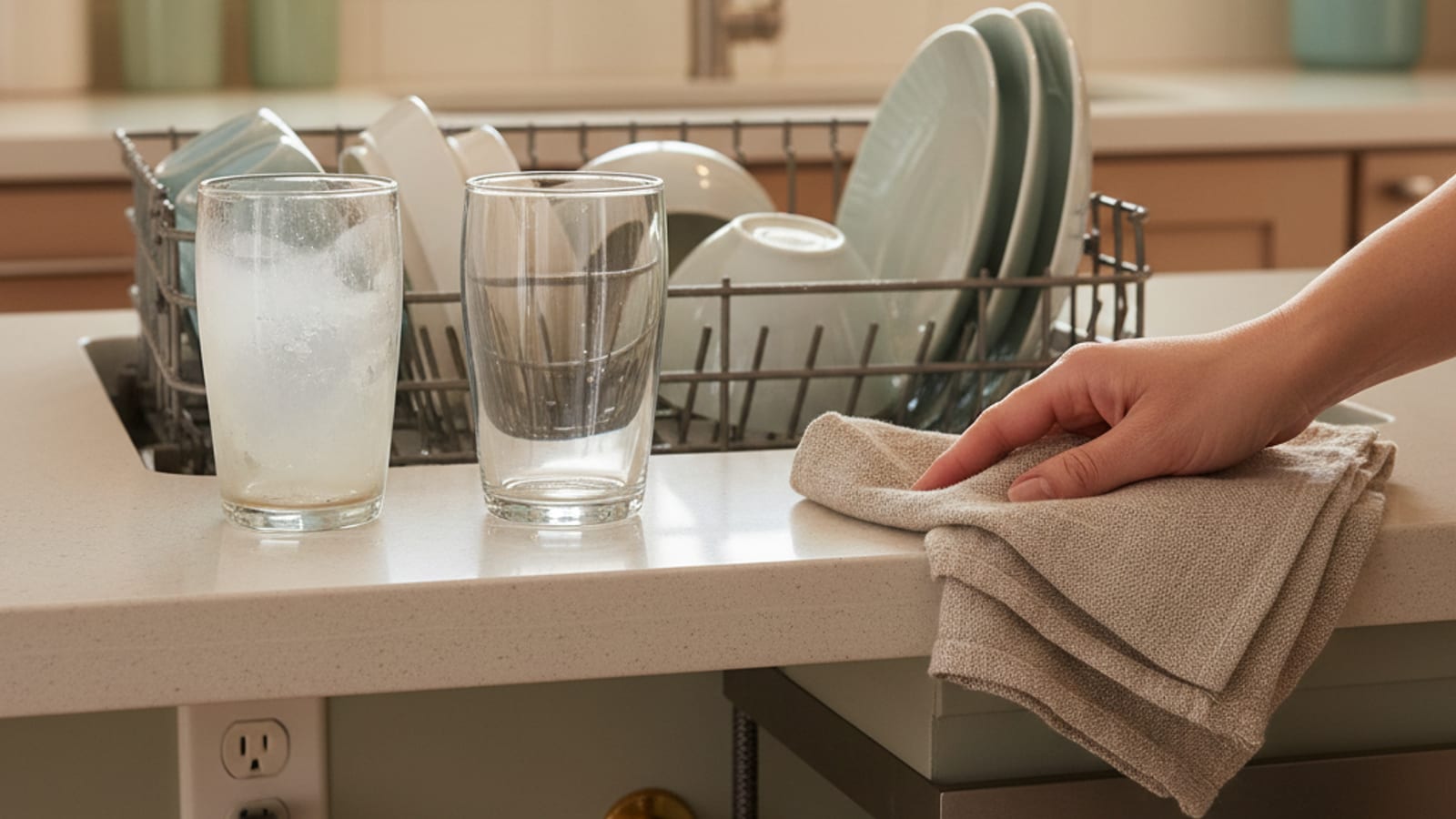
Dishwasher running a full cycle but dishes come out with food residue, cloudy glasses, or a gritty film? Work through these checks in an order that is easy to reverse. They are not ranked by how often they appear on service calls. Use the owner’s manual for spray-arm and filter steps.
1. You’re overloading the bottom rack
This is an easy check because it costs nothing. When the lower rack is packed tight, the lower spray arm may not rotate. If it cannot rotate, water may not reach every dish.
Fix: unload, spin the lower spray arm by hand (it should turn with two fingers), and repack with space between larger items. Run another cycle.
2. The filter at the bottom is clogged
Modern dishwashers (post-2010 on most brands) have a removable filter at the bottom of the tub. Food debris collects there, if you don’t clean it, that debris recirculates back onto your dishes.
Fix: If the manual shows a removable filter, pull the lower rack, unlock the filter as written, rinse it, and reinstall it. A cleaner packet is optional and only if the manufacturer allows that product in this model. Don’t treat a grocery-store packet as required.
If this was the problem, next cycle will tell you immediately.
3. The spray arms are clogged
Hard water and food debris can clog spray jets. Inland San Diego water can be hard. That does not prove your spray arms failed because of San Marcos, Escondido, Poway, or Ramona.
Fix: remove spray arms only the way the exact model manual shows (twist-off, clip, or another method). Clear holes with a tool the manual allows. Vinegar soaks only if the manufacturer says that is safe for that plastic.
4. You’re using rinse aid the wrong way (or not at all)
Dishwashers are designed to use rinse aid. Rinse aid breaks water surface tension so water sheets off dishes instead of beading up. No rinse aid means spotty glasses and a film on everything, even when the wash cycle itself worked fine.
Fix: check the rinse-aid dispenser next to the detergent cup. Fill it. Run a cycle. If your dishwasher is auto-detecting (“3-in-1” pods claiming to include rinse aid), upgrade to a mid-tier pod and see if it helps.
5. Water isn’t hot enough
Dishwashers need hot enough water to clean as designed. Target inlet temperature is in the model’s specifications, not a universal 120°F or 130°F on this page.
Fix: run the hot-water tap at the nearest sink if the manual suggests priming the line. Water-heater setpoint is a household choice. Follow the dishwasher and water-heater instructions.
6. The detergent is old or wrong
Dishwasher detergent loses effectiveness over time, especially in a humid environment. Pods especially absorb moisture, dissolve prematurely, or clump together.
Fix: store pods in an airtight container. If your box is over 6 months old, replace it. Use a detergent the dishwasher maker allows for that model. This page does not rank grocery brands or gel versus pods.
7. The detergent dispenser door isn’t opening
During the wash cycle, a spring-loaded door releases the detergent. If the door is stuck by old detergent residue or a broken spring, no detergent enters the cycle, and dishes come out exactly as dirty as they went in.
Fix: inspect the dispenser door. Clean any detergent residue around the hinge. If the spring is broken, the dispenser needs replacement. That’s a straightforward parts-and-labor job, on the less expensive end of dishwasher repairs.
8. The circulation motor is weak or failed
After everything else is ruled out, the last major cause is the circulation motor, the pump that pushes water to the spray arms. When the motor weakens, water pressure drops and cleaning suffers. You’ll often hear a “humming” during the wash cycle that’s quieter than normal.
Diagnosis: hard to confirm without a service call. Symptoms: filter is clean, spray arms turn freely and aren’t clogged, dishes are still dirty, motor sounds weak.
Repair: national cost guides such as HomeGuide put a dishwasher motor replacement at $350 to $500 for parts and labor (as of 2026). Whether that is worth doing depends on the written diagnosis, not a universal age cutoff.
When to stop troubleshooting and call
Call if:
- You’ve worked through the list and dishes are still dirty
- You hear a grinding or loud mechanical noise during cycles
- Water leaks during or after the cycle
- The cycle won’t complete (error codes, stops mid-cycle)
- You see standing water in the bottom after every cycle (separate drain issue)
A maintenance habit that helps
If the manual gives a filter-cleaning interval, follow it. If it doesn’t, ask the technician. A monthly filter rinse is not a proven 80% prevention rule. Spray-arm and rinse-aid checks belong in the same model document.
Frequently asked questions
Why are my dishes still dirty after a full dishwasher cycle?
An overloaded bottom rack can keep a spray arm from turning. Spin the lower spray arm by hand before starting, if you can reach it. A clogged filter can recirculate debris. Clean it the way the manual shows.
How often should I clean the dishwasher filter?
Follow the model’s instructions. Don’t treat a monthly cleaner packet as required unless the maker names it.
Why do my glasses come out spotty and cloudy?
Low rinse aid is a common contributor. Hard water can make spotting worse. It is not a confirmed local cause. Refill rinse aid if the dispenser is empty.
How do I know if the circulation motor is failing?
After filter, spray arms, rinse aid, water temperature, and detergent checks in the manual, a weak motor is one remaining possibility. HomeGuide puts motor replacement at $350 to $500. Ask for a written diagnosis.
Brand coverage
Technicians in our network work on many dishwasher brands. Our dishwasher repair page is the referral path. Completion in a single visit is not promised. Ask the technician about their diagnostic fee and whether it’s credited toward the repair.
If you’re in east county, appliance repair in La Mesa is in the service area. Call (858) 988-7787 to leave a voicemail.