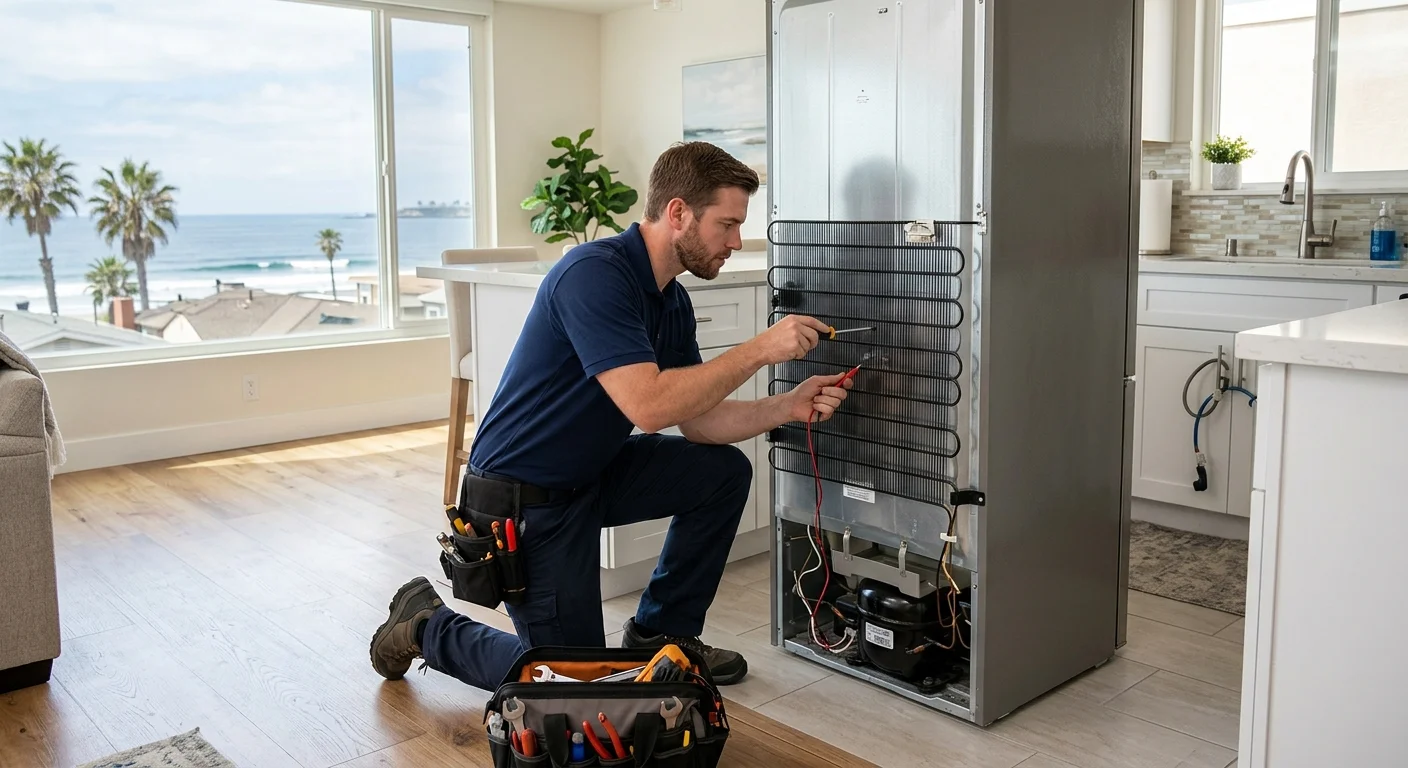
For appliance repair in Pacific Beach, start with the appliance details, fault, and exact placement. Coastal checks should describe what you can see without assuming ocean air caused the failure. That brief helps a matched local technician prepare for a focused diagnosis.
Start with the appliance, model, and symptom
The brand name alone doesn’t identify the right appliance or part. Find the full model and serial numbers using the owner’s manual or manufacturer instructions. Copy the characters exactly, since one letter can identify a different version.
Build a short job brief before requesting a Pacific Beach appliance technician:
- Write down the appliance type, brand, model, and serial number.
- Describe what it does now, using plain and specific language.
- Note when the symptom started and whether it happens every cycle.
- Record any displayed error code exactly as it appears.
- Photograph visible leaks, residue, damaged parts, or unusual placement.
- List recent changes, including a move, installation, outage, or repair.
“Not working” leaves too much open. “The dryer tumbles but the clothes stay damp” gives the technician a useful starting point. For a refrigerator, describe which areas feel warm and whether the lights, fan, or ice maker still operate. Our refrigerator repair referral service can match that information with a local pro.
A timeline also matters. Note whether the fault appeared suddenly or became more frequent. Don’t repeatedly reset the appliance unless its manual directs you to do so. A reset can clear an error display that the technician may need to see.
If a refrigerator is warming, treat food storage separately from the repair decision. FDA guidance says the refrigerator compartment should stay at or below 40°F. Perishable food kept above 40°F should be discarded after two hours, or after one hour when the surrounding temperature exceeds 90°F.
For dryer problems, explain whether the concern involves heat, tumbling, noise, or venting. Those details help distinguish the appliance from the airflow path. See our dryer repair and vent service page for the issues a matched pro can assess.
What Pacific Beach placement details may matter
A Pacific Beach address isn’t enough to describe an appliance setup. A condo near Mission Boulevard may have a different access plan than a unit off Garnet Avenue. Report the actual conditions rather than drawing conclusions from the neighborhood.
Include these placement details when they apply:
- The appliance’s floor and room
- Indoor, garage, patio, or enclosed-alcove placement
- Stairs, elevators, gates, or narrow doorways
- Built-in cabinetry or stacked laundry equipment
- Nearby shutoffs, outlets, drain lines, and vent openings
- Any known loading, parking, or building-entry instructions
Measure the appliance opening and the narrowest access point. Include width, height, and depth. Note whether doors, trim, shelves, or another appliance limit movement. Don’t promise that an appliance can be removed until the technician reviews the setup.
For coastal appliance repair in San Diego, location is context rather than a diagnosis. Photograph visible corrosion or residue, but don’t label it “salt damage” yourself. Moisture, cleaners, spills, worn coatings, and other conditions can leave similar marks. The technician should determine whether the visible condition relates to the failure.
Pacific Beach also shouldn’t be treated as interchangeable with inland San Diego. Tell the matched pro where the appliance sits, what surrounds it, and what can be accessed. Those observations are more useful than a general description such as “near the beach.”
If you’re comparing another coastal property, our Encinitas and Carlsbad coastal appliance guide covers those communities separately. It doesn’t replace the placement notes needed for a Pacific Beach address.
What condo owners, renters, and landlords should document
The person reporting the failure may not be authorized to approve every repair. Confirm that point before the technician arrives. Lease terms, association rules, and property-management procedures differ, so the applicable documents must settle the question.
A renter should send the owner or manager a written symptom report. Include the model number, error code, photos, and the date the issue began. Keep a copy of the repair request and any written response. Don’t state that the landlord approved work unless that approval is clear.
A landlord or manager should identify who can approve diagnosis, parts, and additional work. Provide the technician with the correct contact. If the tenant will provide access, make sure everyone has the same appointment details and unit information.
Condo owners should ask their building contact about any relevant entry procedures. If the property uses elevator reservations, loading instructions, parking permissions, or vendor check-in, share those details before the visit. Repair Pro San Diego can’t confirm a particular building’s rules. The owner or property manager sets them.
Also document whether the appliance belongs to the unit owner, landlord, or building. Shared laundry rooms and common-area equipment may follow different approval paths than an appliance inside a residence. Don’t authorize work on equipment you don’t control.
Keep the written diagnosis and quote together. Add photos of the appliance before work begins. If a technician identifies damage beyond the appliance, ask for that observation in writing without asking them to decide responsibility.
Good documentation reduces confusion between the occupant, owner, manager, and technician. It also creates a clear record of what was reported, approved, and completed.
How to compare repair and replacement
A repair decision should start with a diagnosis, not the appliance’s age alone. No verified universal percentage decides when every appliance should be replaced. Compare the specific repair with the real replacement choices available for that space.
Review these points side by side:
- The diagnosed failure and proposed repair
- Parts availability for the exact model
- The technician’s written labor and parts quote
- Any warranty the technician offers on that work
- The appliance’s other recurring or unresolved faults
- Replacement dimensions, hookups, delivery, and removal
- Manufacturer warranty or recall information
A lower purchase price doesn’t always show the full replacement picture. Check whether delivery, removal, installation, cabinetry changes, or hookup work applies to your property. Don’t assume those items are included. Ask each provider to identify them in writing.
Fit matters in Pacific Beach kitchens and laundry areas just as it does elsewhere. Measure the current opening, doors, counters, and surrounding fixtures. Verify the manufacturer’s required clearances for any replacement model. A product listing’s headline dimensions may not answer every placement question.
For efficiency information, compare models through ENERGY STAR’s appliance resources. Don’t invent projected savings. Use the model’s published specifications and your own utility history when evaluating energy use.
Check the exact model through the Consumer Product Safety Commission recall database. A similar brand or product name isn’t enough. Match the model details and follow the manufacturer’s listed instructions if a recall applies.
Our San Diego appliance repair cost guide explains the factors that can change a quote. Repair Pro San Diego doesn’t set diagnostic fees, repair prices, or credit policies. Ask the independent technician about each item before authorizing work. The matched technician diagnoses first and quotes in writing before work begins.
How to request a matched San Diego technician
Repair Pro San Diego is a referral service. We match customers with licensed, insured, independent local appliance technicians. We don’t perform repairs, employ technicians, stock parts, or set the technician’s fees.
When requesting appliance repair near Pacific Beach, send a concise job summary. Include:
- Your Pacific Beach location and preferred contact method
- The appliance type, brand, model, and serial number
- The exact symptom and any displayed error code
- Photos of the appliance, label, placement, and visible problem
- Stairs, gates, elevators, measurements, or entry instructions
- The owner or manager authorized to approve work
- Any manufacturer warranty or prior repair information
Don’t diagnose the failed part in your request unless another technician confirmed it. Describe the evidence instead. “Water collects below the front-left corner during a cycle” is more useful than “the pump is broken.” The matched pro can test the appliance and identify the cause.
Before authorizing service, ask who will invoice you. California appliance repair businesses must register with the Bureau of Household Goods and Services. You can check the business through the California Department of Consumer Affairs lookup. That registration is separate from proof of technical training, so also ask about experience with your appliance type.
Ask the technician about their diagnostic fee and whether it’s credited toward an approved repair. Confirm the parts, labor, total quote, and payment terms in writing. Ask what warranty the independent technician offers on the completed work. Those policies belong to that technician, not Repair Pro San Diego.
Clear details help us make a better referral. They also let the technician decide whether the model, symptom, and Pacific Beach placement fit their work.
When to call us
A recurring fault, inaccessible component, or diagnosis beyond the owner’s manual is a good time to involve a licensed appliance repair pro. Leave a voicemail at (858) 988-7787 with your appliance and contact details, and we’ll use your message to match you with a local appliance repair pro.