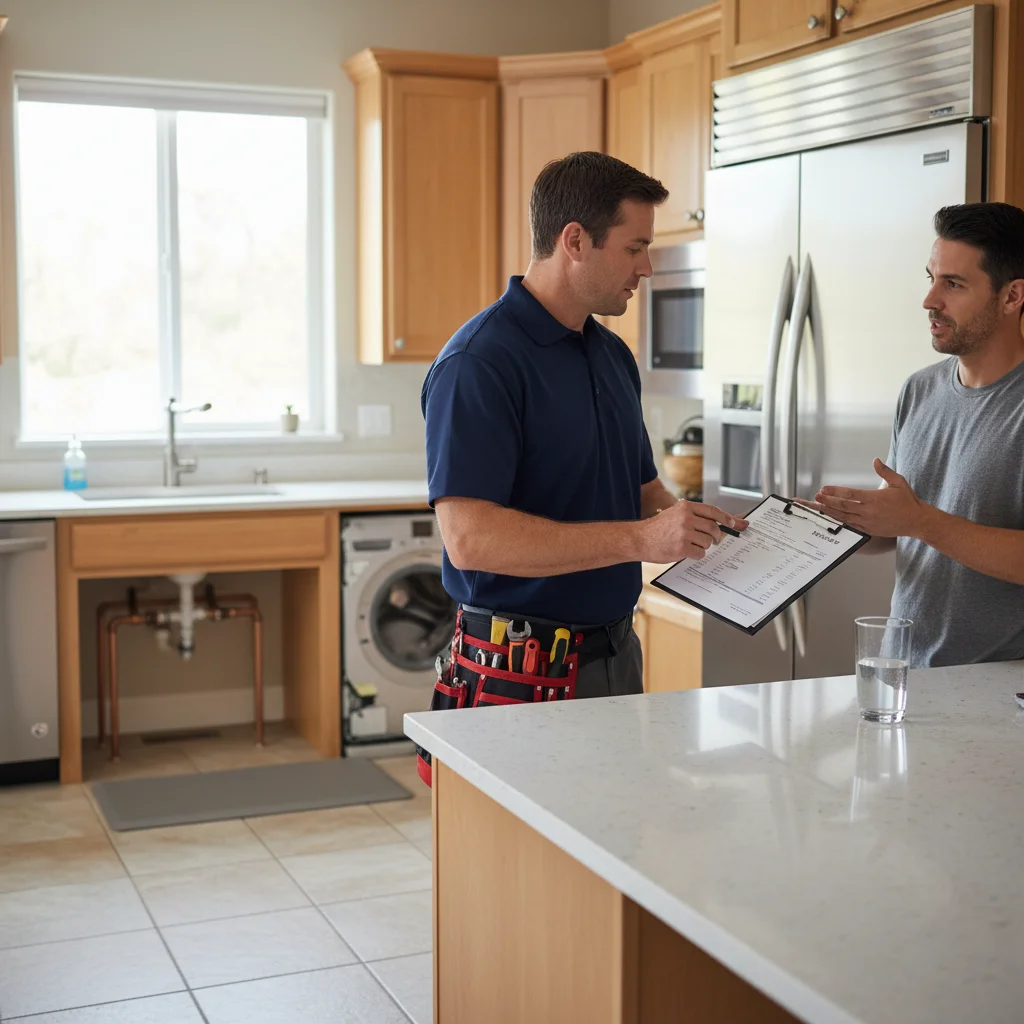
An appliance repair bill in San Diego County is a diagnostic fee plus parts and labor, and the part that failed decides almost all of it. HomeGuide puts common single-part fixes such as a refrigerator water inlet valve at $100 to $225, and a full refrigerator compressor replacement at $700 to $1,250. Repair Pro San Diego sets no prices; the independent technician who takes the job quotes it in writing before any work starts.
If a fridge stopped cooling or a dryer quit on laundry day, you still cannot read a payable San Diego price off this page. Repair Pro San Diego doesn’t set prices. The independent technician who takes the job does. National cost-guide ranges, plus the factors that push a bill up or down, help you read a written quote. They are not a county price list.
What a typical service call costs
Independent appliance repair technicians often charge a diagnostic fee to come out and assess the problem. Ask what that fee covers. It may include drive time, the diagnosis, and a written estimate. It does not automatically cover parts or labor to complete a repair.
Diagnostic fees vary by technician, so ask about it when you request a visit: what the fee is, and whether it’s credited toward the repair if you move forward. Some providers credit it. Some don’t. Confirm before you approve the visit. Repair Pro San Diego does not set that policy.
Labor rates also vary by technician and by the job, depending on complexity and how long the repair actually takes. A simple part swap can cost less than a job that involves pulling a unit apart or testing a sealed system. After-hours and weekend pricing is not a county-wide rule. Ask the independent technician whether that visit has a different diagnostic fee or labor rate, and get it in writing. Repair Pro San Diego does not publish business hours.
The one rule that protects you regardless of the numbers: the technician diagnoses the problem first and gives you a written quote before any work begins. Don’t approve a repair over the phone with no written estimate in hand.
Cost ranges by appliance
Here’s what national cost guides report for common appliance repairs. These are national data points, not a San Diego-specific price list, since no local price list exists for a referral network like this one. Actual quotes vary by technician, by the exact failure, and by your specific make and model.
Refrigerator
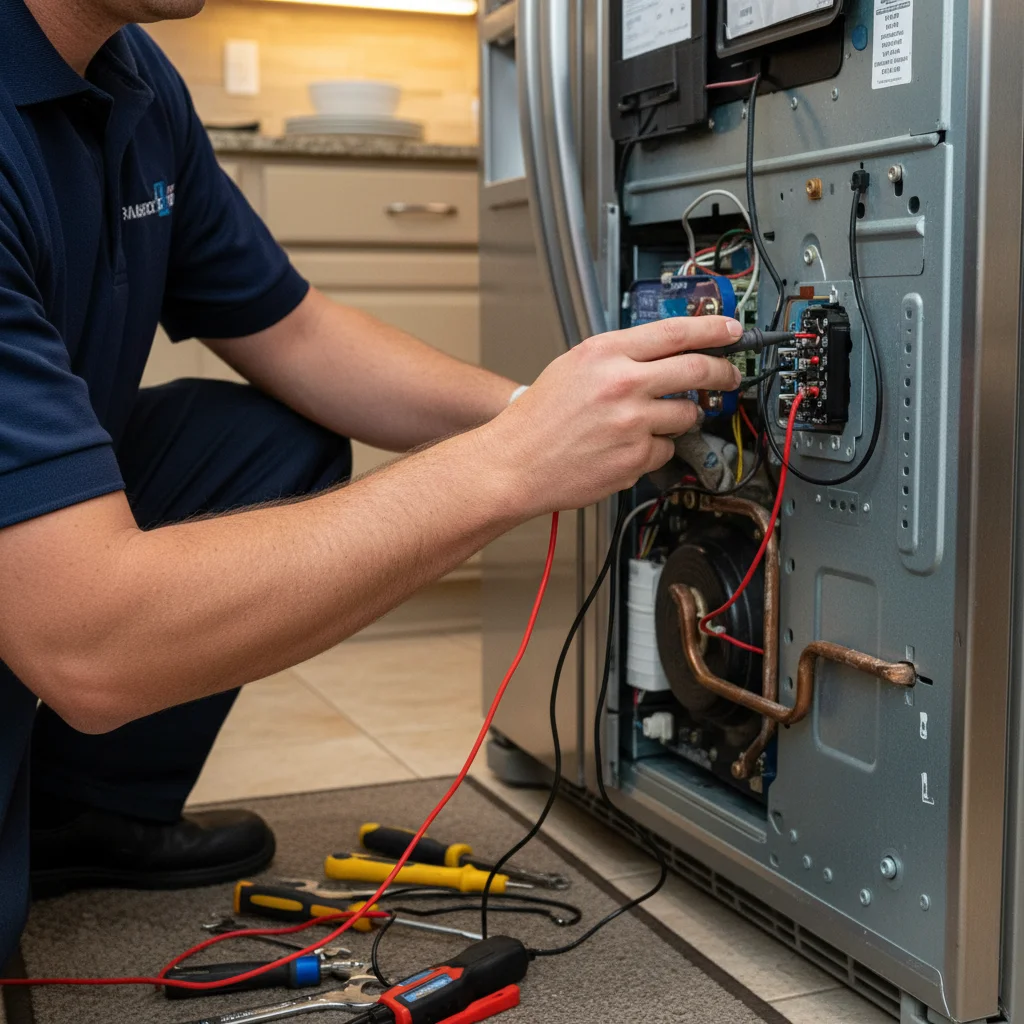
Refrigerator repair costs swing widely depending on what failed. A water inlet valve, one of the more common refrigerator fixes, runs $100 to $225 according to HomeGuide. On the expensive end, a full compressor replacement job averages $700 to $1,250 according to HomeGuide, and that’s the point where it’s worth comparing the repair cost against a new unit (more on that below). Everything in between, thermostats, start relays, evaporator fan motors, ice maker assemblies, tends to land somewhere between those two figures depending on the part and how much disassembly it takes to reach it.
Ice maker
A standalone ice maker repair averages $100 to $225 according to HomeGuide, with Angi reporting a slightly wider range of $100 to $300. A failed ice maker motor runs higher, typically $225 to $400 per HomeGuide. If the whole assembly needs replacing rather than a single part, expect $250 to $600 per HomeGuide. Whether yours needs a small part or a full assembly swap comes down to what the technician finds once it’s open.
Washer
No national cost guide publishes a reliable washing machine repair benchmark, so treat any specific dollar figure you see elsewhere with caution. What actually moves a washer repair bill: whether the failed part is a simple wear item (a lid switch, a door seal, a water inlet valve) or something that requires pulling the drum, like a bearing or a control board. Front-loaders generally take longer to access than top-loaders, since more has to come apart to reach the tub. Ask your technician what’s driving the specific number on your quote.
Dryer
Dryers have fewer water-handling parts than washers or dishwashers, which can keep some jobs smaller. There’s no verified national benchmark to quote here. Cost drivers include the failed part and how much access the technician needs. A heating element, thermal fuse, or igniter is often a smaller part with more straightforward labor than a drum bearing or belt job. Gas models add igniters and valve coils to the list of parts a technician may test. Ask for the written quote for your unit.
Oven and range
No authoritative cost guide covers oven and range repair specifically, so the number on your quote depends entirely on what failed and how the unit is built. An igniter or a bake element is a cheap, common part with a straightforward swap. A control board or a convection fan motor costs more in both parts and labor, since diagnosing an electronic fault takes longer than replacing a heating component. Gas ovens that need work on the gas line itself, rather than just electrical parts, usually cost more because of the added safety steps involved.
Dishwasher
Dishwasher repair runs $100 to $300 on average according to HomeGuide and Angi, with a full range of $75 to $600 depending on the failure and around $225 typical. A pump replacement runs $100 to $400 per HomeGuide. A heating element replacement runs $200 to $350. A full wash motor replacement, the most expensive common dishwasher fix, runs $350 to $500. Door latches and control board swaps tend to fall in the lower half of the overall range.
Microwave
Most microwave repair jobs run $100 to $200 according to Angi, with a typical job landing around $175 and the full range spanning $50 to $500 depending on the part. A magnetron replacement, the most common serious microwave failure, runs $100 to $300 per Angi, with Fixr citing $150 to $350 once labor is included. Built-in and over-the-range units generally cost more to service than a countertop model because of the extra work involved in accessing and reinstalling them.
Wine cooler
No authoritative cost guide publishes reliable wine cooler repair pricing, so be wary of any specific number quoted without a source. What drives a wine cooler repair bill: whether the fix is a simple wear part (a fan motor, a door gasket) or the compressor and sealed refrigerant system, which is the most involved and expensive repair on any cooling appliance. Dual-zone units generally cost more to service than single-zone models, since there are two independent cooling systems to diagnose instead of one.
Garbage disposal
No authoritative cost guide covers garbage disposal repair specifically, and a lot of disposal calls turn out to be a jam or a tripped reset button rather than a real repair. When a technician is actually needed, cost depends on whether the fix is electrical (a bad switch or wiring) or mechanical (a seized motor or damaged grinding components). A full replacement is often more cost-effective than repairing an older unit, since disposals are a relatively inexpensive appliance compared to the labor involved in a complex in-place repair.
Commercial equipment
No authoritative cost guide covers commercial appliance repair pricing, since commercial units vary too much by brand, capacity, and how they’re plumbed or wired into the building. A blanket price would be a guess. Ask the technician for a written quote after they have seen the equipment. Refrigerant type, part sourcing, and any after-hours rate they charge can change the number.
What drives the price up (parts, brand, age, location)
Not every repair of the same type costs the same. Several things push the number higher.
Parts availability and markup. Parts are the biggest variable. A heating element for a common Whirlpool dryer costs a fraction of what the equivalent part costs for a Miele or a Bosch dishwasher. Technicians mark up parts to cover ordering, stocking, and warranty on the part, which is standard practice across the industry. Ask for an itemized estimate so you can see what’s parts and what’s labor.
Brand and model complexity. High-end European brands (Bosch, Miele, Thermador, Sub-Zero) tend to cost more to repair. Parts are pricier, they’re often harder to source locally, and the disassembly can take longer. A Sub-Zero compressor job is a fundamentally different undertaking than the same job on a GE.
Age of the appliance. Older machines sometimes have discontinued parts that have to be sourced from specialty suppliers or remanufactured. That adds cost and lead time to a repair that would otherwise be routine.
Your location in San Diego County. Some technicians factor travel into the quote. Ask whether a trip charge or service-area fee applies to your address.
Permits. Whether a given job needs a permit depends on the work and the jurisdiction. Swapping a part on an existing appliance is not always the same as new gas or electrical work. Ask the technician, and the property’s permitting authority if needed, whether your specific job requires one.
When repair stops making sense vs. replacement
There is no verified percentage that decides repair versus replacement for every appliance. Compare the written repair quote with the real replacement cost for that space, including delivery, removal, and hookup if they apply.
Age alone does not settle the call. A compressor job on a refrigerator that is otherwise working is a different decision than the same job on a unit with other unresolved faults. Use the diagnosis, parts availability, remaining manufacturer or technician warranty, and energy information for the exact model. Our how long do appliances last page discusses typical ranges as typical figures, not measured life for your unit.
We wrote a detailed breakdown on exactly this decision in our repair or replace guide. It walks through cost factors appliance by appliance. Confirm any rebate with the current program administrator before you treat it as part of the math. This page does not publish a California Energy Commission rebate list.
How to avoid getting overcharged
San Diego has good appliance repair techs and a handful of bad ones. A few practices protect you.
Get the diagnostic fee explained before anyone shows up. Ask what the fee is and whether it’s credited toward the repair. If someone won’t answer until they’re at the door, that’s a reason to pause.
Ask for a written, itemized estimate before work begins. It should list parts separately from labor when the provider itemizes that way. A verbal estimate is not enough. You want something you can review.
Check BHGS registration. California appliance repair businesses register with the Bureau of Household Goods and Services. You can check a business through the California Department of Consumer Affairs lookup. That lookup confirms current registration status, not an individual technician’s skill. Appliance repair is not CSLB construction work, and this brand does not hold a CSLB number.
Be skeptical of an unusually low diagnostic fee. A rock-bottom “service call” price sometimes comes with aggressive upselling once the tech is in your home. A fair diagnostic fee upfront gives a technician less incentive to invent problems.
Ask about the warranty on parts and labor. Warranty terms come from the tech who does the work, so ask before you approve the quote. If a technician won’t commit to any warranty on the repair, that tells you something.
How pricing works when you book through Repair Pro San Diego
Repair Pro San Diego is a referral network, not a repair company. We don’t set prices, keep a price list, or charge our own diagnostic fee, because the independent, insured technicians we match you with each set their own rates. What we do control is the match: ask the technician about their diagnostic fee and whether it’s credited toward the repair, and you’ll get a straight answer before anyone books a visit.
Ask the independent technician for a written, itemized estimate before they start work, and do not approve a repair with no quote in hand. Repair Pro San Diego does not guarantee that every matched provider uses the same paperwork. We serve San Diego County, including Chula Vista, El Cajon, La Mesa, Santee, Escondido, Poway, and coastal communities from Point Loma to Carlsbad. See our full lineup of appliance repair services for appliance types and cities.
Frequently asked questions
What is the diagnostic fee for appliance repair in San Diego?
It depends on the technician, since Repair Pro San Diego is a referral network and doesn’t set a fee itself. Ask about their diagnostic fee, whether it’s credited toward the repair if you proceed, and what you owe if you decline the work.
How much does refrigerator repair typically cost in San Diego?
It depends heavily on what failed. A water inlet valve, one of the more common fixes, runs $100 to $225 according to HomeGuide. A full compressor replacement averages $700 to $1,250 per HomeGuide, and that’s usually the point where it’s worth comparing against the cost of a new refrigerator. Everything else, thermostats, evaporator fan motors, ice maker assemblies, tends to fall somewhere between those two figures.
When does repair stop making sense compared to buying a new appliance?
Compare the written repair quote with a real replacement for that opening. There is no approved 50% rule and no age cutoff that applies to every job. Ask about remaining warranty, parts lead time, and other faults on the same appliance.
Are after-hours appliance repair calls more expensive in San Diego?
They can be, if that technician charges a different rate for nights, weekends, or urgent visits. There is no county-wide premium. Ask before you approve the visit. Repair Pro San Diego does not publish hours and does not promise who will be available.
When to call us
If your appliance has stopped working and you want a written diagnosis and quote, leave a voicemail with the appliance type, brand, model if known, and the symptom. Repair Pro San Diego matches you with an independent local technician. Call (858) 988-7787 to request that match.