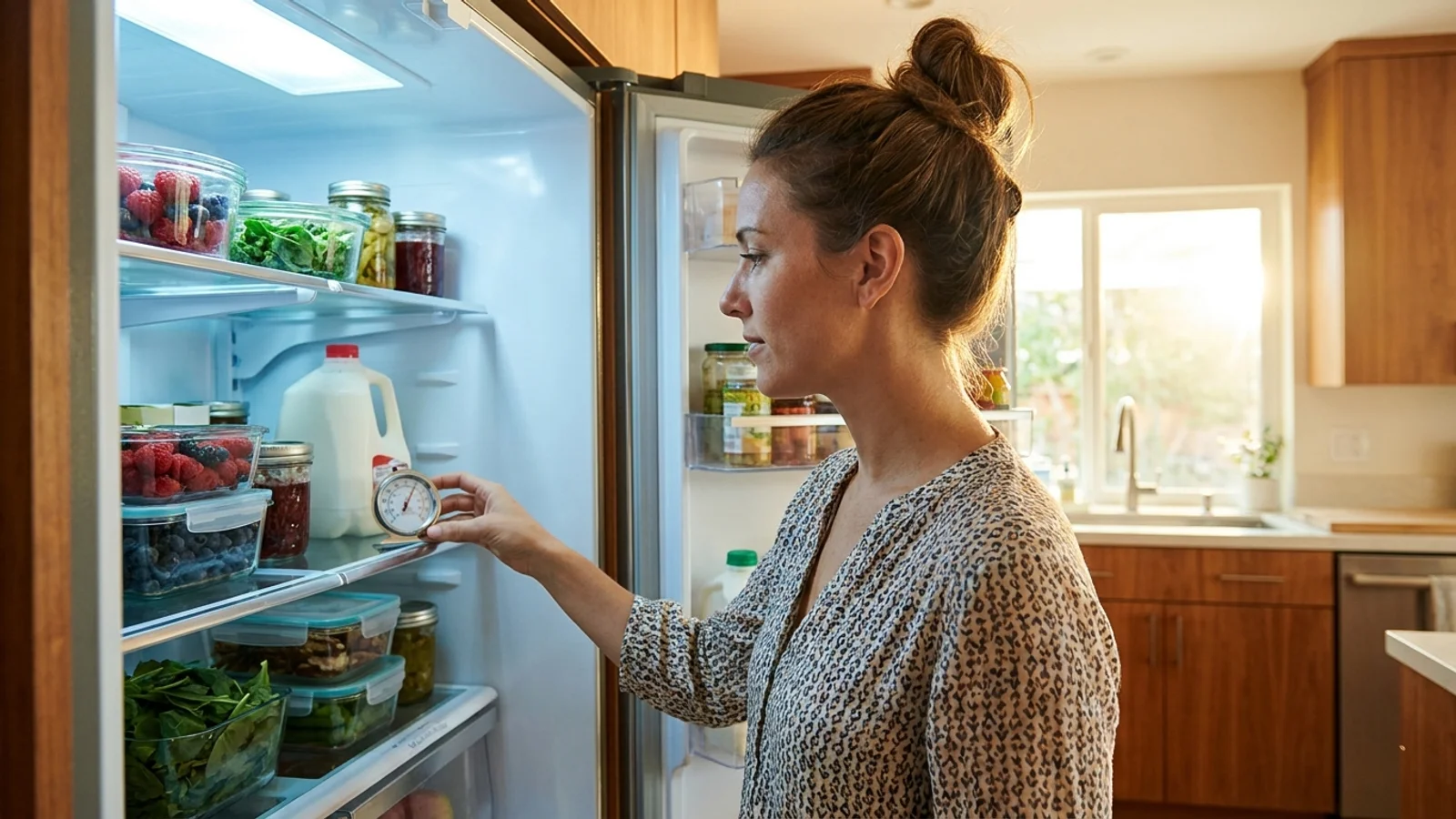
Your refrigerator should sit at 37°F, and never above 40°F. The freezer should hold 0°F. The 40°F ceiling and the 0°F freezer number are the FDA’s food-safety line. 37°F is the target most manufacturers and food-safety guides recommend, and 35 to 38°F is the practical sweet spot most home fridges land in. The number on the dial isn’t the real number, though. The only way to know your actual temperature is a separate thermometer.
Those two numbers, 40°F and 0°F, aren’t arbitrary. They’re the point where bacteria that cause foodborne illness slow down enough to matter. Everything else in this guide is about getting your fridge to actually hit them, and knowing what to do when it won’t.
What temperature should a refrigerator be? 37°F, with 40°F as the ceiling
40°F is the FDA’s official ceiling for the refrigerator compartment. Below that, bacterial growth on perishable food slows dramatically. Above it, especially for more than two hours, food safety experts consider the risk high enough to toss what’s inside.
37°F is the number most manufacturers and food-safety guides actually recommend, because it gives you a buffer. A fridge that reads exactly 40°F on a warm day, with the door opening and closing, can drift past the line without anyone noticing. Aim for 35 to 38°F and you’ve got room to breathe.
Colder isn’t better past that point. Drop much below 34°F and you risk freezing produce and drinks in the coldest zones, which ruins texture on things like lettuce, milk, and eggs. The goal is a stable band, not the lowest number the dial allows.
The right freezer temperature
0°F, flat. That’s the standard for a home freezer, and it’s what keeps frozen food safe indefinitely rather than just “safe for a while.” At 0°F, bacterial activity essentially stops, though quality (freezer burn, texture) still degrades slowly over months.
A freezer running at 10°F or 15°F might feel plenty cold to the touch, but it’s not holding food the way it should. Ice cream gets soft, meat develops freezer burn faster, and the compressor works harder than it needs to. If your freezer has its own dial, set it to 0°F and check it with the same thermometer method below.
How to check the real temperature (the dial lies)
Most refrigerator dials are labeled 1 through 5, or “warmer” to “colder,” not actual degrees. Even models with a digital display are reading a sensor near the vent, not the middle of the compartment where your milk sits. Both can drift several degrees off from reality over time, especially on units past the 8 to 10 year mark.
The fix is cheap and takes one step: put an appliance thermometer in a glass of water on the middle shelf, leave it for 24 hours, then read it. Repeat in the freezer with the thermometer just sitting on a shelf, no water needed. Appliance thermometers cost a few dollars at any hardware store, and there’s no better cheap insurance for kitchen food safety.
If the thermometer reads warmer than the dial suggests it should, adjust the dial one setting at a time. Give the fridge a full 24 hours to stabilize before you check again and adjust further. Refrigerators don’t respond to a dial change in minutes, they respond over a day.
Fridge temperature zone by zone
Not every shelf holds the same temperature, and where you store food matters as much as the overall setting.
| Zone | How it runs | Store here |
|---|---|---|
| Top shelf | Steady, slightly warmer than the bottom | Ready-to-eat food, drinks, leftovers |
| Bottom shelf | The coldest spot in the compartment | Raw meat, poultry, fish (on a tray, below everything else) |
| Crisper drawers | Close to the bottom shelf, higher humidity | Fruits and vegetables |
| Door shelves | The warmest zone, and it swings every time the door opens | Condiments and juice (never milk or eggs) |
| Freezer | 0°F | Frozen food, ice |
The door is the warmest spot in the fridge because it opens constantly and sits furthest from the cooling vent. It’s fine for ketchup and jam. It’s a bad spot for milk, eggs, or anything you want held at a strict 37°F, even though a lot of refrigerator doors are designed with an egg tray built in.
When your fridge won’t hold temperature
If you’ve adjusted the dial, given it 24 hours, and the thermometer still reads warm, the problem usually isn’t the setting anymore. A few common causes:
- Dirty condenser coils that can’t shed heat properly (see our guide on how to clean refrigerator coils)
- A door seal that’s no longer sealing, letting warm air in constantly
- A failing condenser or evaporator fan
- Frost buildup blocking airflow in the freezer (covered in freezer frosting up and how to defrost a freezer)
- A refrigerant or compressor issue that needs a technician
Our fridge not cooling checklist walks through diagnosing these in order, cheapest fix first. If you’ve been through that list and it’s still running warm, that’s a repair, not a maintenance job. See what a visit typically runs in our refrigerator repair cost guide, check our refrigerator repair service page for what’s covered, or call (858) 988-7787 and the technicians in our network can get a look at it.
San Diego specifics: garages, heat waves, and power shutoffs
A few local conditions push refrigerator temperature from “nice to know” to “actually matters this week.”
Garage refrigerators in East County. Homes in El Cajon and Santee often keep a second fridge in the garage, and summer garage temps out there regularly clear 100°F. That’s hotter than the climate class most refrigerators are rated for, which means the compressor runs nearly nonstop trying to hold 37°F against that kind of ambient heat. A garage unit usually needs its dial set a notch colder than a kitchen fridge, and clean coils matter even more, since a garage collects dust and lint fast. If a garage fridge in El Cajon still can’t hold temperature after that, it’s a job for appliance repair in El Cajon.
Santa Ana heat waves. When a Santa Ana blows through and kitchens run warm for a few days straight, fridges that were coping all spring start to struggle. A compressor that cycles fine in a 70°F kitchen has to work much harder in an 85°F one, and an aging unit or dirty coils that were fine all spring suddenly can’t keep up.
SDG&E public-safety power shutoffs. During a planned outage, the FDA’s rules stop being trivia and start being the plan. Perishable food above 40°F for more than 2 hours should be thrown out. A full freezer holds 0°F for roughly 48 hours with the door closed; a half-full freezer holds it for about 24 hours. Knowing those two numbers before the power goes out is what tells you whether to cook the meat now or trust the freezer to ride it out.
Frequently asked questions
What temperature should a refrigerator be set at?
Set it to keep the compartment at 37°F, and never let it run above 40°F. That’s the FDA’s food-safety ceiling. Check the actual temperature with a separate appliance thermometer rather than trusting the dial, since dials and even digital readouts can drift several degrees off over time.
What temperature should a freezer be?
0°F. At that temperature, bacterial growth on frozen food effectively stops, though quality slowly declines over months regardless. If your freezer has a separate dial from the fridge, set it to 0°F and confirm with a thermometer left on a shelf overnight.
How long can food sit above 40°F before it’s unsafe?
Two hours, per the FDA. Past that window, throw perishable food out rather than risk it, even if it still looks and smells fine. In a power outage, that same 2-hour rule applies from the moment the fridge stops holding temperature, which is usually a few hours after the power actually cuts out.
Why is my garage refrigerator warmer than my kitchen fridge, even on the same setting?
Garage ambient heat, especially in East County spots like El Cajon and Santee, can exceed 100°F in summer, which is hotter than most refrigerators are built to fight against. The compressor runs longer and still may not hit 37°F. Setting the garage unit’s dial a notch colder and keeping the coils clean both help; if it’s still running warm after that, it may need service.
Why is my fridge warm even on the coldest setting?
If turning the dial all the way down doesn’t bring the temperature down, the setting isn’t the problem anymore. Dirty coils, a bad door seal, a failing fan, or a refrigerant issue are the usual causes. Our fridge not cooling checklist walks through checking each one in order before you call for a repair.