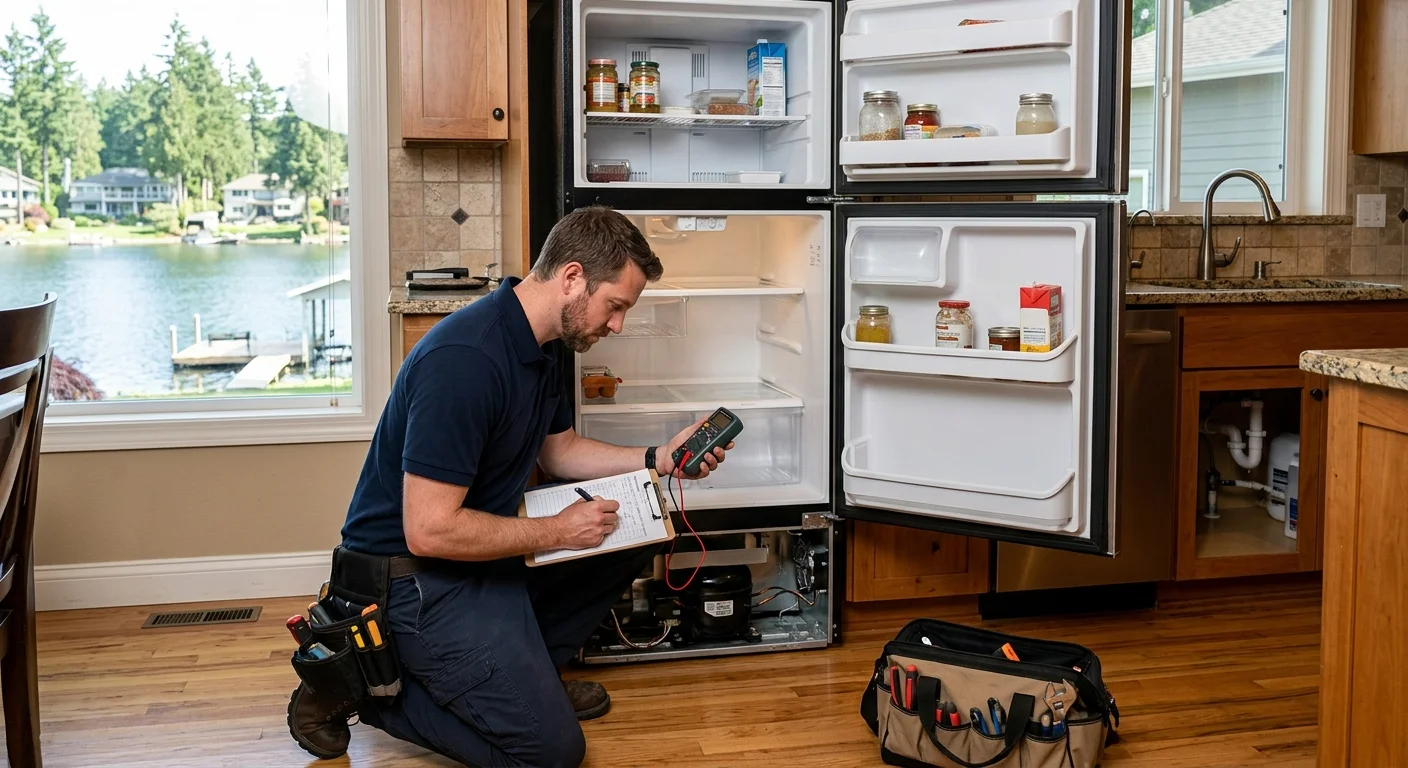
The fridge in a Lakeside kitchen should stay on. When it clicks off, then comes back, then dies again, the pattern is the complaint, not a single guess. Log what you can see, protect the food, and match with an independent technician who can test the unit in place.
Record the shutdown and restart pattern
A fridge that keeps turning off is an intermittent problem. One snapshot at noon does not tell the matched technician what happened at 2 a.m. Write a short log before anyone moves the cabinet or pulls the plug for a reset.
Note the clock time when it dies. Note whether it restarts on its own, after a door open, or only after you unplug it. Write whether the interior light still works when cooling stops. Write whether the display is blank, frozen on a set of digits, or showing an error. If you hear a click, a hum, or silence, put that on the same line.
Track how long it stays off. A unit that drops out for two minutes is a different visit than one that stays dark for two hours. Track how many times it happens in a day. Track whether it lines up with the ice maker cycle, a defrost period, or someone using the microwave on the same kitchen circuit.
Keep the doors closed while you log. The FDA sets the refrigerator compartment ceiling at or below 40°F and the freezer at or below 0°F. Perishables that sit above 40°F should be discarded after 2 hours, or after 1 hour if the room is already above 90°F. A cheap appliance thermometer on a middle shelf beats guessing from the door display. If you want a fuller temperature walkthrough, use our fridge temperature guide.
A full freezer with the door closed can hold temperature for about 48 hours in an outage. A half-full freezer is closer to 24 hours. Those FDA figures apply when the box stays shut. Repeated short shutdowns still warm the fresh-food side faster than a sealed freezer. Move milk, meat, and leftovers first if the log shows long off periods.
Photograph the model and serial tag while the unit is still in place. The tag is usually in the fresh-food compartment, on the wall or in the door liner. That string of characters is what a Lakeside refrigerator technician uses to pull the right wiring diagram. It is also what you use later to check CPSC recalls against the exact model, not a lookalike from the same brand.
Repair Pro San Diego is a referral match for lakeside appliance repair, not a shop that rolls a truck. The independent pro you are matched with diagnoses from this log plus on-site tests. The log is the cheapest part of that visit, and you can finish it before anyone arrives.
What owners can observe without opening components
Stay on the outside of the machine. Do not remove the rear cover, unclip a start relay, or crack a sealed-system line. Those steps belong to a technician, and refrigerant work belongs to an EPA Section 608 certified tech.
Stand in front of the doors and watch a full on/off cycle if you can catch one. See whether both doors still seal when closed. A dirty or rolled gasket lets warm Lakeside kitchen air in, and the control may run, stop, and run again as it hunts. Wipe the gasket with mild soap and water. Do not stretch it.
Feel the floor in front of the kick plate. A small puddle can mean a defrost drain issue, not a compressor that “just died.” Look through the front grille, without tools, for lint packed against the condenser area. If you can see a mat of dust from the front, note it. Coil cleaning from the rear is a separate job. Our coil-cleaning walkthrough covers the owner-safe version.
Listen from the side, not with your ear on a live panel. A short click then silence is different from a steady buzz that never turns into a run. A buzz that repeats every few minutes is worth writing down. So is a fan you can hear in the freezer that stops when the box shuts down.
Check the wall outlet the way you would any other kitchen load. Confirm the plug is fully seated. If the fridge shares a GFCI in a garage or on a patio kitchen, see whether that GFCI has tripped. Resetting a tripped device is an observation, not a repair. If it trips again, stop and leave it for the technician. Do not daisy-chain a cheap extension cord behind a full-size fridge.
Look at neighboring loads on the same room. Lights that dip when the compressor tries to start point at supply or a weak start, not at food storage settings. If the rest of the house is dark, treat it as a power event and check with SDG&E before you assume the sealed system failed.
None of that names the failed part. It tells the matched tech whether to bring a control-board focus, an airflow focus, or an electrical-supply focus into a Lakeside kitchen.
How controls and cooling symptoms narrow the complaint
Shutdown and “not cold” get searched as if they were the same job. They are not. A control that blanks out, then reboots, is a different path than a compressor that runs while the box slowly warms. Pair the log with what the food is doing.
If the display dies and the interior light dies at the same moment, start with supply: plug, outlet, and whether the whole kitchen flickered. If the light stays on and only the compressor sound stops, the complaint is closer to a control, a thermistor, a defrost timeout, or a start device. If the fans keep moving and the box still warms, you are in cooling-performance territory. Use the fridge not cooling checklist alongside this page when temperatures climb and the unit never fully goes dark.
Watch the two compartments separately. A freezer that stays hard while the fresh-food side swings points at damper or control logic, not a dead compressor. Both sides warming together after a shutdown points at a run problem. Ice on the freezer back wall, with short run times, often sits on the defrost side of the tree. Do not chip that ice with a knife.
Read the setpoints. Many owners find the control parked several degrees warmer than they thought. Manufacturer guidance usually sits in a 35-38°F comfort band, under the FDA 40°F ceiling. A 37°F target is a practical middle. Turning the control to the coldest stop does not fix a unit that is powering down.
Error codes matter when they repeat with the shutdown. Photograph the code. Do not clear it until the technician has seen it, unless the maker’s sheet says a reset is required to restore cooling. Brand sheets differ. The model tag is how you find the right sheet.
Warranty status belongs in this same narrowing step. If the fridge is still under a manufacturer’s express warranty, California’s Song-Beverly Consumer Warranty Act says covered repairs should be completed within 30 days unless a delay is outside the maker’s control. That is a manufacturer and authorized-servicer issue. It is not a promise from this referral match. If the tag shows an LG linear-compressor refrigerator built from January 1, 2014 through December 31, 2017, the 2020 class-action settlement (not a government recall) is closed. Do not try to file under it. Tell the technician the model years anyway, because cooling-circuit history still shapes the diagnosis.
None of this is a parts order. It is a cleaner complaint: power loss, control reboot, cooling stop with fans on, or both boxes warming after a shutdown.
What technicians inspect during diagnosis
The independent technician you match with starts where your log leaves off. Expect a written diagnosis before any repair, not a guess from the doorway.
Supply comes first. The tech will verify voltage at the outlet and at the cabinet. A weak receptacle, a scorched plug, or a shared garage circuit can shut a fridge down and then let it return. That is an electrical finding, and it can look like a failed board until someone measures it.
Then the tech watches a commanded run. On many units that means reading control outputs, checking thermistors against a known temperature, and seeing whether the compressor and both fans are actually being asked to run. A board that drops out, a loose harness in the hinge, or a failed door switch can all produce a “it just turns off” story.
If the compressor is being asked to run and does not, the next checks are the start device, windings, and whether the compressor is in thermal limit. A short click-hum-stop loop often lives here. That is also where a buzzing refrigerator and a shutting-off refrigerator overlap. The tech decides that on the meter, not from the sound alone.
Airflow and defrost come next when the box still has power. Restricted condenser airflow, a stuck evaporator fan, or a defrost heater that never clears ice will make the control short-cycle or shut down on limit. The tech inspects those with covers off. That is past the owner-safe line.
Sealed-system work is a separate lane. If gauges and temperatures point at a refrigerant leak or a failed compressor, the person doing that work needs EPA Section 608 certification under the Clean Air Act. Repair Pro San Diego does not perform that work. The matched pro does, if the diagnosis lands there. National cost guides such as HomeGuide have put a full refrigerator compressor job around $700-$1,250 on average (verified against that guide as of August 2026). Treat that as a national range, not a Lakeside quote. The technician diagnoses first and quotes in writing before work begins.
Ask how the visit is billed. This brand has no diagnostic fee, no hourly list, and no waiver policy. Hourly shop rates for East County are not a figure we can confirm from a government source. Job-total ranges from named national guides are the only cost numbers this page will use. There is also no verified 50/50 replacement rule in the claims we are allowed to publish. If you are weighing repair against a new cabinet, read the repair-or-replace guide and use the written quote in front of you.
You can confirm the independent appliance service dealer you are matched with is registered in California through the Bureau of Household Goods and Services lookup. That search shows registration status. It does not grade a technician’s skill.
Which Lakeside property details need confirmation
Lakeside is East County, unincorporated San Diego County, along the San Diego River valley and the SR-67 corridor. The kitchen you are standing in may sit near Lindo Lake, toward Santee, against El Cajon, or on a more rural lot out toward Flinn Springs or Lake Jennings. Those are different access problems for the same complaint. A matched tech needs the actual address, gate code, and whether the fridge is in the main kitchen, a garage, or a converted patio room.
Do not invent a housing-age percentage for this page. Census figures for Lakeside belong in the network facts file, and a number that is not checked against that file stays off this post. What you can confirm on site is the hookup in front of you. Tell the technician the outlet type, whether it is GFCI-protected, and whether the fridge shares a kitchen island circuit with a microwave or air fryer. Note steep drives, stairs, and manufactured-home skirting if those are how someone reaches the coil cover.
If you also have a second unit in a garage, log that separately. Garage boxes see more door time and more dust at the grille. That is an observation about the machine’s location, not a climate claim about East County summers. We are not going to pin this shutdown on heat, Santa Ana wind, or river-valley humidity. Those make for tidy copy. They are not a diagnosis.
Neighboring East County jobs do not copy-paste. A ranch kitchen in Lakeside and a tighter home in El Cajon can share a brand and still differ on circuit, ventilation behind the cabinet, and how far the unit pulls out. Give the tech photos of both sides of the fridge and the wall behind it if you can ease the cabinet out an inch without tipping it.
Have the purchase date, any extended warranty contract, and the model tag ready. If food was lost, keep a simple list of what was discarded and when the thermometer crossed 40°F. That list helps you, not a claim against this referral service. Repair Pro San Diego matches homeowners with licensed, insured independent technicians across San Diego County. The pro who walks into the Lakeside kitchen owns the diagnosis, the repair, and any warranty on that work.
When to call us
Call when the fridge keeps shutting off, when food is climbing through 40°F, or when a reset only buys another short run. A matched, licensed appliance repair pro should test supply, controls, and cooling on site before anyone orders a part. Call (858) 988-7787 to leave a voicemail requesting a match with a local appliance repair pro.