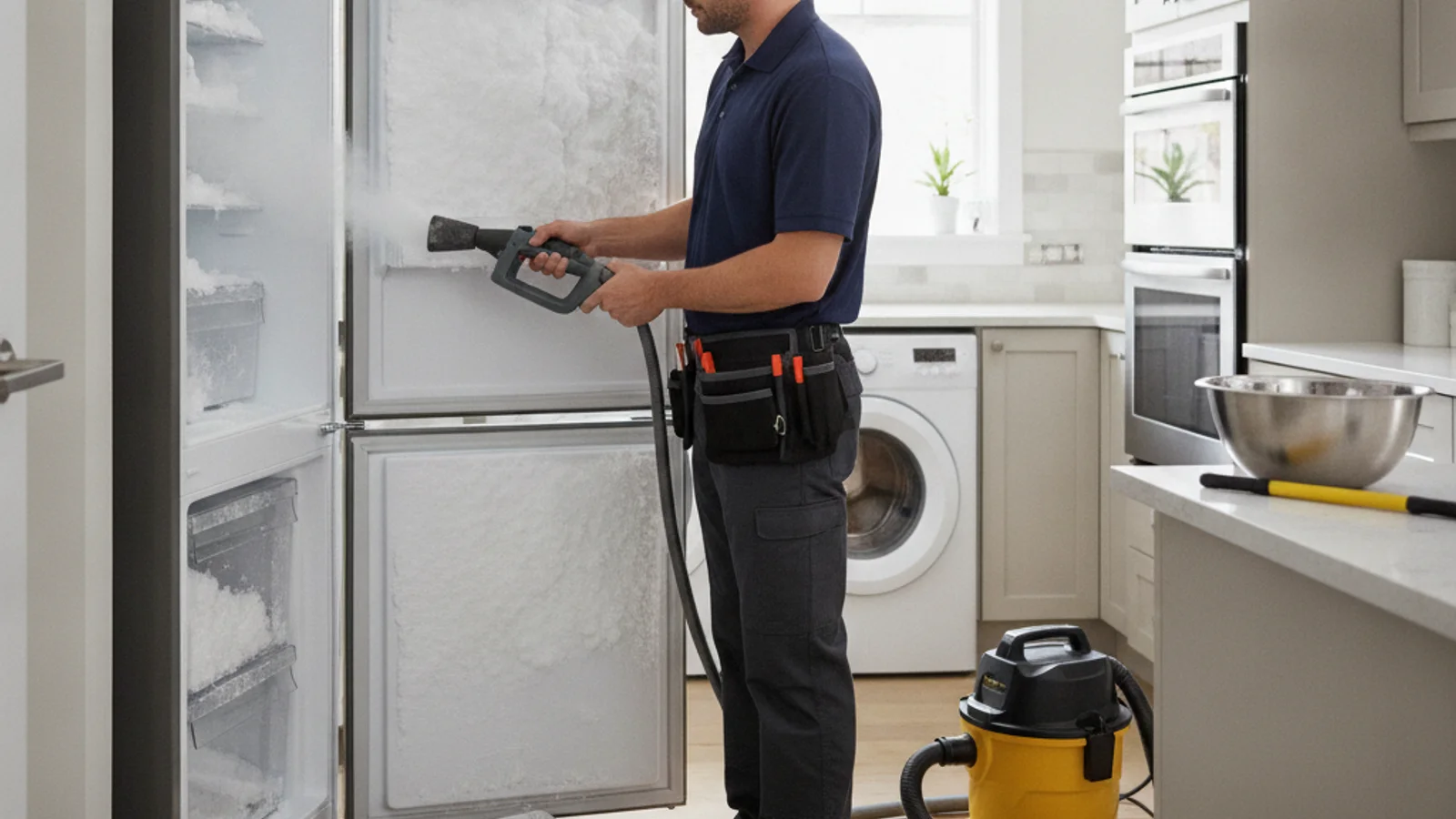
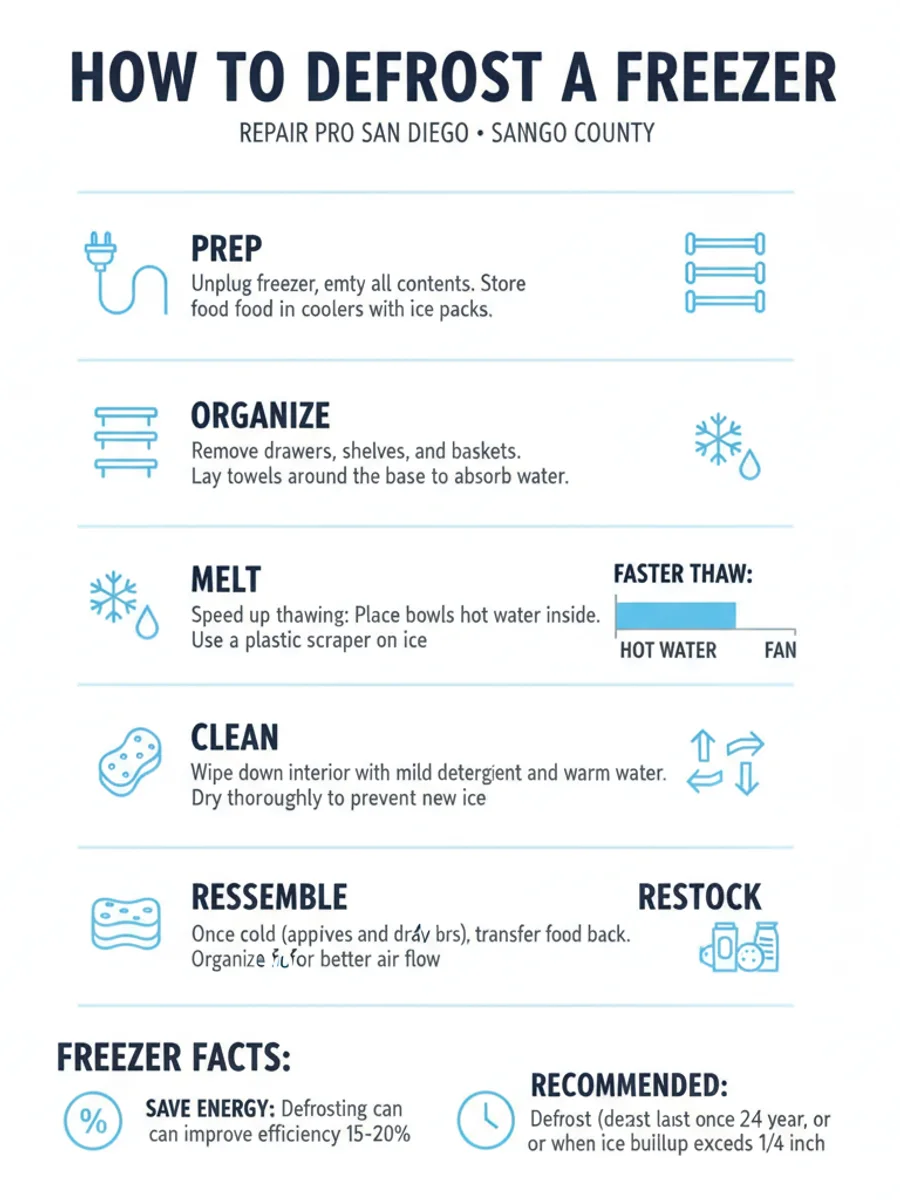
To defrost a freezer, move the food to a cooler with ice, unplug the unit or set it to the defrost cycle, lay old towels around the base, then let the ice melt naturally over two to four hours. You can speed the process by placing a bowl of hot water inside and closing the door, or by running a small fan at the open door to push warm air in. Never chip at ice with a knife or sharp tool. One slip can puncture a refrigerant line or the plastic liner, turning a routine maintenance task into a costly repair. Once the ice has melted, wipe the interior dry, let it air for 15 minutes, then plug it back in and wait two hours before reloading food.
What you need before you start
The job takes two to four hours for moderate frost, up to eight hours if you’ve got a solid wall of ice several inches thick. Before unplugging anything, get these ready:
- A large cooler with plenty of ice or frozen gel packs
- Old towels or shallow baking pans to catch water
- A bowl that fits inside the freezer
- A sponge and a mild cleaner (dish soap works fine)
- Optional: a small box fan
That’s the whole supply list. No heat gun, no hair dryer aimed directly at coils, no ice pick.
Step 1: protect the food
Move everything to the cooler first. Frozen food stays safe for four to six hours in a well-packed cooler, longer if you add dry ice. If you’re doing this quickly and your fridge has a freezer compartment, you can shift the most critical items there temporarily.
Check expiration dates while everything is out. A defrost is a good excuse to clear freezer-burned items you’ll never use.
Step 2: disconnect power
Unplug the freezer at the wall. If it’s hardwired or awkward to reach, flip the dedicated circuit breaker instead. Some models have a manual defrost button or setting. Using it keeps the compressor off without cutting power to the light, which is fine.
Set the temperature dial to “off” if you have one. You don’t want the thermostat kicking the compressor on mid-defrost.
Step 3: lay towels and let it melt
Spread towels on the floor around the base and drape a couple inside along the bottom. Chest freezers need towels inside; uprights drip toward the bottom drain or out the door.
Now wait. Room-temperature air does the work. For light frost (half an inch or less), count on 60 to 90 minutes. For a quarter-inch slab covering an entire wall, two to three hours is realistic. A chest freezer packed with several inches of ice can take five to eight hours if you’re going purely passive.
Check every 30 to 45 minutes and swap out saturated towels.
Step 4: speed it up safely
If you want to move faster, two methods work without risking damage:
Bowl of hot water. Fill a large bowl or pot with the hottest water from your tap, set it inside, and close the door. The steam softens ice quickly. Swap it for fresh hot water every 20 to 30 minutes. This alone can cut defrost time in half.
Box fan at the door. Open the door and aim a small fan at the interior. Moving warm air dislodges frost faster than still air. Works especially well for upright freezers where you can angle the fan directly at the walls.
What not to do: avoid pointing a hair dryer directly at the evaporator coils at the back. The concentrated heat can warp plastic components or damage the coils themselves. Brief, indirect use on thick ice patches from a distance of six or more inches is generally fine, but it’s not worth the risk when a bowl of hot water does the same job safely.
Step 5: clean while it’s empty
Once the ice is gone, wipe down every surface with a sponge dampened with warm soapy water. A mix of one tablespoon of baking soda per quart of water neutralizes odors and leaves no residue. Pay attention to the door gasket. Food debris in the seal folds causes the gasket to pull away from the frame, which invites warm air in and sets up your next frost problem.
Rinse with a clean damp cloth, then dry everything thoroughly. Any moisture left before you restart will freeze immediately and become tomorrow’s frost.
Step 6: restart and reload
Leave the door open for about 15 minutes to let any remaining humidity escape. Then plug it back in, set the temperature to your normal setting (0°F for a standalone freezer), and close the door.
Wait two hours before putting food back. That gives the unit time to pull down to temperature before it has to manage a full load. Reloading too early means the compressor runs hard for hours, which stresses it and takes longer to reach safe storage temperatures.
San Diego considerations
Coastal kitchens in San Diego (anywhere from Ocean Beach to Solana Beach to Chula Vista) tend to run more humid than inland areas, especially during May Gray and June Gloom. Every time you open the freezer, a dose of humid Pacific air goes in. That accelerates frost formation compared to a dry climate.
Garage freezers face a harder version of this. An uninsulated garage in San Diego can swing from 60°F on a cool morning to 85°F on a summer afternoon, and the humidity follows. A freezer working against that environment frosts noticeably faster. If your garage freezer needs defrosting every two to three months rather than once or twice a year, the environment is partly to blame, but a weak door seal is still worth ruling out first.
If you’re in Solana Beach or nearby coastal areas, it’s worth checking your door gasket more often than the manual suggests.
When frequent frost signals a real fault
A manual defrost once or twice a year is normal for older freezers without automatic defrost cycles. If you’re defrosting more than that, or if heavy frost returns within two to three weeks, the freezer has a problem.
The usual suspects:
Door gasket failure. A cracked, flattened, or dirty gasket lets warm air in constantly. The dollar-bill test is quick: close the door on a bill and try to pull it out. Easy removal means the seal isn’t holding.
Defrost system failure. Frost-free freezers run an automatic defrost cycle every eight to twelve hours. If the defrost heater burns out or the defrost thermostat fails, frost accumulates unchecked. You’ll see a thick, hard layer forming faster than normal, often on the back wall near the evaporator coils. This is covered in detail in our guide to why your freezer keeps frosting up.
Defrost drain clog. Meltwater from the automatic cycle drains through a small tube. If that tube freezes or clogs, water refreezes at the bottom and eventually migrates up the walls.
These faults require a technician. A failed defrost heater or thermostat means pulling panels and working near refrigerant lines. That’s not a DIY job.
If your freezer won’t hold temperature after defrosting, or frosts back up within days, refrigerator and freezer repair is available across San Diego County. You can also read about freezer repair options in San Diego for more on what to expect cost-wise.
When the problem comes back quickly after a clean defrost, call us at (858) 988-7787 to get matched with a technician.
Frequently asked questions
How long does it take to defrost a freezer?
Most freezers defrost in two to four hours with passive melting at room temperature. Light frost on an upright can clear in under an hour. A chest freezer with several inches of ice buildup may take six to eight hours. Using a bowl of hot water inside the closed freezer cuts the time roughly in half.
What is the fastest way to defrost a freezer?
Place the largest bowl or pot you have filled with hot tap water inside the freezer and close the door. Replace the water every 20 to 30 minutes as it cools. Combined with a fan aimed at the open door between swaps, this method can defrost a moderately frosted unit in 45 to 90 minutes without any risk to the liner or coils.
Can you defrost a freezer without turning it off?
Technically yes. You can remove food and let the door stand open while the unit is running, and the warm room air will melt the frost. In practice it’s wasteful and hard on the compressor, which fights the incoming warm air while you’re trying to melt ice. Unplugging or switching to the defrost setting is safer for the appliance and faster overall.
How often should you defrost a freezer?
Manual-defrost freezers (common in chest freezers and older models) typically need defrosting once or twice a year, or whenever frost exceeds about a quarter inch thick. Frost-free models handle this automatically and shouldn’t need a manual defrost under normal use. If you’re defrosting more than twice a year, check the door gasket. If frost returns within weeks of a full defrost, the automatic defrost system likely has a fault.
Is it safe to use a hair dryer to defrost a freezer?
A hair dryer used carefully from a distance (six or more inches away, kept moving, never aimed directly at coils or plastic liner seams) is unlikely to cause immediate damage. But it introduces more risk than benefit when a bowl of hot water achieves the same result without heat stress to the components. If you do use one, keep it away from any pooled water on the floor.