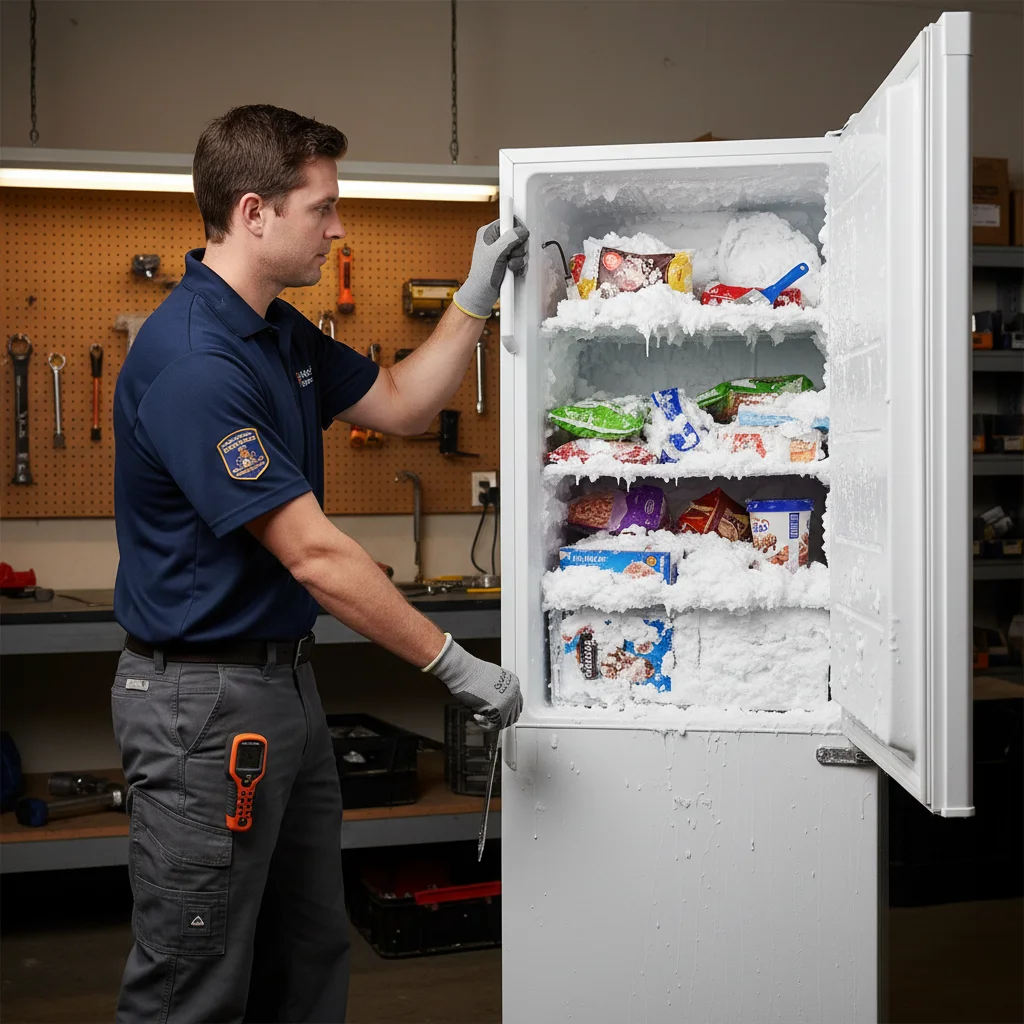
Frost in freezer compartments often involves humid air getting in or ice that the defrost path is no longer clearing. Those are observations for a technician, not a two-cause diagnosis you can confirm from the door. If your freezer is frosting up, check the visible door gasket first. Leave heater, thermostat, timer, and sealed-panel work to the matched pro.
Frost forms when warm, moist air enters the freezer and hits the cold interior surfaces. A little is normal in older models, but a thick, snowy layer means something is persistently wrong. Humid air through a gasket gap can add frost. How fast that happens is not a city timeline on this page. Check the visible gasket, then request diagnosis if frost keeps returning.
Is it frost or freezer burn? How to tell the difference
Before you start troubleshooting, it’s important to know what you’re dealing with. People often use the terms “frost” and “freezer burn” interchangeably, but they are two very different things caused by opposite problems.
Frost buildup is an environmental issue. It’s the soft, white, flaky ice crystals that coat the interior walls, shelves, and packages inside your freezer. This happens when humid air from outside the freezer gets inside. The moisture from that air freezes, creating the snowy buildup you see. If your entire freezer looks like it’s been dusted with snow, you’re dealing with a frost problem. This points to an issue with the freezer itself, like a bad seal or a faulty defrost system.
Freezer burn, on the other hand, is a food quality issue. It appears as grayish-brown, leathery spots or large, dry patches on the food itself. It occurs when moisture is drawn out of the food and evaporates, a process called sublimation. This is usually caused by improper packaging that allows air to come into direct contact with the food’s surface. While the food is still safe to eat, freezer burn ruins its texture and flavor.
So, to summarize:
- Frost: Moisture getting into the freezer. It’s on the walls and packages.
- Freezer Burn: Moisture getting out of the food. It’s on the food itself.
If you’re seeing a lot of frost, your freezer is working too hard and wasting energy. If you’re seeing freezer burn, it’s time to re-evaluate your food storage techniques. This article focuses on tackling the first problem: excessive frost buildup.
Check the door seal first
A common place to start is a worn door seal, also known as a gasket. This flexible rubber or vinyl strip runs along the edge of your freezer door, creating an airtight seal to keep the cold air in and the warm, moist air out. Over time, this gasket can become dirty, cracked, brittle, or warped, compromising the seal.
When the seal is weak, warm air from your kitchen continuously seeps into the freezer. This air is loaded with moisture, especially here in San Diego. Every time that moist air hits the freezing-cold interior, the water vapor turns to frost. It’s a constant cycle that leads to rapid ice buildup. Your freezer’s compressor also has to run more often to combat the incoming warm air, which shortens its lifespan and increases your SDG&E bill.
Fortunately, checking your door seal is easy. Here are two simple tests:
The Dollar Bill Test
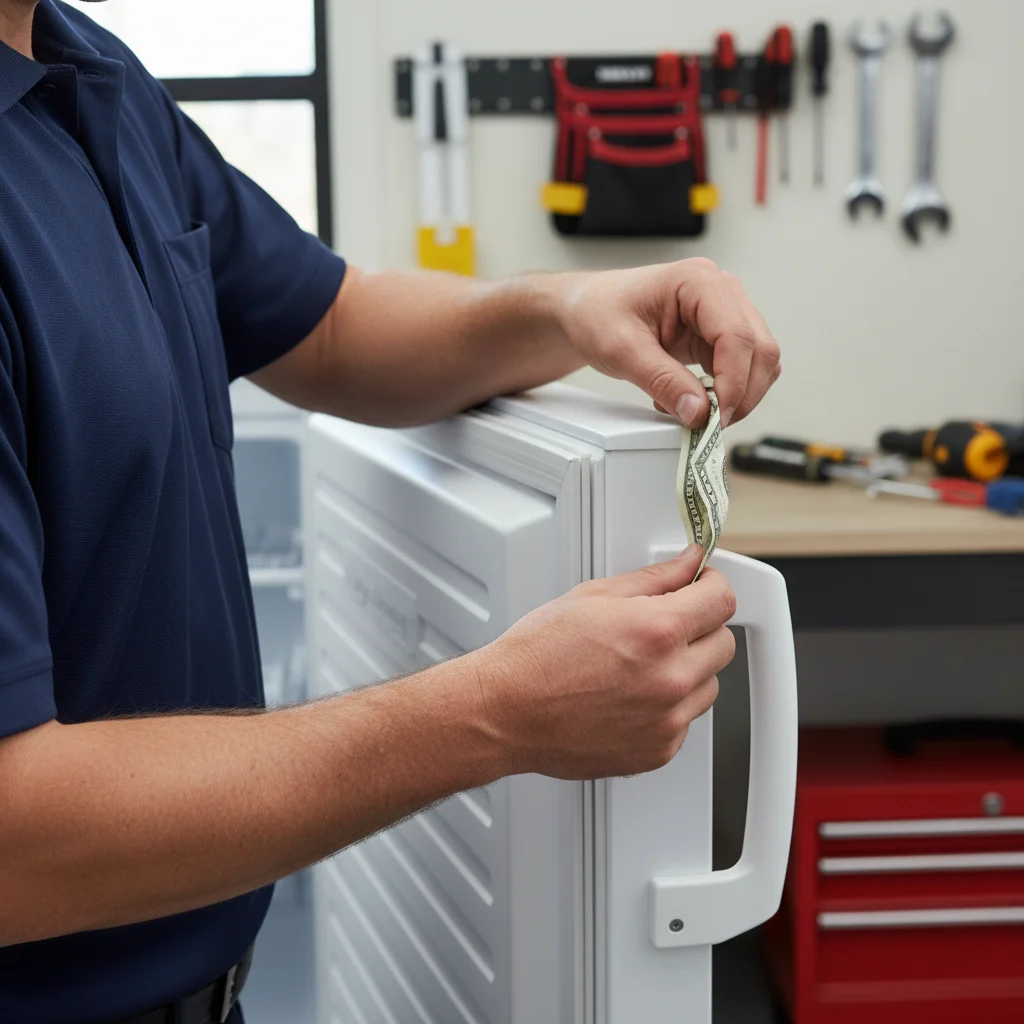
This is the classic way to check your gasket’s integrity. Take a dollar bill (or any piece of paper) and close the freezer door on it, leaving a bit sticking out. Now, try to pull the bill out. You should feel a slight but firm resistance. If the bill slides out with little to no effort, that section of the seal is not making proper contact. Test this in several spots all around the door, top, bottom, and both sides.
The Visual Inspection
Take a close look at the entire gasket. Do you see any cracks, tears, or sections that look flattened or twisted? Run your finger along it. Does it feel hard and brittle instead of soft and flexible? Also, check for any sticky residue from spills or grime buildup. Sometimes, just cleaning the gasket with warm, soapy water and a sponge is enough to restore a proper seal. If it’s damaged, however, it will need to be replaced.
Freezer icing up near the door
If the frost is worst right around the door opening, the frame, or the top corners, the gasket is the first visible check. The door is where room air meets the cold box, so a gap can show as ice at the edges. Run the dollar-bill test along the top and both upper corners first. Some models also have a frame heater. Treat a suspected heater failure as a technician diagnosis, not a confirmed cause or a quick part swap.
Why your freezer keeps icing up: a blocked air vent
Modern frost-free freezers rely on a system of vents to circulate cold air. This constant airflow is key to maintaining a consistent temperature throughout the compartment and preventing ice from forming in any one spot. You’ll typically find these vents along the back or side walls of the freezer interior.
The problem starts when these vents get blocked. It’s easy to do without realizing it. Shoving in one too many bags of frozen vegetables, stacking pizza boxes against the back wall, or just generally over-packing the freezer can obstruct the flow of air.
When a vent is blocked, the cold air can’t circulate as designed. This creates two problems. First, some areas of the freezer won’t get cold enough, putting your food at risk. Second, the area right around the blocked vent can become extremely cold, causing any ambient moisture to freeze there instantly. This often results in solid chunks of ice forming around the vent, which only makes the circulation problem worse.
Clear visible blockage around interior vents if you can do it without forcing packages. How full the box should be is a question for the model manual, not a three-quarters-full packing rule. Tell the technician if the freezer was packed tight, if the door sat ajar, or if coastal humidity is in the room. Those notes are context, not confirmed causes.
When the automatic defrost system fails
If your door seal is tight and your vents are clear, but you’re still getting thick sheets of ice, the problem likely lies with the automatic defrost system. This system is designed to periodically melt the small amount of frost that naturally accumulates on the evaporator coils, preventing it from turning into a major ice problem.
The defrost system has three main components that work together:
- Defrost Timer: This is the brain of the operation. It’s either a mechanical clock or an electronic control board that tells the freezer to switch from cooling mode to defrost mode several times a day.
- Defrost Heater: This is a heating element that wraps around or sits near the evaporator coils. When the timer activates it, the heater warms up just enough to melt the frost off the coils. The resulting water drains out through a small tube to a pan under the freezer, where it evaporates.
- Defrost Thermostat (or Terminator): This small device monitors the temperature of the coils. Once the ice has melted and the coils reach a certain temperature (usually above freezing), the thermostat signals the heater to turn off and tells the timer to switch back to cooling mode. This prevents the freezer from getting too warm.
If any one of these parts fails, the entire system breaks down. If the timer gets stuck in cooling mode, the heater never turns on. If the heater burns out, it can’t melt the ice. If the thermostat fails, it might not turn the heater on or might not turn it off at the right time. In any of these cases, frost will continuously build up on the coils until they become a solid block of ice, choking off airflow and causing your freezer to frost up. Diagnosing and replacing these components involves working with electrical parts and is often best left to a professional. A failed defrost system is a common reason for a standalone freezer repair call.
Why does a frost-free freezer still frost up?
A frost-free freezer that keeps frosting up can involve a gasket gap, a defrost component, or a drain that has iced. Those are questions for the technician. The “frost-free” label means the unit runs an automatic defrost cycle, not that it cannot form frost.
Coastal humidity in San Diego and its effect on freezers
Living in beautiful San Diego County has its perks, but the coastal climate can be tough on our appliances, especially freezers. The “May Gray” and “June Gloom” we’re all familiar with are just symptoms of our proximity to the Pacific Ocean, which keeps our air more humid than in inland areas.
This high ambient humidity plays a significant role in freezer frost. Remember, frost is just frozen moisture from the air. The more moisture in the air, the more potential there is for frost. Here in San Diego, the air that enters your freezer every time you open the door (or that seeps in through a weak seal) is carrying a heavy load of water vapor.
This makes a perfect door seal absolutely critical. A gasket gap in a dry inland climate may frost slowly. The same gap in a humid coastal kitchen can frost faster. That is a humidity observation, not a Phoenix-versus-La-Jolla timeline. The freezer works harder whenever moist air keeps entering.
That’s why the dollar bill test is so important for San Diego residents. You can’t afford to have a leaky seal. If your freezer is in a garage or an area without climate control, the effect is even more pronounced. Regular maintenance, like cleaning your gasket and checking for a tight seal, can go a long way in preventing your freezer from becoming an ice cave.
What to do when DIY fixes don’t work
You’ve cleaned the gasket, passed the dollar bill test, and rearranged frozen foods to clear the vents. Unplugging for a full melt is not a repair substitute. If frost returns, the technician needs to diagnose the defrost path. Do not treat a 24-hour unplug as the fix.
Heater, timer, and thermostat parts sit behind panels near the evaporator. Those are not owner checks. Attempting that work without the model’s service steps can damage the appliance and is unsafe.
This is the point to request a match. A technician diagnoses which part of the defrost path has failed and quotes in writing. Whether it’s a simple freezer or part of a larger unit, refrigerator repair can prevent food loss and extra run time. If you’re in East County, you can also request appliance repair in Spring Valley. The line is voicemail, not a booked slot.
Frequently asked questions
Why is my freezer frosting up?
Start with the dollar-bill gasket check. Packing, room humidity, and defrost parts are observations to give the technician. They are not a confirmed two-cause diagnosis from the doorway.
Why does my frost-free freezer have frost?
A frost-free label means the unit runs an automatic defrost cycle, not that it’s immune to moisture problems. When the defrost heater burns out, the thermostat fails, or the timer gets stuck, frost comes back fast. A clogged defrost drain that refreezes can also cause ice buildup at the bottom of the compartment. Any of these will need a technician to diagnose and replace.
How do I stop my freezer from icing up?
Clean the door gasket and run the dollar bill test around the full perimeter. Clear items blocking interior vents. If frost keeps building, request diagnosis. A long unplug may melt ice. It is not a substitute for finding the fault.
Is frost in the freezer a sign it needs repair?
A thin layer of frost is normal, especially in older manual-defrost models. Thick, widespread frost that keeps coming back after you clear it is a sign of a real problem, and yes, it usually needs a repair. Left alone, a frozen-over evaporator coil will starve the unit of airflow and eventually cause the compressor to overwork and fail.
Can a bad door seal cause freezer frost?
A damaged gasket can let humid air in, and coastal humidity can make frost show faster. That is still a technician-confirmed cause after the visible check, not a guarantee that a gasket swap will stop every frost pattern.
When to call us
If you’ve tried the simple fixes and your freezer is still frosting up, it’s time to let a professional take a look. A persistent ice buildup usually signals a problem with the defrost system or a damaged door seal that needs replacing. The technicians in our network can diagnose the issue. There is no speed or same-day promise from Repair Pro San Diego.
Call us at (858) 988-7787 and we’ll match you with a local tech.