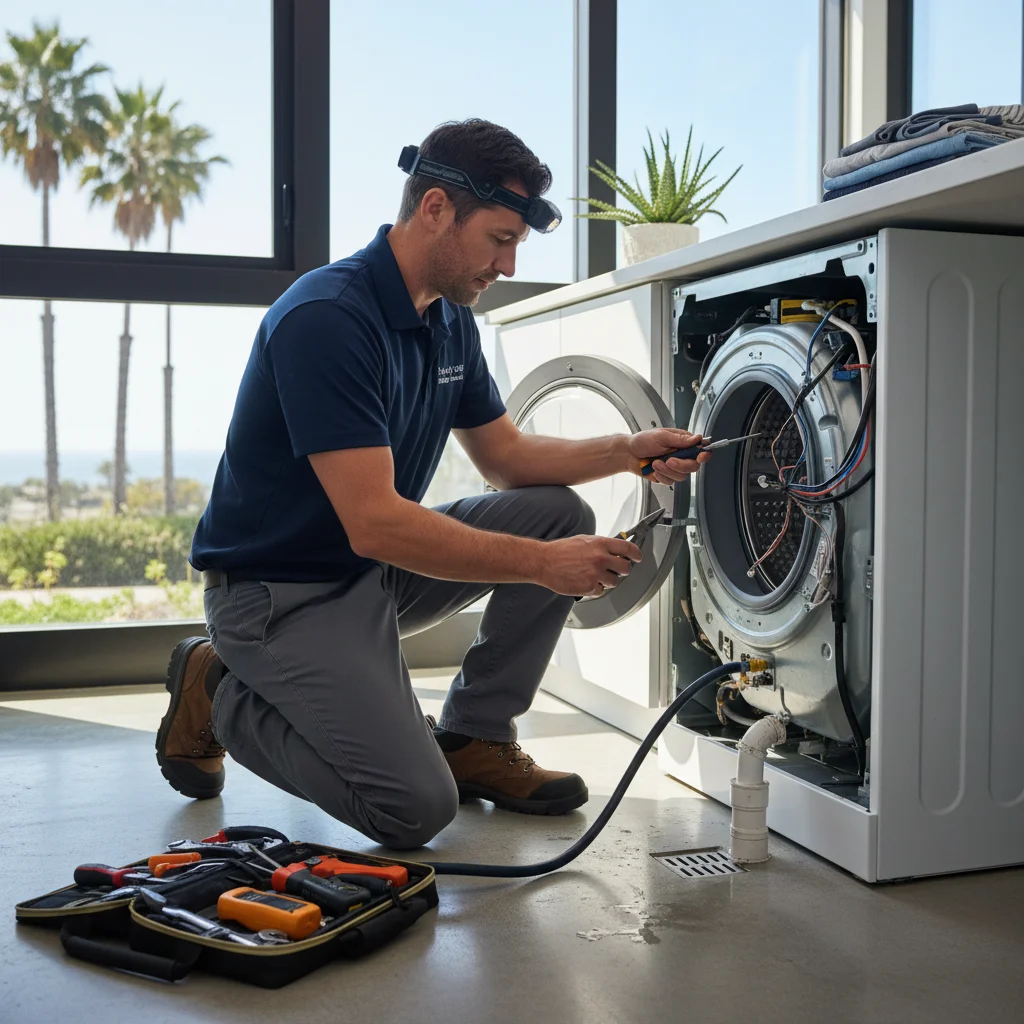
Your washer stops mid-cycle on a Tuesday night. You’ve got a pile of wet clothes, no backup plan, and no idea what it’s going to cost to fix. That’s the moment most San Diego homeowners start searching, and we want to give you straight answers before you call anyone.
Common washer problems across San Diego County
We run calls from Chula Vista to Oceanside, Santee to Point Loma. The problems techs see are pretty consistent no matter the neighborhood.
Won’t drain. This is our most common call. A clogged drain pump filter, a failed pump, or a kinked drain hose can all cause standing water at the end of a cycle. We’ve written a full breakdown of what causes it and what to check first, see our post on what to do when your washer won’t drain.
Won’t spin. Usually a worn lid switch on top-loaders or a bad door latch on front-loaders. Sometimes it’s the motor coupling or a broken drive belt. The machine might fill and drain fine but the drum just sits there.
Leaking water. Common culprits: door boot seals on front-loaders, worn tub bearings, loose inlet hoses, or an overfilled tub from a bad water inlet valve. Front-load leaks around the door almost always point to the rubber gasket.
Loud during spin. A grinding or banging sound during spin usually means worn drum bearings or a foreign object (coins, underwire) caught between the drum and tub. Ignoring bearing noise leads to a much bigger repair bill.
Error codes. Samsung and LG machines throw error codes like UE, LE, 5E, OE. They’re useful, a 5E on a Samsung almost always means a drain issue. Knowing the code narrows the diagnosis before we even open the machine.
Not starting at all. Could be a blown thermal fuse, a failed control board, or a tripped breaker. A fair number of “dead” washers just need a fuse, a small, cheap part, instead of a full replacement.
San Diego’s hard water accelerates wear on inlet valves and solenoids. If you’re in Escondido, El Cajon, or Lakeside (areas with higher mineral content in the water supply) expect to see valve issues sooner than homeowners on the coast.
What drives the cost of a typical washer repair
We don’t love vague “it depends” answers, so here’s what actually moves the price up or down on a typical job.
Diagnostic fee: every tech in the network sets their own diagnostic fee for the visit and assessment. Ask whether it’s credited toward the repair before you approve the quote.
What affects the price on common repairs:
- Drain pump replacement: a straightforward parts-and-labor job, cost mostly comes down to how hard the pump is to reach.
- Door boot seal (front-load): price depends on the gasket design and whether the outer tub has to come apart to get to it.
- Lid switch or door latch: usually one of the cheaper fixes, quick to diagnose and swap.
- Water inlet valve: price depends on whether one valve or both need replacing.
- Drive belt: a fast, low-cost repair on most top-loaders.
- Control board: one of the pricier repairs, since boards vary widely by model and aren’t interchangeable across brands.
- Drum bearing replacement: labor-intensive since it means a partial teardown, but often still worth it on a newer machine.
Parts prices shift with supply chains, and labor on a compact stackable unit takes longer than on a freestanding top-loader. The matched technician diagnoses the actual fault first and quotes the job in writing before any work starts.
The technician gives you the price in writing before work begins. No surprise invoices.
Front-load vs top-load: which fails more often here
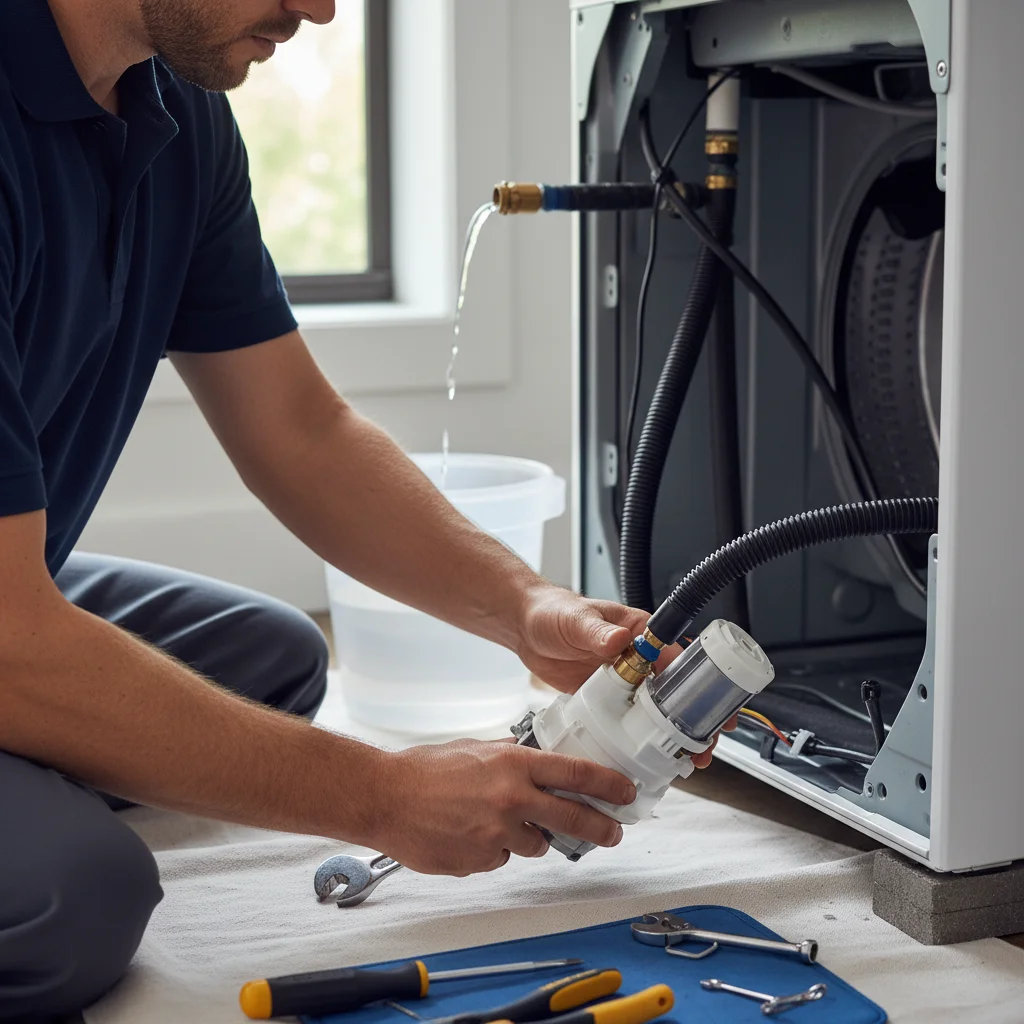
Short answer: front-loaders come in more often, and their repairs cost more on average.
That’s not a knock on front-loaders, they’re more water-efficient, which matters in San Diego where tiered water rates bite. But they have more failure points: door seals, bellows, bearings, and a drain pump that works harder than on most top-loaders.
The bigger issue we see with front-loaders in San Diego is mildew. Coastal humidity, combined with closed laundry closets that don’t get much airflow, creates the perfect environment for mold in the door gasket. It’s not just a smell problem, it can permanently stain clothes and degrade the seal itself. We have a detailed guide on fixing front-loader mildew if you’re dealing with that specific problem.
Top-loaders are simpler mechanically. Agitator models especially. They fail too (transmission problems, lid switch issues, worn belts) but parts are cheaper and labor is faster. An older Maytag top-loader with a broken lid switch is a 45-minute job. A front-loader with a bad bearing is a two-hour job.
If you’re still deciding which type to buy, our comparison of top-load vs front-load washers walks through the tradeoffs in depth.
Brands seen most often (Samsung, LG, Maytag, Whirlpool)
The network covers all major brands. These four come through most often.
Samsung. Extremely common in San Diego homes. Parts availability is good. The most frequent issues: drain pump failures, error code OE/5E (drainage), and door latch problems on front-loaders. Control boards can be expensive on mid-range models.
LG. Similar profile to Samsung, lots of front-loaders, lots of connected features, similar failure points. LG drum bearings are a known weak spot on older units. The LE error code (motor issue) often resolves with a reset but sometimes indicates a failing rotor position sensor.
Maytag. Built simpler, lasts longer, costs less to fix. We see a lot of older Maytag top-loaders still running in San Diego homes that have had nothing more than a drive belt or lid switch. Parts are inexpensive and widely available.
Whirlpool. The most common brand serviced by volume. Whirlpool, Kenmore (many of which are Whirlpool-built), and Amana share a lot of parts. That’s good news, faster turnaround, lower parts cost. Common issues include water inlet valves, lid switches on top-loaders, and door latches on front-loaders.
The network also covers Bosch, GE, Speed Queen, Electrolux, and Fisher & Paykel. If your brand isn’t listed, call us, it’s probably covered. Our full washing machine repair service page covers the complete brand list.
When to repair vs replace your washer
The rule we use: if the repair costs more than 50% of the replacement cost of a comparable machine, replacing starts to make financial sense. But that’s a starting point, not a hard rule.
A few factors that tip toward repair:
- The machine is under 8 years old
- It’s a high-end model that would be expensive to replace with something equivalent
- The broken part is mechanical (pump, belt, valve) rather than a control board or drum bearing on an older unit
- You’re happy with its performance otherwise
Factors that tip toward replace:
- The machine is 10+ years old and the repair would be a significant expense relative to a new machine
- It’s had multiple repairs in the past two years
- You’re seeing rust inside the drum or on the cabinet
- Energy use is high, older machines can use 40+ gallons per load vs 15-20 for modern efficient models
We wrote a longer piece on this exact question (when to repair vs replace an appliance) that walks through the math for washers specifically.
We’ll always give you our honest read. If a machine isn’t worth fixing, we’ll tell you that before you spend money on it.
How to book a repair visit
We cover all of San Diego County, Mission Valley, North Park, La Mesa, National City, Rancho Bernardo, Poway, San Marcos, Encinitas, Chula Vista, and everywhere in between.
If the washer will not drain or is leaking, say so in the voicemail. Arrival times vary and we don’t promise one. The matched technician sets timing after reviewing the request.
What to have ready when you call: your washer’s brand and model number (usually on a sticker inside the door frame or lid), what it’s doing wrong, and any error codes it’s showing. That information helps the matched tech show up with the most likely parts already on hand, which saves everyone time.
Frequently asked questions
How much does washing machine repair cost in San Diego?
Cost depends on the part that failed and how labor-intensive the job is. A drain pump, lid switch, or drive belt swap sits toward the lower end since they’re quick, straightforward jobs. Control board replacements and drum bearing jobs run higher, since boards vary by model and bearing work means a partial teardown. Every tech in the network sets their own diagnostic fee, so ask if it’s credited toward the repair before you approve the quote.
What does a 5E error code mean on a Samsung washer?
A 5E code signals a drain fault, meaning water isn’t exiting the tub at the end of the cycle. The most common cause is a clogged drain pump filter, but a failed pump or kinked drain hose can also trigger it. Clearing the filter is the first DIY step; if the code comes back, the pump itself likely needs replacement.
Do front-load washers break down more than top-loaders?
Front-loaders come in for repair more often and cost more to fix on average, mainly because of their door seals, drum bearings, and drain pumps. San Diego’s coastal humidity speeds up mold growth in the door gasket, which is a common front-loader problem on the coast. Top-loaders are simpler mechanically, and parts like belts and lid switches are cheaper and faster to swap.
When does a washer repair stop being worth it?
The rule we use is 50 percent: if the repair costs more than half what a comparable new machine would cost, replacing starts to make financial sense. Age matters too; a 10-plus-year-old washer needing a major repair, or one that’s had multiple fixes in the past two years, is usually a candidate for replacement.
When to call us
A washing machine that won’t drain, spin, or start is worth having a professional look at, especially if error codes are involved or you’re hearing grinding noises that suggest bearing wear. Attempting to replace drum bearings or a control board without the right tools can cause more damage and void any remaining warranty. Call us at (858) 988-7787 and we’ll match you with a local tech.
Running a laundromat, apartment complex, or gym instead of a house? See our commercial laundry repair guide for coin-op and card-reader machines.