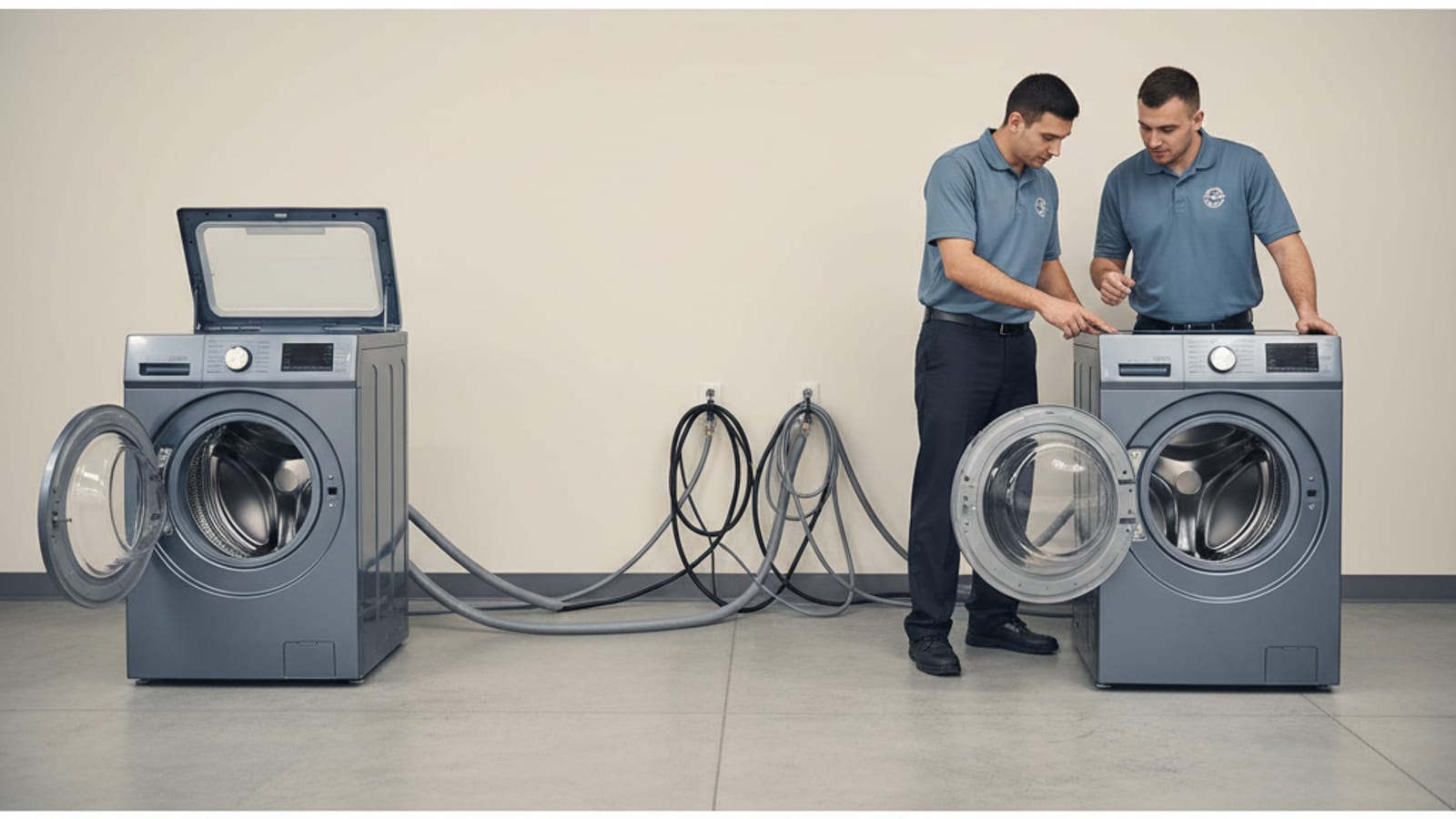
Front-load washers clean better and use less water, but they cost more to repair and need regular mildew maintenance. Top-load washers are cheaper to buy, have faster cycles, are easier on your back, and hold up longer with less fuss. For most households, an HE top-load is the better total-cost decision. Front-load wins if you have delicates, limited floor space (stacking), or the budget for a premium brand like Miele. Here’s the honest tradeoff from the side of the counter that actually repairs them.
The short version
Front-load cleans better, uses less water, saves energy, but fails more often and costs more to repair. Lifespan: 10-12 years.
Top-load (HE / agitator-less) cleans nearly as well, uses more water, costs less to buy, fails less often, and when it does, repairs are cheaper. Lifespan: 12-15 years.
Top-load (traditional agitator) cleans roughest on clothes, uses the most water, costs the least, lasts the longest, and is the cheapest to repair. Lifespan: 15+ years.
If you launder delicates and high-end fabrics, front-load. If you want the cheapest total cost over 10 years, HE top-load. If you have a utility room in a rental property and want something you’ll barely think about, agitator top-load.
Side-by-side comparison
| Front-load | HE top-load | Agitator top-load | |
|---|---|---|---|
| Purchase price | Highest | Mid-range | Lowest |
| Cleaning | Best | 80-90% as good | Best on heavy soil, rougher on delicates |
| Water per cycle | ~11 gal | ~18 gal | ~30 gal |
| Cycle time | Longer (60-90 min) | Moderate (45-70 min) | Fastest (35-55 min) |
| Mildew risk | High (door gasket traps moisture) | Low | Low |
| Common repairs | Door boot, bearings, shocks | Lid switch, belt, pump | Agitator coupler, pump, belt |
| Repair frequency over 10 yrs | Highest | Moderate | Lowest |
| Lifespan | 10-12 years | 12-15 years | 15+ years |
| Stackable | Yes | No | No |
| Best for | Delicates, small spaces, premium brands | Most households | Rentals, workwear, budget buyers |
Why front-loaders break more
Based on what technicians in the network see most, the hardest-worked, most-failing components on a front-loader:
1. Door boot (rubber gasket), fails at 5-8 years
The rubber seal around the door opening traps water, accumulates mildew, and eventually develops tears or perforation. It’s one of the more affordable washer repairs, but a universal issue across every front-load brand.
2. Main bearings, fail at 7-10 years
Front-loaders spin the drum horizontally on bearings that carry the full weight of a wet load at high spin speeds. Bearing replacement is one of the pricier washer repairs, and it’s almost always on the edge of “should I just replace the whole thing?“
3. Shock absorbers, fail at 5-8 years
The dampers that prevent the washer from walking during spin wear out. You’ll notice: the washer vibrates more than it used to, maybe walks across the floor. Replacement is a moderate-cost repair.
4. Drain pumps, fail at 4-7 years
Small plastic pumps with small plastic impellers. Foreign objects (coins, underwires, hair pins) break the impeller; wet lint shortens motor life. A relatively affordable replacement.
Add these up and a front-loader’s potential repair total over a 10-year span can approach a meaningful share of what the machine cost new. Math matters.
Why top-loaders hold up
Top-loaders have fewer stressed components:
- No rubber door boot, the lid seal is simpler and less stressed
- Vertical drum orientation, gravity doesn’t ride the bearings the same way
- Simpler drain path, often gravity-assisted rather than pump-only
- Fewer electronics in HE models, though the newer computerized HE top-loaders are closing this gap
Top-loader repair calls the network sees most:
- Lid switch fails, a low-cost fix
- Drive belt or coupling wears, a moderate-cost fix
- Suspension rods stretched or broken, a moderate-cost set
- Pump fails, a moderate-cost repair
Same order of magnitude for individual repairs. But fewer of them happen.
The energy and water math
Front-load (HE): ~11 gallons per cycle, the lowest combined water-and-electric operating cost of the three. HE Top-load: ~18 gallons per cycle, a moderate combined operating cost. Traditional agitator top-load: ~30 gallons per cycle, the highest combined operating cost of the three.
Over 10 years, a front-loader’s water and energy savings are real, but modest.
Compared to the repair cost delta, front-loader energy savings usually don’t make up for the extra service cost.
Cleaning performance
Consumer Reports and similar testers consistently show:
- Front-load: best cleaning, especially on heavily soiled items
- HE top-load (no agitator): 80-90% as good as front-load on most stains; nearly as good on everything
- Traditional agitator: best on heavily soiled towels, bedding, and durable fabrics; rough on delicates and knits
Unless you wash workwear or cloth diapers, HE top-load gets you 90% of front-load cleaning with 50% less repair risk.
Which brand to buy in each category
Front-load
- Miele, German-built, best reliability, high price. If budget allows, this is the answer.
- Speed Queen Home Professional, commercial-grade reliability, simpler controls, 5-year parts warranty.
- LG / Samsung, good features, average reliability. Watch for ice-maker-style rumors of failure patterns.
- Whirlpool / Maytag front-load, solid value, acceptable reliability.
- Avoid, budget front-loaders from any off-brand. The failure rates are worse than name-brand, not better.
HE Top-load (no agitator)
- Speed Queen TC5, the longest-lasting agitator-less top-load. Premium-priced, 10-year manufacturer warranty. Overkill for most, perfect for rentals.
- Maytag MVW series, sold by Whirlpool, reliable, reasonable price.
- Whirlpool WTW series, the “just works” option. Good value.
Traditional agitator
- Speed Queen TR7, still sold, still last-forever reliable, at a premium price.
- Maytag Commercial Technology (MVWP575GW or similar), designed for coin-op use, built for residential.
- Most entry-level agitator top-loaders are budget-priced and fine choices if you don’t need premium features.
The bottom line
For most San Diego households, an HE top-load washer from Whirlpool, Maytag, or Speed Queen is the best total-cost-of-ownership decision: a moderate purchase price, 12-15 years of life, and repair costs that stay on the low end over that period.
Front-loaders are the right choice if:
- Laundry-room space constrains you (only stacking front-loaders work stacked)
- You care about clothes longevity on delicates and technical fabrics
- You can afford premium brands (Miele, Speed Queen Home Pro)
Traditional agitator top-loaders are right for:
- Workwear, heavily-soiled items, towels, bedding
- Rental properties where simplicity wins
- Budget-constrained buying decisions
Every style, installed and repaired across the network
The techs in our network have installed and repaired thousands of washers across San Diego County. Regardless of which style you choose:
- Leveling matters. Front-loaders that aren’t level vibrate themselves into early bearing failure
- Supply hoses deserve respect. Rubber hoses fail at the 5-year mark. Replace with stainless-braided at install or before, preventive replacement is inexpensive and can save you from a costly flood.
- The vent goes to UL 2158A steel-flex. Not plastic. Not reused old flex. Code requires it; the fire marshal enforces it.
Already have a front-loader that’s developed a smell? See our guide on fixing front-loader mildew. Need service on a washer that’s stopped working? Our washing machine repair page covers common repairs and what they typically cost. We also serve appliance repair in Encinitas and throughout San Diego County.
Ask the technician about their diagnostic fee and whether it’s credited toward the repair. (858) 988-7787.
Frequently asked questions
Which is better, a top-load or front-load washer?
For most households, an HE top-load is the better choice. It costs less upfront, lasts 12-15 years, and repairs are cheaper and less frequent than a front-loader. Front-load wins if you need to stack units, care deeply about clothing longevity on delicates, or can budget for a premium brand like Miele or Speed Queen.
Do front-load washers clean better?
Yes, front-loaders consistently outperform top-loaders on cleaning tests, especially for heavily soiled items and delicates. The tumbling action is gentler and more thorough than agitation. That said, an HE top-load without an agitator gets you roughly 80-90% of that cleaning performance without the added repair risk.
Why do front-load washers smell?
The rubber door gasket (boot seal) traps water after every cycle, and the sealed front door keeps moisture from evaporating. That creates ideal conditions for mildew. Leaving the door slightly ajar after each load and wiping the gasket dry are the main preventive steps. If the smell is already established, the gasket and drum may need a deep clean or replacement. See our front-loader mildew fix guide for the full process.
Are top-load washers more reliable?
Yes. Top-loaders have fewer stressed components: no rubber door boot, a simpler drain path, and bearings that don’t carry the full weight of a spinning wet load. From a repair-frequency standpoint, front-loaders generate significantly more service calls over a 10-year period, and the repairs tend to cost more.
Which washer lasts longer?
Traditional agitator top-loaders last the longest, often 15+ years. HE top-loaders typically run 12-15 years. Front-loaders average 10-12 years. If longevity is the priority, a Speed Queen agitator top-load is the standard recommendation from the repair side.