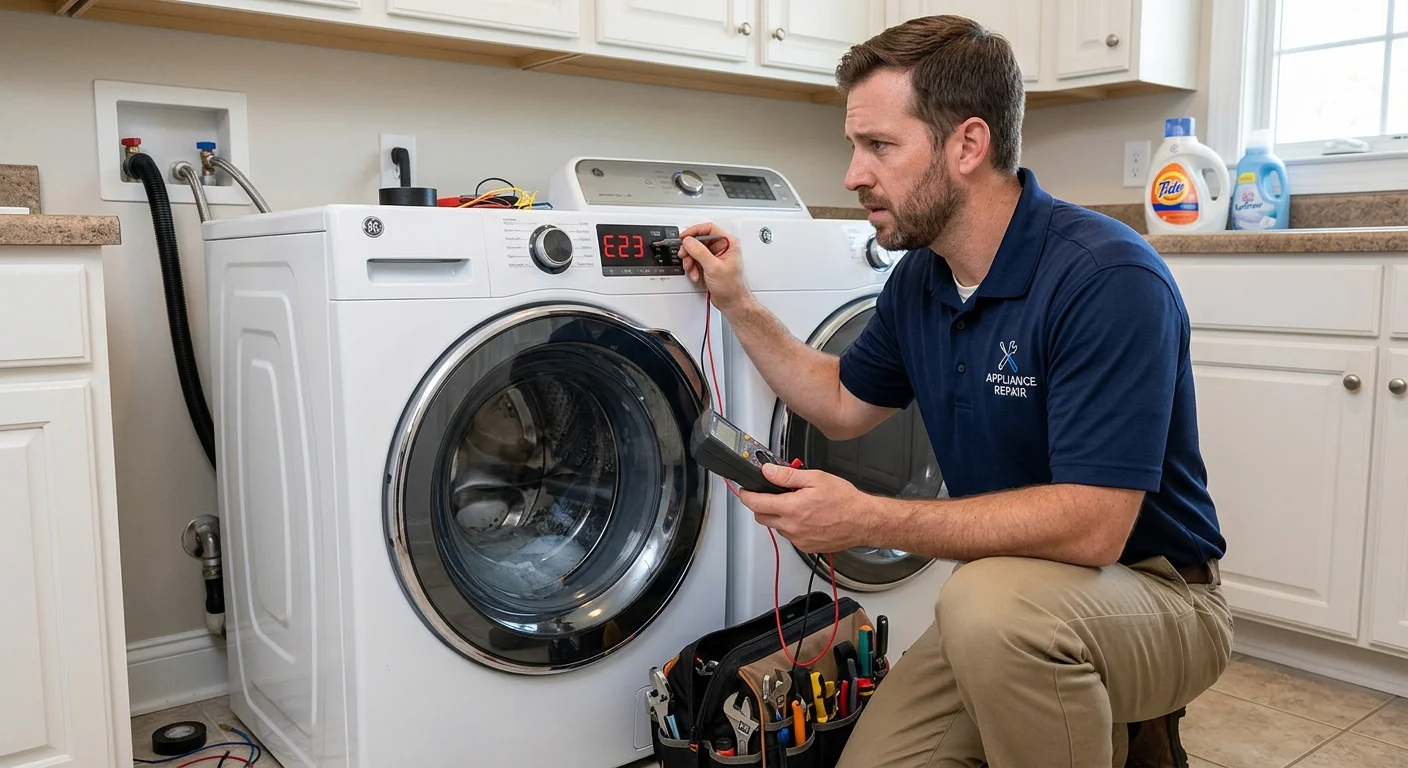
GE washer problems include a washer that won’t drain, won’t spin, or won’t start. Possible related parts include a pump filter, drain hose, lid switch or door latch, breaker, or control lock. Those are starting checks, not a ranked “most common” list for every GE. Use the owner’s manual for your exact model.
Why your GE washer won’t start (and how to check)
Nothing is more frustrating than a washing machine that just won’t power on or begin a cycle. If your GE washer won’t start, don’t assume the worst right away. Often, a simple check can reveal the issue.
First, verify the power supply. Make sure the washer is securely plugged into a functioning electrical outlet. Sometimes, a tripped circuit breaker can be the culprit. Head to your electrical panel and check if any breakers are in the “off” or “tripped” position. Reset any that need it. If your GE washer has a control lock feature, ensure it’s not accidentally activated, preventing any commands from being input. Look for a padlock icon or a “control lock” button and hold it down for a few seconds to deactivate.
Next, examine the lid switch or door latch if the manual describes that check. For some top-load models, the lid switch detects a closed lid. For some front-load models, the door latch must engage. Listen for a click if the manual says to. A malfunctioning switch can prevent a start. It is not the most common call on every GE.
Finally, confirm your water supply. While it might seem obvious, ensure both hot and cold water faucets behind the machine are fully open. Kinked supply hoses can also restrict water flow, preventing the washer from sensing it has enough water to start a cycle. Always perform these basic checks first; they often solve the problem without needing a professional.
GE washer not draining or spinning
When a GE washer won’t drain, check whether your model has an owner-accessible drain pump filter. Location and drain-hose steps differ. The owner’s manual shows whether there is a front access panel, how to drain standing water, and how to remove the filter. Don’t unscrew a filter unless that document shows it for your serial.
Inspect the drain hose at the back if you can see it without pulling the cabinet into an unsafe position. A kink is worth straightening. If the manual does not show a user filter, skip that step.
Another common cause for a washer not spinning properly is an unbalanced load. If you’re washing heavy items like blankets or towels, they can shift to one side, causing the machine to stop spinning to prevent damage. Try redistributing the load evenly or removing some items. If the lid switch or door latch (mentioned earlier) isn’t functioning correctly, it can also prevent the spin cycle from engaging, as the machine won’t sense a secure closure. For more in-depth guidance on these problems, check out our guide on washing machine repair in San Diego. Sometimes, though, these symptoms point to a deeper problem like a failing drain pump or motor, which means it’s time for expert washing machine repair.
Troubleshooting loud noises during the spin cycle
A GE washer that makes loud noise during the spin cycle is worth checking. Sometimes the cause is a load that shifted. Persistent grinding or roaring can be a mechanical fault that needs diagnosis.
Just like with draining and spinning issues, an unbalanced load is a frequent offender when it comes to loud noises. If your washer is trying to spin an unevenly distributed load, it can bang, vibrate, and make a significant racket. Stop the cycle, redistribute the clothes, and try again. Also, check inside the drum and pockets for foreign objects like coins, keys, or even small toys. These items can get caught between the drum and the tub, creating a clanking or grinding sound during operation.
More serious noises, such as grinding, squealing, or continuous thumping, can indicate internal component wear. Worn drum bearings are a common culprit, especially in older machines or if you have a GE front load washer repair need. When bearings fail, the drum won’t rotate smoothly, leading to a loud grinding or roaring noise that gets worse during the spin cycle. Similarly, worn shock absorbers can cause excessive vibrations and thumping if they can no longer dampen the drum’s movement. A stretched or damaged drive belt can also produce a squealing sound. While checking for foreign objects and balancing the load are good DIY steps, persistent loud noises often mean it’s time for a professional diagnosis.
Error codes on GE washers explained
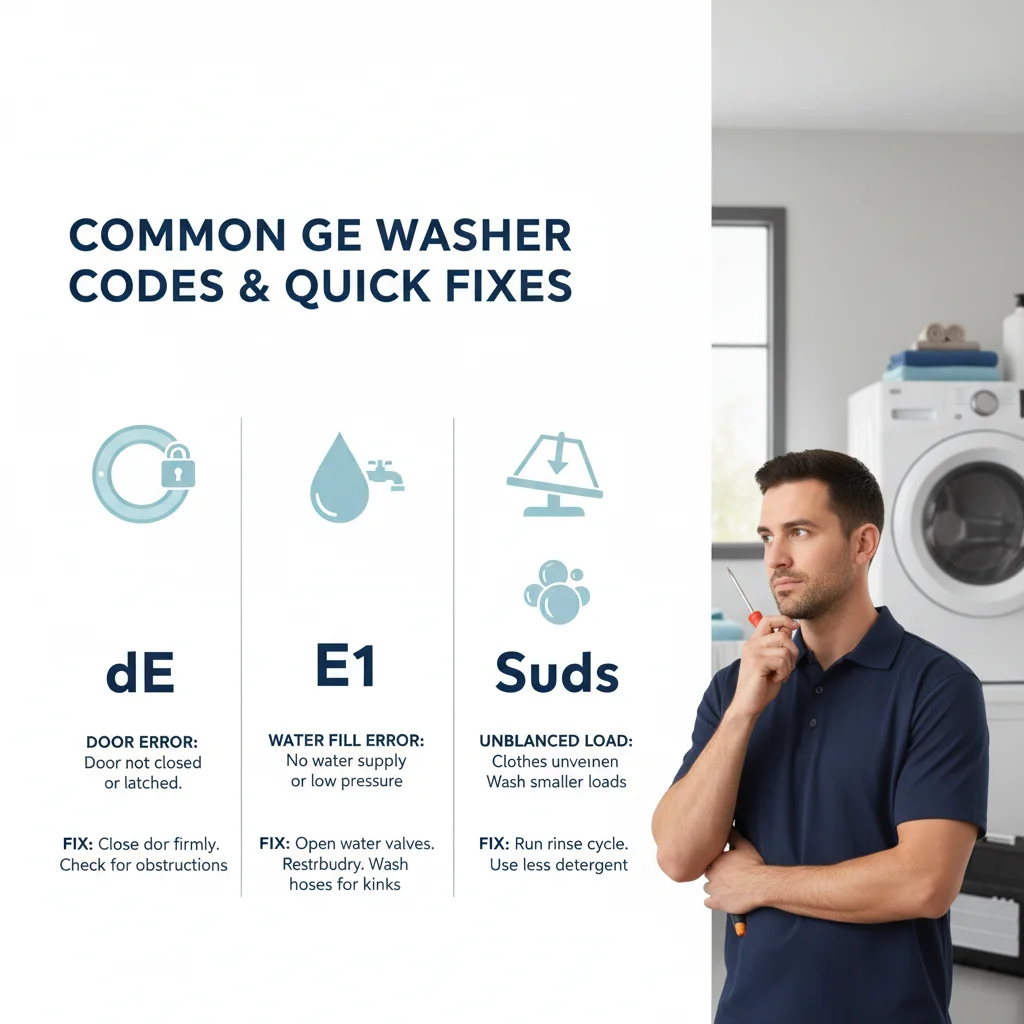
Modern GE washers are equipped with diagnostic systems that display error codes when a fault occurs. A displayed code is a prompt, not a completed diagnosis. Confirm the letters on the exact model chart in the owner’s manual. Meanings can differ by series. Examples that appear on some GE controls include dE, E1, LE, uC, or Suds. Treat them only as a reason to open that chart.
- dE or dOOc: On some GE charts these letters flag a door or latch path. Confirm the meaning in the exact model chart. Try opening and firmly re-closing the door if the chart names that owner step.
- E1 or F-series fill codes: On some charts these mean a fill or water-supply question. Check supply hoses, faucets, and kinks only after the chart matches those letters.
- LE or LO: Some charts list a long-drain or water-level path. A clogged pump filter or kinked hose is a possible owner check when the manual names it.
- uC: Some charts list an unbalanced-load path. Redistribute the laundry if that is the charted owner step.
- Suds: Some charts flag excess foam. Use the detergent type and rinse step the manual names.
When you see an error code, the first step is the GE washer’s user manual for that model. Codes such as dE, E1, LE, uC, or Suds are examples that appear on some controls. They are not universal. If the code persists after the manual’s steps, request GE washing machine repair.
When DIY isn’t enough: calling for professional GE repair
While many GE washer problems have simple DIY solutions, there are times when calling a professional is the smartest, safest, and most cost-effective choice. If you’ve tried the basic troubleshooting steps mentioned above and your GE washer is still acting up, it’s probably time to bring in the experts.
Complex electrical issues, leaks you cannot source, or major component work (motor, transmission, drum bearings) belong to a technician. Attempting those repairs without the right tools can damage the machine or create electrical and water hazards. Whether a DIY step affects a remaining manufacturer warranty depends on that warranty’s written terms. Don’t assume any owner check voids coverage. In San Diego, you can check an appliance repair company’s BHGS registration through the California Department of Consumer Affairs lookup. That lookup confirms registration status, not an individual technician’s skill.
Professional GE washer technicians use diagnostic tools and model documentation. Ask whether they can source GE or equivalent parts for your serial. Repair Pro San Diego does not claim all-model capability.
Frequently asked questions
Why won’t my GE washer drain?
A clogged drain pump filter can cause a no-drain on models that have an owner-accessible filter. Confirm that part in the manual, then check the drain hose for a visible kink.
What causes a GE washer not to spin?
An unbalanced load is the first thing to check. Heavy items like blankets can shift to one side and cause the machine to stop spinning to protect itself. If redistributing the load doesn’t help, the lid switch or door latch may be faulty, since the washer won’t spin if it can’t confirm the lid is securely closed.
What do GE washer error codes mean?
Codes are model-specific. dE, dOOc, E1, F, uC, and Suds are examples that appear on some GE controls. Confirm each code and the owner steps in the user manual for that serial. Do not treat those letters as a universal parts map.
When should I call a technician instead of fixing it myself?
Call a technician when the repair involves the motor, drum bearings, transmission, or a persistent water leak you can’t trace. These repairs require specialized tools and carry electrical and water safety risks. Loud grinding during the spin cycle, a GE washer error code that keeps returning, or water leaking from an unknown source all warrant a professional diagnosis.
When to call us
When your GE washer still fails after the manual-approved checks, Repair Pro San Diego can match you with an independent technician. Call (858) 988-7787 to leave a voicemail requesting a match.