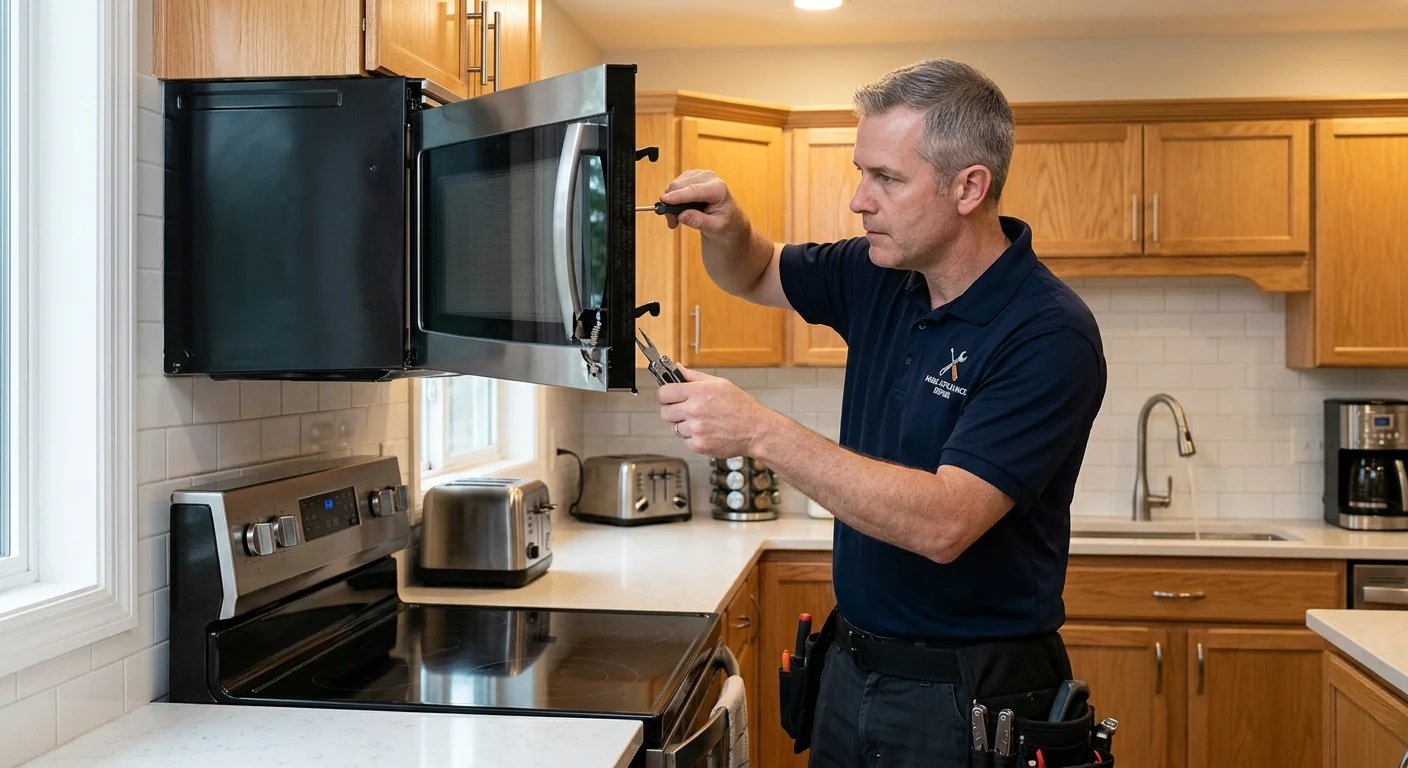
A microwave door that won’t close can involve an obstruction, poor alignment, a damaged latch piece, or a fault in the parts that register the door as shut. Note exactly what the door does, then leave cabinet and electrical checks to a technician. A model-specific diagnosis helps separate a door problem from a control problem.
Confirm the model and exact door symptom
Start with the model number and a precise description. “The microwave door won’t close” can describe several different symptoms. The door may stop before reaching the frame. It may reach the frame but spring back open. It may latch physically while the display still reports an open door.
Write down whether the problem started suddenly or became worse gradually. Note any recent cleaning, moving, cabinet work, or impact to the door. These details help the technician focus the first inspection.
Find the model and serial label without removing panels. Its location varies by manufacturer and model. Check the visible door frame, inner opening, back panel, or owner’s manual. Take a clear photo instead of copying a long number by hand. One incorrect character can point to the wrong parts diagram.
Also identify the installation type. Countertop, over-the-range, drawer, and built-in microwaves have different doors and mounting arrangements. A built-in unit may also use a trim kit. Include that detail when requesting service.
Record what happens at the controls. Does the interior light stay on? Does the display show a door message? Does pressing the door-release button change anything? Don’t repeatedly slam or force the door to test it. That can change the original symptom before inspection.
If the door closes normally but the microwave doesn’t heat, use the separate microwave not heating guide. That symptom can require a different diagnostic path.
What owners can observe without opening the cabinet
Begin with what you can see around the cooking cavity and door edge. Look for food residue, packaging, a loose label, or another object blocking the door’s path. Check the full perimeter rather than only the latch side.
Observe the door from the front and side. A sagging corner, uneven gap, or rubbing point gives the technician useful direction. Compare the top and bottom gaps without trying to bend the hinges or door. Photos taken straight on can make subtle alignment differences easier to document.
Next, look at the visible latch hooks. Note whether one appears cracked, loose, recessed, or different from the other. Don’t insert tools into the latch openings. Those openings lead to parts behind the control-panel area.
If the model has a push-button release, describe its feel. It may move normally, feel loose, remain depressed, or meet unusual resistance. If it has a pull handle, note whether the handle or surrounding door panel shifts during use. A microwave door not closing after a handle becomes loose is different from a door blocked by debris.
Check whether the symptom changes when the appliance is cold. Don’t run extra heating cycles to create a comparison. Simply report whether the problem appeared after ordinary use or was present before use.
These observations aren’t a diagnosis. They create a clean record for the matched pro. For broader service details, visit the microwave repair service page. It explains how referrals work across San Diego County.
What technicians inspect around the door and controls
A technician starts by confirming the complaint and checking the visible door fit. The inspection may include the hinges, hinge mounts, latch hooks, door-release mechanism, and the openings that receive the latches. The exact sequence depends on the model’s design.
The door itself can also require close inspection. The technician looks for looseness, distortion, damaged mounting points, or parts that no longer move together. A door that reaches the frame but won’t latch suggests a different path from one that sits unevenly before making contact.
Inside the latch area, switches register the door’s position for the controls. A technician can check whether the door moves each mechanism as intended. They may also inspect switch holders, connectors, and related wiring. These checks require cabinet access and shouldn’t be treated as an owner procedure.
A microwave door switch repair isn’t automatically the answer. A switch can test differently because the door, latch, or switch mount isn’t moving correctly. Replacing one part without finding the mechanical cause may leave the original problem unresolved.
The technician may then compare the door signal with the control response. This matters when the door latches but the display behaves as though it’s open. Model-specific service information helps distinguish a mechanical fault from a control issue.
San Diego homes contain every major installation style. An over-the-range unit in Chula Vista presents different access questions from a built-in model in La Jolla or a countertop microwave in El Cajon. Share cabinet photos before the appointment if removal access looks limited. Our San Diego microwave repair guide offers more context about models and service requests.
When repair and replacement should be compared
Compare repair and replacement after the technician identifies the failed part. A loose mechanism and a damaged door assembly can produce similar symptoms but lead to very different decisions. Diagnosis should come before shopping or ordering parts.
Ask whether the required part is available for the exact model. Door assemblies, trim pieces, hinges, switches, and control parts aren’t interchangeable simply because two microwaves look alike. Color and finish can also matter when the unit is part of a matching kitchen.
Installation changes the comparison. A countertop microwave can often be replaced without cabinet alterations. An over-the-range or built-in model may involve mounting dimensions, ventilation layout, trim fit, and surrounding cabinetry. Those factors can make a repair attractive even when a basic replacement model is easy to find.
Check the manufacturer’s current warranty terms using the full model and serial number. Don’t assume that the door, labor, or a specific component is covered. Ask the manufacturer or an authorized service channel to confirm coverage before approving paid work.
Also search the model in the CPSC recall database. A listing there may provide model-specific directions. Match every character before relying on a recall notice.
For a broader decision framework, read when to repair or replace an appliance. Compare the written repair quote with the correct replacement type, required installation work, and cabinet fit. The matched technician diagnoses first and quotes in writing before work begins.
How to request a matched microwave technician
Send a short, useful summary when requesting a match. Include the brand, complete model number, installation type, and exact door behavior. State whether the door stops early, springs open, latches loosely, or closes while the controls still report it as open.
Attach a few focused photos when possible. Capture the full front, the door gap, the visible latch pieces, and the model label. For built-in and over-the-range units, add one photo showing the surrounding cabinet or mounting area. Those images help the independent technician understand access before discussing the job.
Mention anything that changed before the symptom appeared. Useful examples include a recent move, cleaning around the latch, a loose handle, or contact with the open door. Stick to what you observed. There’s no need to name the failed part yourself.
Ask the technician whether they service that specific model and installation type. You can also ask about their diagnostic fee, whether it’s credited toward the repair, parts availability, written quote, and warranty terms. Those policies belong to the independent technician, not Repair Pro San Diego.
Repair Pro San Diego is a referral service. We match homeowners and businesses with licensed, insured, independent local appliance technicians. The matched pro diagnoses the microwave, provides the quote, and performs any approved repair.
Service requests may come from coastal North County, central San Diego, East County, or the South Bay. Location, building access, and installation style should be included in the request. That gives the referral enough context to identify an appropriate local pro.
When to call us
Request a licensed, insured appliance repair pro when the door remains misaligned, won’t latch, or doesn’t register as closed after visible obstructions are ruled out. The matched independent technician can diagnose the door, latch, switches, and controls.
Call (858) 988-7787 to leave a voicemail requesting a match with a local appliance repair pro.