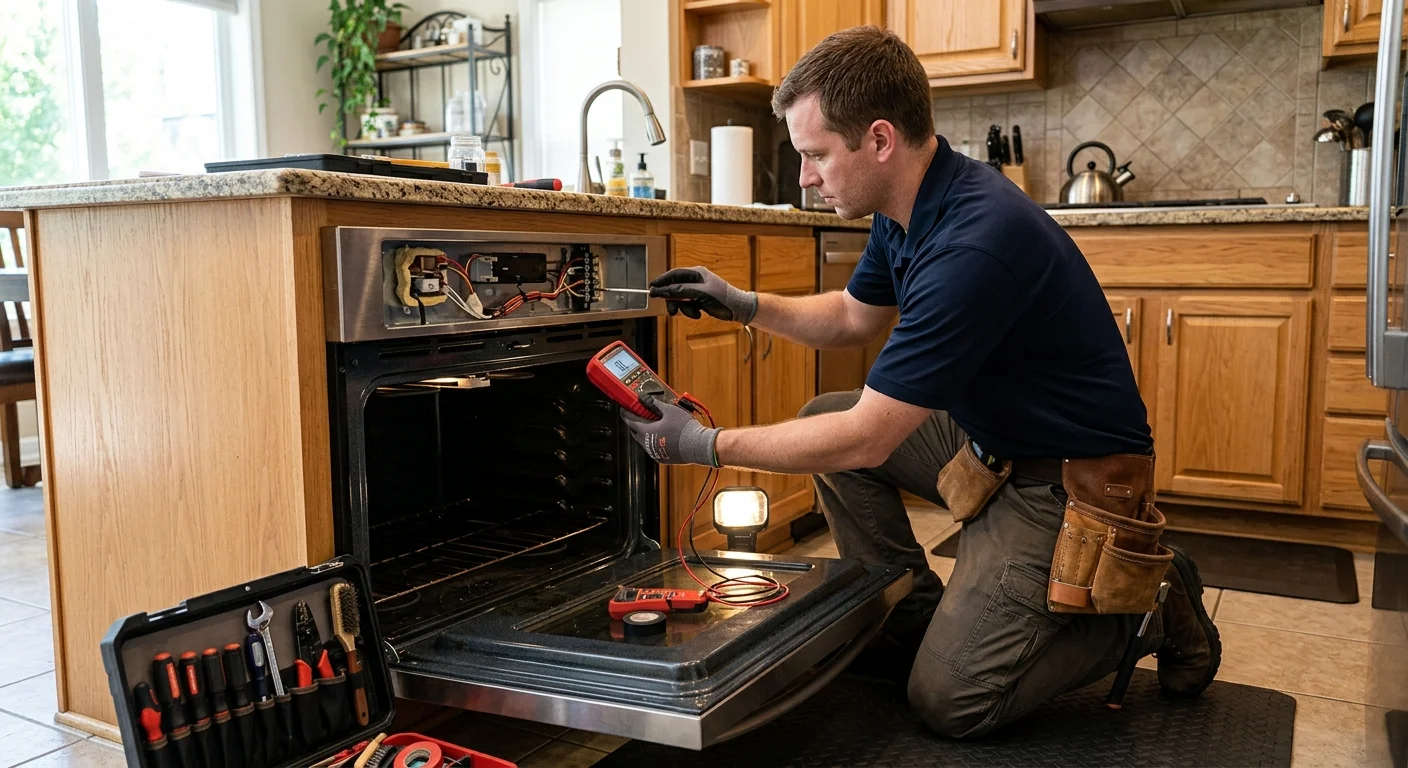
The bake cycle on a KitchenAid range can sit at room temperature while the cooktop still lights. That is a no-heat oven, not a weak one, and it usually shows up in a San Diego kitchen on a weeknight. KitchenAid appliance repair for that complaint starts with the model tag, the fuel type, and the exact heat pattern, then a matched local technician who can test the cavity.
Confirm the model and exact no-heat pattern
Write down the full model and serial before anyone talks about parts. On many KitchenAid free-standing ranges the tag sits on the frame around the oven door, or on the side of the storage drawer opening. On a built-in wall oven it is often on the left side of the cavity, visible with the door open. Photograph the whole label. A partial number sends the wrong tech sheet and the wrong part.
KitchenAid is a Whirlpool Corporation brand, so some boards and sensors look familiar to techs who already work that family. The tag still matters. A slide-in dual-fuel range in a Carlsbad remodel is not the same machine as a free-standing electric range in an El Cajon ranch house, and a double wall oven is two cavities with two heat paths. The model tells the matched technician which one you have.
Then name the heat pattern in plain words. A KitchenAid oven not heating is several different jobs:
The cavity never warms on bake, broil, or convection. Broil works and bake does not, or bake works and broil does not. The cooktop works and the oven does not. The oven heats a little, then stalls below the set temperature. The convection fan runs and the cavity stays cold. A gas oven clicks or the igniter glows, and there is still no flame. Only the upper or lower oven in a double wall unit is dead.
That list is the diagnostic. A bake-only failure points at a different circuit than a unit that is dark, silent, and locked. A KitchenAid range won’t heat the same way after a self-clean cycle as it does after a power blip. Coastal north county kitchens (Encinitas, Carlsbad, Solana Beach) often run dual-fuel or 36-inch ranges in remodelled spaces. East County and inland north county still have a lot of free-standing electric ranges on original 240-volt circuits. The housing is older, the hookup is older, and the first question is whether the oven even has clean power.
Do not guess the series from the door style. Superba, Architect, and commercial-style KitchenAid lines exist, and they do not all share one control. If you are not sure, the photograph of the tag is enough. Pair it with one sentence: what you set, what you heard, and whether any heat showed up in the first ten minutes.
If the oven is still under a written manufacturer warranty, keep the purchase date with the photos. California’s Song-Beverly Consumer Warranty Act requires manufacturers who make express warranties to start service in a reasonable time and to finish repairs within 30 days unless the delay is beyond the manufacturer’s control. That is a manufacturer duty, not a promise from this referral service. An independent technician can still be the right next call when the unit is out of warranty, or when you want a local diagnosis first.
What owners can observe without opening panels
Stay on the outside of the machine. You are collecting notes, not opening live panels or gas lines.
Set bake at a normal temperature and stand there for a few minutes. Note whether the display accepts the command, whether you hear a relay click, and whether the cavity gets any warmer than the room. Try broil next, then convection if the model has it. Write down which modes do nothing. A KitchenAid oven repair visit goes faster when the technician already knows bake is dead and broil is alive.
Look at the display. Photograph any code, word, or flashing icon before you clear it. Do not guess what the letters mean from a generic chart. KitchenAid ovens share a lot of logic with other Whirlpool-family controls, but the valid codes still live on that model’s tech sheet. A code after a self-clean, a door-lock icon that will not clear, or a control-lock padlock are all useful. A blank dark display on an electric range is useful too: check the range breaker, which is often a two-pole 240-volt breaker in the panel. If it has tripped, reset it once and see whether the oven comes back. If it trips again, leave it off.
On a gas range, if you smell gas, do not keep clicking the bake pad. Leave the house, and use 911 or SDG&E’s gas emergency line from outside. Do not go looking for a leak with the oven door open.
Other owner-level notes that help:
The door will not close or the latch feels stuck after a clean cycle. A child lock or control lock is on. The clock survived a brief outage, then bake stopped. Only the warming drawer or the cooktop still works. You recently had work on the range receptacle, the gas shutoff, or the island circuit.
Those notes sit next to the generic oven not heating troubleshooting checks: power, door, mode, and fuel. This page is narrower. It is the KitchenAid no-heat pattern in a San Diego house, including built-ins that sit in a cabinet with almost no airflow behind them, and slide-ins that share a wall with a dishwasher.
Do not pull the oven, remove the rear panel, or meter an element. Do not pull an igniter to “see if it glows better.” You can burn a board, crack a hidden bake element, or move a gas connection. The matched technician is the person who opens the cabinet.
If you want a second set of eyes on the brand as a whole, our KitchenAid appliance repair in San Diego hub covers the rest of the kitchen. This post stays on the oven that will not heat.
What technicians inspect on gas and electric ovens
Repair Pro San Diego matches you with an independent, insured local technician. The brand does not send a truck, stock parts, or hold a manufacturer authorization. The person at the range does the diagnosis and the repair.
On an electric KitchenAid oven, that inspection usually starts at supply. Many East County and inland homes still run a range on the original 240-volt receptacle. A loose range cord, a weak breaker, or a burnt terminal block can kill bake while the clock still looks fine. The technician then checks whether the bake element, the broil element, or a hidden element under the floor is open, blistered, or not getting a command from the control. A sensor that reads the wrong temperature can also keep the control from calling for heat, or it can call for heat and never satisfy the set point. Double wall ovens get both cavities tested, because one dead oven is not proof the other control is healthy.
On a gas KitchenAid oven, the cooktop can still light while bake stays cold. The matched technician is looking at whether the bake igniter glows and whether it is drawing enough current to open the safety valve. A weak glow with no flame is a common gas-oven story, and it is still a closed-panel, live-gas diagnosis. If you want the broader gas-igniter picture, we keep a separate gas oven igniter guide. Dual-fuel ranges add a twist: electric oven, gas cooktop, two utilities in one chassis. La Jolla, Rancho Santa Fe, and coastal remodels use that layout more than a 1970s El Cajon kitchen does.
The technician should also look at the door switch, the lock motor after a clean cycle, and the control board or touch overlay when buttons do not match what the cavity does. None of that is a parts list you should shop in advance. KitchenAid does not publish a public “this part always fails” chart that we can treat as a local fact, and this site will not invent one.
Ask the technician to put the diagnosis in writing before work starts, including what was tested and what they propose to replace. Ask whether their diagnostic fee is credited toward the repair. This referral service has no fee schedule and no parts inventory, so any dollar figure you hear is that technician’s quote, not ours. National cost guides do not currently sit in our claims file for oven jobs, so we will not paste a fake San Diego average here.
You can confirm that an appliance service dealer is registered with California’s Bureau of Household Goods and Services through the state’s license lookup. Registration is a dealer registration, not a skills exam. It is still worth checking before someone opens a gas valve or a live 240-volt range.
For the wider county picture of who handles ranges, wall ovens, and cooktops, see oven, range, and cooktop repair.
How controls and error codes change the next step
A dead element and a confused control can look the same from the dinner table. The next step changes once the display talks.
If the control is dark, the first question is power, then the control itself. If the control lights, accepts bake, and the cavity stays cold, the technician is chasing the heat path: element, igniter, sensor, relay, or valve. If the control refuses bake, flashes a code, or chirps and locks, stop pressing buttons and photograph the screen. Clearing a code without a photo throws away the only hint the board will give.
KitchenAid owner materials and the model’s tech sheet are the place for code definitions. We are not going to reprint a borrowed code table. Competitor pages do that, and the codes drift by platform. Bring the photo, the model, and the sequence: what you pressed, what the oven did, and whether a clean cycle or an outage happened first. After SDG&E work or a Public Safety Power Shutoff, some controls wake up in a fault or a lock that looks like a KitchenAid oven not heating. It may be a control state, not a failed bake element.
Touch overlays on glass controls fail in a different way. The display looks alive, one pad is dead, and bake never starts because the board never got a clean command. That is not something to fix with a household cleaner on the glass. If the overlay is peeling, say so in the notes.
Do not assume a factory lifetime warranty covers the oven. KitchenAid publishes limited warranties in the product literature that ships with the appliance. Those documents are the source for coverage, not a mixer-housing rumor and not this page. We could not confirm a current lifetime oven warranty in our claims ledger. If you are still in the written warranty window, call KitchenAid’s own support path as well, and keep the independent diagnosis. Song-Beverly still sets the 30-day repair clock for manufacturers on covered consumer goods.
Before anyone orders a board, it is fair to ask the technician to check CPSC recall listings against the model and serial. A recall is a specific campaign, not a vibe. If nothing is listed, say so and move on to the failed part in front of you.
When to request KitchenAid oven repair
Request a match when the oven stays cold after the owner notes above, when a breaker trips twice, when a code returns, or when bake heat is so uneven that food is raw on one rack and burnt on another. Request it immediately if you smell gas, see scorch marks at the range cord, or hear a rapid clicking that does not light.
A wall oven that is cold in a La Jolla or downtown condo is also a cabinet problem. Built-ins hide the junction box and the vent path. Do not slide the unit yourself. A free-standing range in Spring Valley or National City is easier to pull, and it is still a two-person, live-fuel job once the technician is there.
Repair versus replace is a quote, not a slogan. This site does not publish a “replace at half the cost of new” rule, and it does not invent a KitchenAid oven lifespan. Ask the matched technician what they found, what a repair would include, and what a replacement range or wall oven would mean for your existing hookup. Older 240-volt receptacles and older gas shutoffs in pre-1978 housing are part of that conversation in East County. Newer dual-fuel slide-ins on the coast are a different conversation.
If you already know you need oven repair in San Diego, bring the model photo and the heat-pattern notes. That is the difference between a focused KitchenAid oven repair visit and a generic “oven is broken” call.
When to call us
When a KitchenAid oven will not heat, or a KitchenAid range won’t heat while the cooktop still works, skip the live panels and request a matched local appliance repair pro. Call (858) 988-7787 to leave a voicemail requesting a match with a local appliance repair pro. The technician diagnoses the cavity, quotes in writing, and does the work.