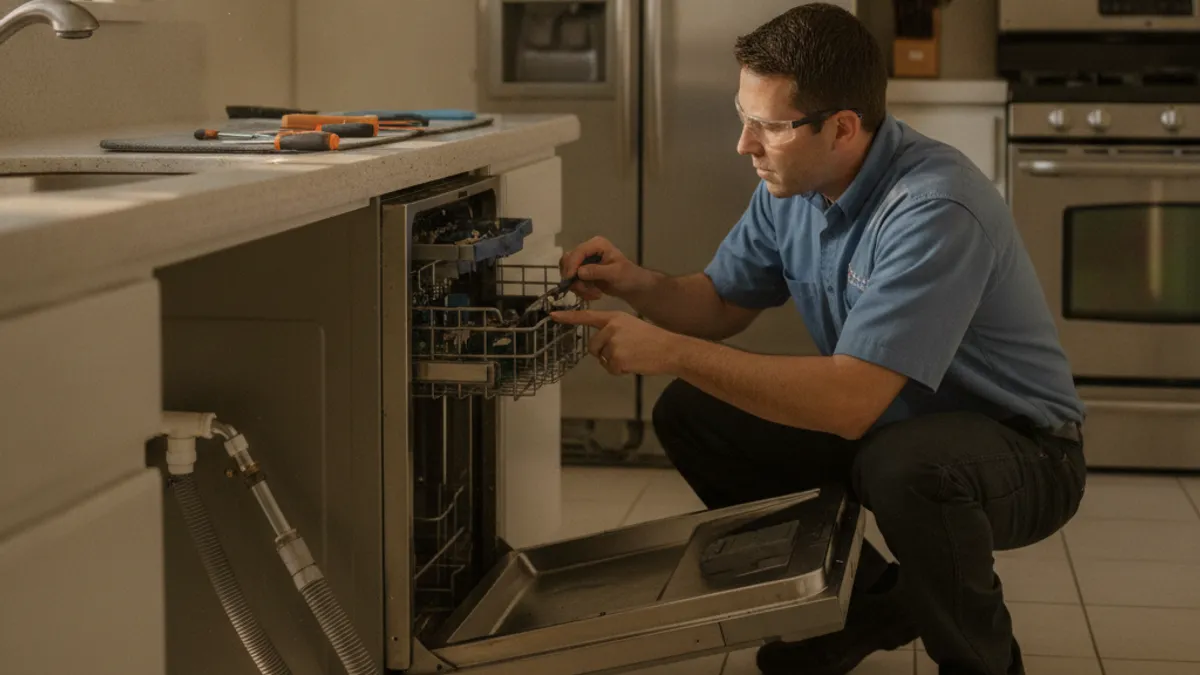
KitchenAid covers three appliances in most San Diego kitchens: the dishwasher, the range or wall oven, and sometimes the refrigerator. All three share something most homeowners don’t know. KitchenAid is built by Whirlpool Corporation, on the same manufacturing platforms as Whirlpool and Maytag, with different styling and a few brand-specific features layered on top. That matters when something breaks, because the failure points are largely the same across the lineup, even though the trim and control panel look different.
KitchenAid dishwashers: what actually fails
The most common call we get on a KitchenAid dishwasher is standing water at the bottom of the tub after a cycle. That almost always traces to the drain pump or a clogged check valve, not the whole unit. We’ve also written a full breakdown of that exact problem in our KitchenAid dishwasher not draining guide if that’s your symptom right now.
Beyond drainage, the next most common faults are the door latch, the control board, and the heating element used for the heated dry cycle. The latch on these units is a wax motor assembly on most models built in the last decade, and it wears out from thousands of open-close cycles rather than failing all at once. You’ll notice the dishwasher won’t start, or it starts and stops mid-cycle, before the latch fails completely. The control board itself rarely dies outright. More often, one input, like the water temperature sensor or the float switch, sends bad data and the board reacts by aborting the cycle or throwing an error code.
San Diego’s water plays a role too. Homes on inland well or municipal water with higher mineral content, common in East County communities like El Cajon and Santee, see faster buildup on the wash arm jets and the fine mesh filter under the lower rack. That buildup doesn’t damage the machine, but it does make dishes come out spotty or gritty, which owners often mistake for a mechanical fault.
KitchenAid ranges and wall ovens
Gas ranges have their own failure pattern. The igniter is the part that fails most, since it’s a wear item that glows and clicks with every burner light. When a burner won’t light at all, or it takes several tries, the igniter or the spark module is almost always the cause, not the gas valve. Electric ranges and wall ovens more commonly fail at the bake or broil element, or at the oven temperature sensor, which is a simple two-wire probe that drifts out of calibration over years of heat cycling. An oven that runs 25-50 degrees off what the dial says is a sensor problem nine times out of ten, not a control board.
Self-clean cycles are hard on these units. The extreme heat can warp door gaskets and occasionally trip the door lock mechanism so it won’t release after the cycle finishes. If that happens, don’t force the door. Let the oven cool fully first, since most models won’t unlock above a set internal temperature as a safety measure.
KitchenAid refrigerators
We cover refrigerator-specific failures in depth in our KitchenAid refrigerator repair guide, including the thermistor and defrost issues that account for most no-cooling calls on built-in and French door models. The short version: refrigerators fail differently than dishwashers and ranges because they run continuously, so wear shows up in the compressor, the evaporator fan, and the defrost system rather than in switches and latches.
What to check before you call
A few things take five minutes and rule out the easy causes:
- Dishwasher not starting. Confirm the door is latching fully and the child lock isn’t engaged. Check that the water supply valve under the sink is open.
- Range burner won’t light. Make sure the burner cap is seated correctly. A cap sitting even slightly crooked blocks the igniter spark from reaching the gas port.
- Oven temperature seems off. Verify with a separate oven thermometer placed on the middle rack before assuming the appliance is wrong. Many ovens run a little hot or cool by design and it’s still within spec.
- Refrigerator running warm. Check that the vents inside the fridge and freezer aren’t blocked by food packed too tightly. Blocked airflow is a common false alarm.
If none of that resolves it, the part that’s actually failing needs a multimeter and the KitchenAid spec chart to confirm, not a guess.
How we handle KitchenAid repairs
When you leave a voicemail, include the model number off the tag, usually inside the door frame on a dishwasher, inside the door on a range, or on the fridge’s interior wall, along with what the appliance is doing. That helps the matched technician prepare. If the kitchen has no working dishwasher, range, or fridge, say so in the message. The technician sets timing, quotes in writing, and confirms the repair before leaving.
For dishwasher issues, see our dishwasher repair service page. For ranges and ovens, see oven and range repair. Whatever brand or appliance is giving you trouble, call us at (858) 988-7787 and we’ll get a tech out.
Frequently asked questions
Are KitchenAid appliances the same as Whirlpool?
KitchenAid appliances are manufactured by Whirlpool Corporation and often share the same core components, motors, and control platforms as Whirlpool and Maytag models. The styling, some premium features, and the price point differ, but the parts that typically fail are similar across the three brands.
Why does my KitchenAid dishwasher have water in the bottom after a cycle?
Standing water almost always points to the drain pump or a clogged drain check valve, not a failed dishwasher. Food debris and grease buildup in the check valve is the most common cause we find on service calls.
How do I find my KitchenAid appliance’s model number?
On a dishwasher, look on the tub edge behind the door or on the door frame itself. On a range or wall oven, check inside the door frame or the storage drawer. On a refrigerator, check the interior side wall or behind the crisper drawer. Having this number ready before you call speeds up the repair.
Why is my KitchenAid oven temperature off from what I set?
A drifting temperature sensor is the most common cause, and it’s a simple, inexpensive part to replace. Confirm with an independent oven thermometer first, since a small variance is normal and within most manufacturers’ spec.
When to call us
Call us when a dishwasher won’t drain or start, a range burner won’t light consistently, an oven runs noticeably hot or cold, or a refrigerator won’t hold temperature. These point to a specific worn part, and chasing it yourself without the spec chart usually means guessing at parts that don’t need replacing. Call (858) 988-7787 and we’ll match you with a technician.