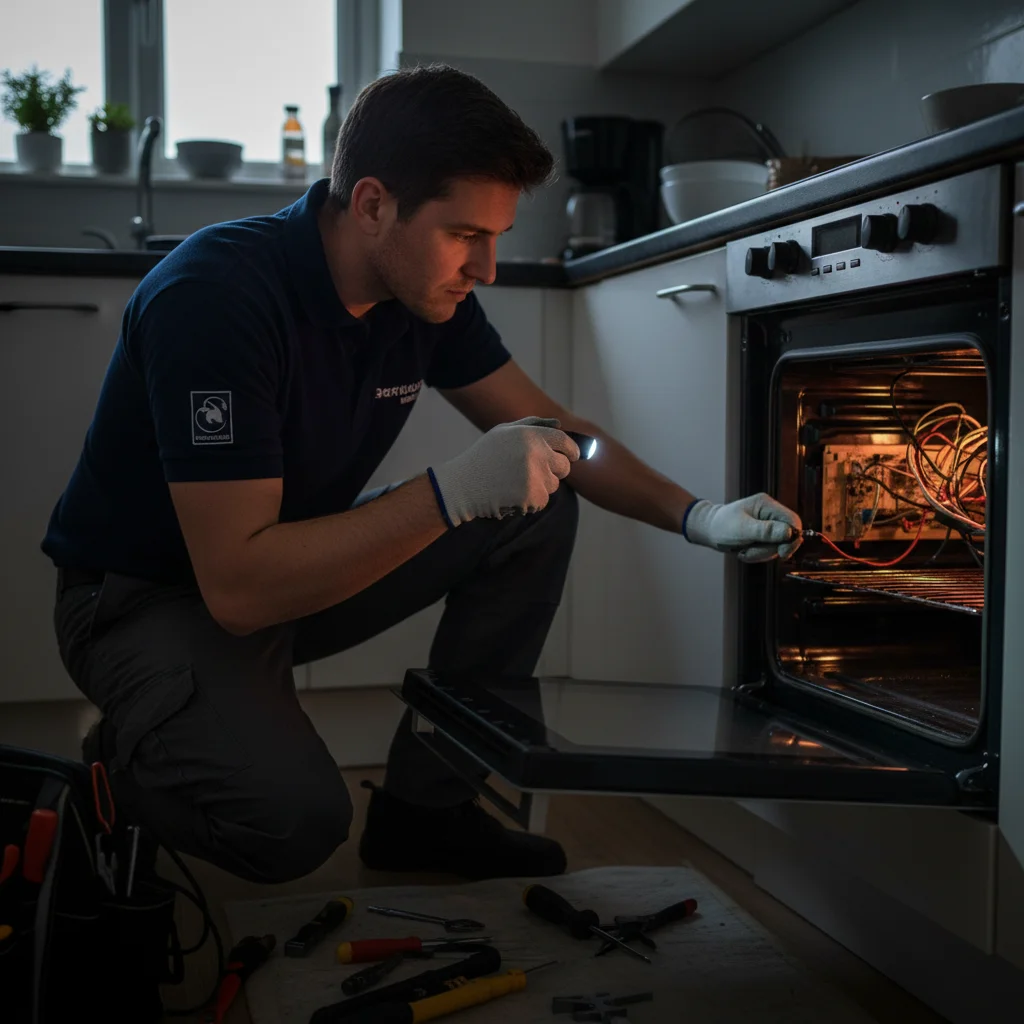
A gas oven igniter not working may stay dark, click without lighting, or glow while the burner remains cold. A glow-bar igniter must draw enough current to open the gas safety valve. When it weakens, it can glow without opening that valve. Diagnosis should follow the manufacturer’s instructions for the exact model. If you see, hear, or smell signs of a gas leak, leave immediately and call 911 or SDG&E from a safe location.
Stop if you smell gas
Do not keep restarting the bake cycle when the burner does not light.
If you see, hear, or smell signs of a gas leak, leave the area immediately. From a safe location, call 911 or SDG&E at 1-800-411-7343. Do not stop to disconnect power, operate a valve, or continue troubleshooting before leaving. This follows SDG&E’s gas-appliance safety guidance.
Our gas range safety checklist covers general maintenance after emergency authorities or the utility have addressed the immediate hazard.
A weak glow-bar igniter often keeps the safety valve closed. That means there may be no gas smell at all. Gas odor without a flame needs separate attention and shouldn’t be treated as proof of a weak igniter.
How to tell whether the igniter is failing
When there are no signs of a gas leak, start with the owner’s manual for the exact model. Do not remove access panels or disturb a gas connection to identify the problem.
Some ovens use a glow-bar igniter. Others use a spark system that clicks. A spark electrode doesn’t glow, so clicking without an orange glow isn’t automatically a failed glow bar.
Watch for these patterns:
| What you observe | What it suggests | Safe next step |
|---|---|---|
| The igniter stays dark | Failed igniter, lost power, damaged wiring, or a control problem | Turn the oven off and arrange electrical testing |
| The igniter glows and the burner lights | The ignition sequence may be operating | Compare operation with the owner’s manual |
| The igniter glows but the burner does not light | The igniter, valve, wiring, or control may need testing | Stop using the oven and arrange qualified service |
| The oven clicks but never lights | The oven may use spark ignition | Stop using the oven and arrange qualified service |
| You see, hear, or smell signs of a gas leak | A possible gas leak needs an emergency response | Leave immediately; call 911 or SDG&E from a safe location |
Timing varies by model, so a generic threshold does not prove which component failed. The owner’s manual remains the reference for normal operation, and electrical testing is needed to distinguish an igniter problem from a valve, wiring, or control failure.
The important detail is that brightness alone doesn’t prove the igniter works. It can look hot while remaining electrically weak. That is why a glowing igniter is still a common cause when a gas oven won’t heat.
Our broader oven-not-heating guide covers controls, sensors, and other causes when the igniter stays dark.
Why a glowing igniter may not light the burner
A glow-bar igniter sits in the gas valve’s electrical circuit. As the bar heats, its electrical behavior changes. Once it draws the required current, the safety valve can open and release gas to the burner.
An aging igniter may still turn orange. However, it may never draw enough current to open the valve. The oven then appears partly alive while producing no flame or heat.
That symptom is different from a gas valve that receives the correct current but doesn’t open. A technician can measure current during the ignition cycle and test the remaining circuit. That separates a weak igniter from a valve, wiring, or control failure.
Never bypass the safety valve to test it. That removes the safeguard designed to prevent gas flow during an incomplete ignition sequence.
Who should replace a gas oven igniter?
Igniter replacement can require opening the appliance, matching electrical requirements, and working around the gas ignition system. Use a qualified appliance professional and the manufacturer’s service information for the exact model. Do not disturb a gas connection or remove panels while investigating a suspected leak.
The techs in our network handle this diagnosis through oven and range repair service after any gas-leak hazard has been addressed.
What else can cause the same symptoms?
An igniter isn’t the only possible cause. A damaged wire, loose connector, control-board fault, or failed gas valve can produce a similar no-heat condition.
A completely dark igniter doesn’t identify the failed part by itself. The igniter may be open, but it also may not be receiving power. Testing continuity with the appliance disconnected can check the igniter. Voltage and current tests during operation belong with someone trained to work around energized gas appliances.
Temperature problems after the burner lights point elsewhere. Long preheats, temperature swings, and undercooked food may involve the sensor or controls. Use the oven-temperature troubleshooting guide for those symptoms.
San Diego’s coast adds one more inspection point
Coastal salt air can speed corrosion at electrical contacts and connector terminals. Indoor appliances get less exposure than outdoor equipment, but humid marine air still enters kitchens and cabinet spaces.
Homes in Coronado, Point Loma, Pacific Beach, La Jolla, and Ocean Beach should put connector corrosion higher on the inspection list. Homes farther inland, including El Cajon and Escondido, generally face less direct salt-air exposure.
Corrosion doesn’t prove the igniter failed. It can interrupt power to a good igniter or damage the connector during removal. White or green residue, heat discoloration, and loose terminals should be addressed before a new part is installed.
Homeowners near the coast can request a local match through the Coronado appliance repair page.
What does professional igniter replacement cost?
There isn’t one flat price for gas oven igniter replacement. The exact part, model design, access depth, connector condition, and required diagnosis all affect the total.
A freestanding range with front-accessible wiring is usually simpler than a double wall oven. Corroded terminals or damaged wiring can also expand the job beyond a basic part swap.
See the San Diego oven repair cost guide for the factors behind a local estimate. Ask the technician about their diagnostic fee and whether it is credited toward the repair. The matched technician diagnoses first and quotes in writing before work begins.
Gas igniter problems versus electric element failures
A gas oven igniter failure isn’t the same as an electric heating-element failure. Electric bake elements may show a bulge, break, blister, or scorch mark. A weak gas igniter often shows no visible damage and may still glow brightly.
That difference makes electrical testing more useful than appearance. Confirm whether the oven is gas or electric before ordering any heating part.
Frequently asked questions
Why does my gas oven igniter glow but not light?
A glowing igniter may be too weak to open the gas safety valve. It can reach an orange color without drawing the required current. Current testing distinguishes that failure from a valve, wiring, or control problem.
How long should a gas oven igniter glow before lighting?
The exact timing depends on the oven model. Use the owner’s manual for the normal ignition sequence. A generic number cannot confirm that the igniter failed.
Can I replace a gas oven igniter myself?
Use a qualified appliance professional when the repair involves panels, wiring, or the gas ignition system. The replacement and service procedure must match the exact model.
Is it safe to keep trying a gas oven that won’t ignite?
No, repeated attempts are not a safe troubleshooting method. If you see, hear, or smell signs of a gas leak, leave immediately and call 911 or SDG&E from a safe location.
How do I know whether it’s the igniter or gas valve?
An amperage test during ignition provides the clearest answer. Low current with a glowing igniter points toward the igniter. Correct current without valve operation shifts attention toward the valve, wiring, or control circuit.
Why is my gas oven clicking but not lighting?
A clicking oven may use a spark electrode instead of a glow-bar igniter. The problem could involve the electrode, its wiring, the control, or gas delivery. Stop using the oven if it does not light. If you see, hear, or smell signs of a gas leak, leave immediately and call 911 or SDG&E from a safe location.
Get matched with a local oven technician
Stop using the oven when ignition is unreliable. If you see, hear, or smell signs of a gas leak, leave immediately and call 911 or SDG&E from a safe location. After the hazard has been addressed, note the model number and describe the problem when requesting an appliance technician.
Call (858) 988-7787 and leave a message to request a match with a local appliance technician.