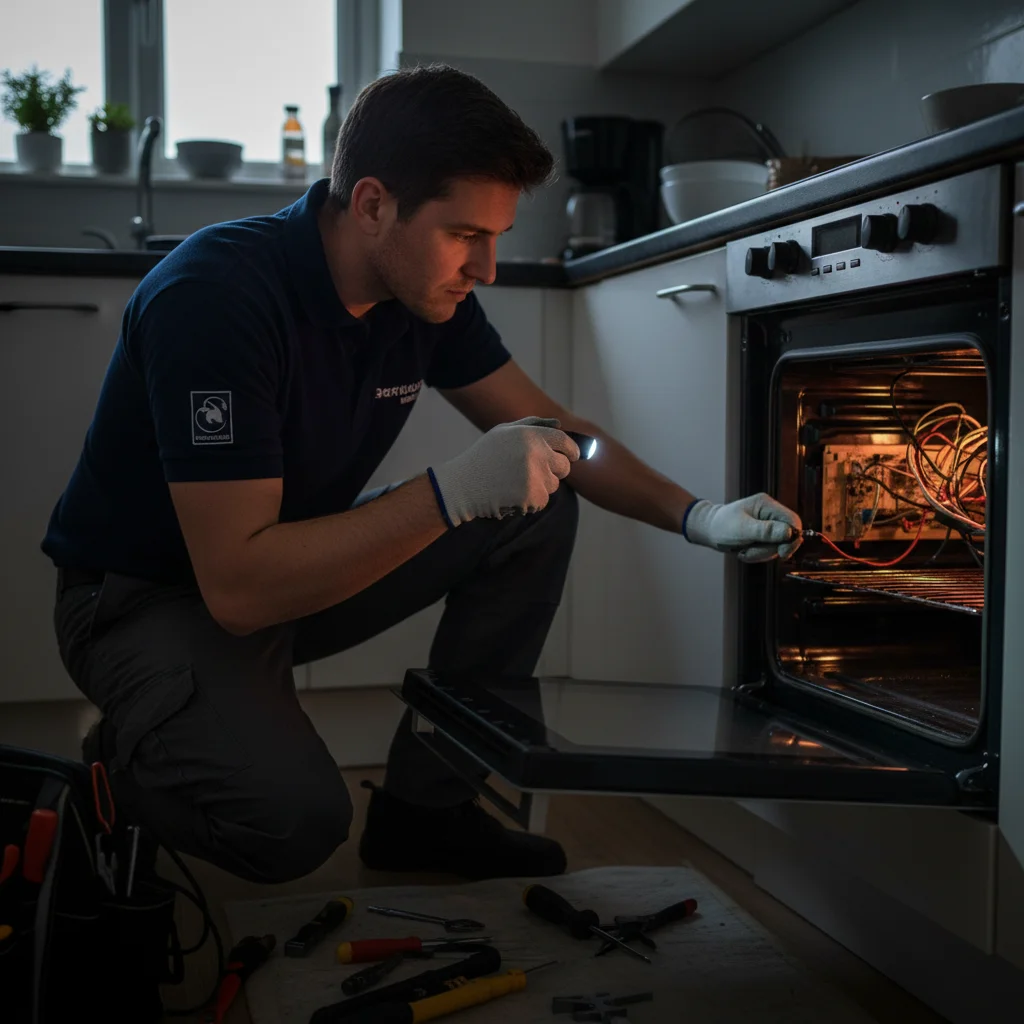
You’ve prepped the lasagna, set the oven to 375°F, and slid it in. An hour later, the cheese is still unmelted and the kitchen is stubbornly room temperature. An oven that won’t heat is disruptive. Owner checks stay at the breaker, the display, and the cooking mode. Valves, igniters, and amp readings belong to a technician.
If you see, hear, or smell signs of a gas leak, leave the area immediately. From a safe location, call 911 or SDG&E at 1-800-411-7343. Do not operate a shut-off valve, watch an igniter, or begin appliance troubleshooting before leaving. This follows SDG&E’s gas-appliance safety guidance. After emergency authorities or the utility have addressed the hazard, request a technician match.
First: breaker, display, and cooking mode
Start with what you can see without moving the range or opening a gas fitting.
For an electric oven not heating, go to the circuit breaker panel. Find the breaker for the oven. It is usually a large, double-pole breaker. If it looks tripped or sits between on and off, flip it fully off, then firmly back on. Check the oven display. If the clock and controls are dark, you have a power-supply question, not a confirmed heating-part failure. Some ovens have a Sabbath or Demo mode that disables heating. Use the owner’s manual for that exact model to confirm the mode is off.
For a gas oven, stay at observation. Note whether the display accepts Bake, whether a preheat message appears, and whether any code shows. Do not check a shut-off valve behind the range. Do not light burners as a gas-line test from this page. If you already left for a suspected leak, wait for 911 or SDG&E before arranging appliance service.
Electric oven: bake and broil observation only
In an electric oven, heat comes from the bake element at the bottom and the broil element at the top. You can look through the door after selecting a mode. Do not unplug, pull, or replace an element from this page.
With the oven cool, you may look at the bake and broil elements for obvious blisters, cracks, or a clean break. Visible damage is a clue for the technician. It is not a DIY replacement instruction.
If the elements look intact, you can select Bake, then Broil, and record whether either begins to glow. Do not touch an element. If one mode heats and the other does not, write that down. If neither responds, say so. Those notes help the person who will meter the circuit.
If you are not sure what you are seeing, request oven and stove repair. The matched technician diagnoses first and quotes in writing before work begins.
Gas oven: do not test the igniter or the valve
The most common internet advice for a gas oven that won’t heat is to watch the igniter and compare amp draw. Do not do that from this page. Igniter glow, amp thresholds, and the gas safety valve are technician checks. They involve the gas system.
Set Bake only if there is no suspected leak and the area is already cleared by 911 or SDG&E when a leak was involved. Record whether the display changes and whether the cavity stays cold. Do not remove the oven floor. Do not look for a whoosh of ignition as a repair step.
Use our gas range safety checklist for leak response. Then request a match for diagnosis.
Control board and thermostat, when owner checks end
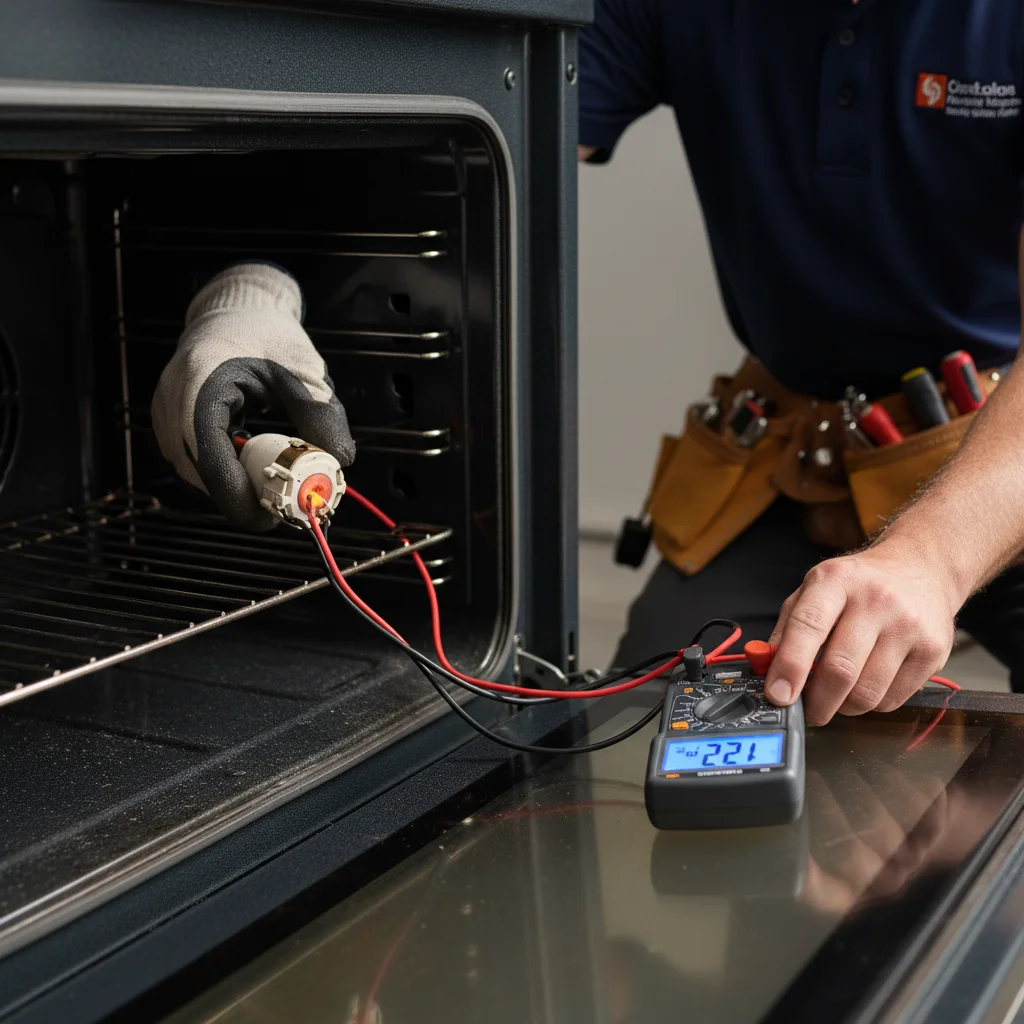
If power, display, and mode all look normal and the cavity stays cold, the next inspection points can include the temperature sensor, thermostat, or electronic control board. Those need a meter and the model’s wiring map. Replacing a control board on a guess wastes money. This is where owner troubleshooting stops.
Why a calibrated oven thermometer still helps
Sometimes an oven that “won’t heat” is heating, just not to the temperature you set. An oven running far below the setpoint can ruin a recipe. Before you assume a major part failed, a dedicated oven thermometer can separate a no-heat problem from a calibration problem.
- Place the oven thermometer on the center rack. Don’t let it touch the oven walls.
- Preheat to 350°F.
- Wait for the preheat light to go off, then wait another 15-20 minutes so the cavity can cycle.
- Read the thermometer through the door window.
If the thermometer is well below the setpoint, you may have a regulation problem rather than a totally dead element. Many ovens allow user calibration. Check the manual. Large offsets still need a technician to test the sensor. Do not treat a 50 or 75 degree miss as a universal failure rule.
Repair versus replacement is a written quote
Repair versus replace depends on the diagnosis, parts availability, and the rest of the appliance. There is no 50% rule on this site. Age bands such as 10 to 15 years are typical ranges on this site, not a measured lifespan for your range. See how long do appliances last and repair or replace an appliance. Ask the independent technician for an itemized quote.
Frequently asked questions
Why won’t my gas oven heat even though the igniter glows?
Glow does not confirm a healthy igniter or an open gas valve. Amp thresholds and valve operation belong to a technician. If you see, hear, or smell a leak, leave and call 911 or SDG&E at 1-800-411-7343 from a safe location before any appliance request.
How do I know if my electric oven’s bake element is the problem?
Record whether the bottom element stays dark in Bake while Broil still glows, or whether you already see a crack or blister. That is an observation for the technician. It is not an owner replacement step from this page.
What does an oven thermostat do and how does it fail?
The thermostat or temperature sensor tells the control when to cycle heat on and off. A failed sensor can report that the oven is already at temperature when it isn’t. Confirming that takes a meter. An oven thermometer that reads far below the setpoint is a clue, not a confirmed part.
When is it cheaper to replace a range than repair it?
There is no percentage cutoff on this site. Compare the written repair quote to a comparable new range, the rest of the unit’s condition, and parts availability. The matched technician quotes before work begins.
When to call us
If breaker, display, and mode checks do not restore heat, or if the work would touch gas or 240-volt parts, leave a voicemail at (858) 988-7787. Repair Pro San Diego matches homeowners with independent technicians across San Diego County.