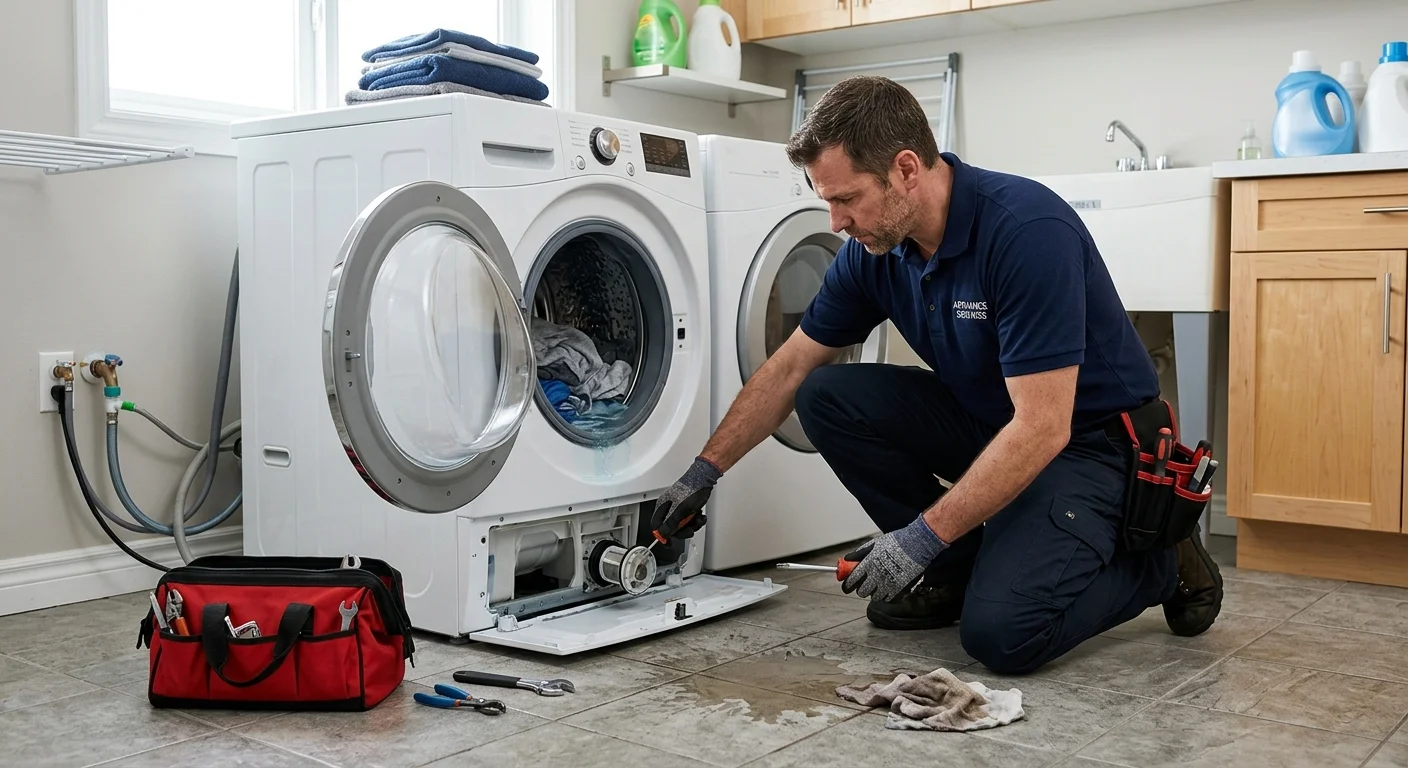
Standing water after a cycle signals an Electrolux washer drain problem. First, confirm where the cycle stopped, note any display code, and inspect the visible drain hose. If water remains or the problem returns, request Electrolux washer repair instead of guessing at the pump.
Confirm the model and failed drain stage
Start with the complete model and serial number. Electrolux materials place that information on a label inside the washer door. Take a clear photo rather than copying a long number by hand. That number lets a technician check the correct parts diagram and service information.
Next, identify exactly when the problem appeared. Did the washer stop after washing, during rinsing, before final spin, or after the display showed a completed cycle? Note whether the drum still holds a full load of water or only a shallow amount.
Check the screen before pressing more buttons. Photograph every code, message, and flashing indicator. Electrolux’s guidance for code E21 says the code means water isn’t pumping out fast enough or takes too long to empty. E21 identifies a drain delay, but it doesn’t prove the pump itself has failed.
Also record anything that changed recently. A moved washer may have a pinched hose. A newly installed unit may have a drain connection problem. A load that stopped once creates a different complaint than one that fails during every cycle.
Keep these details together:
- Complete model and serial number
- Selected cycle and options
- Last stage reached
- Display code or message
- Approximate water level in the drum
- Any pump sound during the drain stage
- Recent installation, movement, or plumbing work
That short record gives an Electrolux washing machine repair technician a useful starting point.
What owners can observe without opening the washer
Begin with the parts you can see. Look behind or beside the washer without moving a stacked unit. Check the visible drain hose for a sharp bend, flattening, or pressure against the wall. Electrolux lists a kinked or restricted drain hose among the first checks for E21.
Look where the hose enters the standpipe or laundry sink. Note whether water rises from that drain when the washer tries to empty. A backup at the home drain points toward a plumbing restriction rather than an internal washer failure. Tell the technician what you saw, but don’t disconnect hidden plumbing or remove washer panels.
Confirm that the cycle isn’t paused and that Delay Start wasn’t selected. Then consult the exact owner’s guide before using any cancel, reset, drain, or spin command. Controls differ between models. A button sequence from another Electrolux washer may not apply to yours.
Listen during one drain attempt. A hum with no visible discharge differs from complete silence. Pulsing, grinding, or repeated stopping also matters. Record the sound from a short distance if possible. Don’t claim a diagnosis from the noise alone.
Watch for these exterior clues:
- Water remains after the display reports completion
- The cycle stalls before final spin
- The pump sounds active, but little water leaves
- The standpipe fills or overflows during discharge
- The drain hose shifts when pumping begins
- An E21 code returns after the hose is straightened
Avoid opening a filter cover unless your model’s owner guide identifies it as an owner-accessible part. Electrolux designs vary, and trapped water may release when a drain path opens.
Once the drainage fault is fixed, lingering odor may need separate care. Our front-load washer mildew guide covers routine cleaning without treating it as a drain repair.
How control and spin symptoms narrow the complaint
Drain, spin, and control symptoms often overlap. A washer may delay or skip a high-speed spin while water remains. That can make a drain complaint look like a motor problem. Record the order of events instead of reporting only that the washer “won’t finish.”
An E21 code makes slow pump-out the main complaint. It doesn’t identify whether the restriction sits in the hose, an internal passage, a filter, or the pump area. No code doesn’t rule out drainage trouble either. The water level and cycle behavior still matter.
Compare the symptoms carefully:
- If water stays in the drum and spin never begins, drainage is the first path to inspect.
- If the tub empties but clothes remain unusually wet, describe it as a spin complaint.
- If the display goes dark, buttons stop responding, or the cycle never starts, note that separately.
- If the door stays locked, record when that happened and whether water remains visible.
- If a code clears and returns on the next load, photograph both appearances.
Our general guide to a washer that won’t drain explains how household drainage, load conditions, and internal components can produce similar symptoms. For an Electrolux model, the exact service information still controls the diagnosis.
Repeated resets can erase the sequence a technician needs to see. Write down the code and cycle stage first. If the owner’s guide provides a model-specific control step, follow that wording. If the washer still holds water, leave the internal checks to the matched pro.
What technicians inspect along the drain path
A technician usually starts outside the cabinet. The hose route, drain connection, and observed discharge can rule out installation and household plumbing problems. This also prevents replacing an internal part when the restriction sits beyond the washer.
The internal inspection depends on the model. The technician may trace the path from the tub to the pump, then from the pump to the outlet hose. Depending on the washer, that can include a filter or trap, internal hoses, pump housing, impeller, wiring, connectors, water-level sensing parts, and control output.
Each finding answers a different question. A physical obstruction can stop an otherwise working pump. A damaged impeller may produce sound without moving enough water. A silent pump complaint may require electrical checks before anyone condemns the pump. A pressure-sensing fault can affect how the control interprets the remaining water.
Access also matters. A front-loader beneath a counter, inside a narrow closet, or paired in a stacked setup may require added preparation. Tell the matcher about stairs, gates, parking access, and the installation layout. Those details help identify an appropriate independent technician.
Ask the technician to separate washer findings from home-drain findings. The written diagnosis should name the failed or restricted area and the proposed work. Ask about the technician’s diagnostic fee and whether it’s credited toward repair. The matched technician diagnoses first and quotes in writing before work begins.
California appliance repair businesses must register with the Bureau of Household Goods and Services. Consumers can check a service dealer through the state’s Department of Consumer Affairs lookup. Repair Pro San Diego makes referrals and doesn’t perform the inspection or repair.
When to request Electrolux washer repair
Request service when standing water returns after the visible hose is checked. An E21 code that repeats also deserves diagnosis. Other strong reasons include an inaccessible drain path, unusual pump noise, a stalled cycle, or water that never reaches the standpipe.
Gather the model photo, code photo, and cycle notes before requesting a match. Include whether the washer is freestanding, under a counter, or stacked. For San Diego County matching, give the full address and access notes. That’s useful whether you’re near I-5 in Chula Vista, SR-94 in La Mesa, or I-15 in Escondido.
Check your purchase records and contact Electrolux to confirm current warranty coverage. Coverage can’t be determined from the symptom alone.
Repair Pro San Diego can match you with a licensed, insured, independent local technician through its washing machine repair service. The broader San Diego washing machine repair guide explains what information helps when requesting local service.
When to call us
Call when water remains after exterior checks, E21 returns, or the drain path requires cabinet access. We match San Diego County homeowners with licensed, insured, independent appliance repair pros, and the matched pro performs the diagnosis and repair. Call (858) 988-7787 to leave a voicemail requesting a match with a local appliance repair pro.