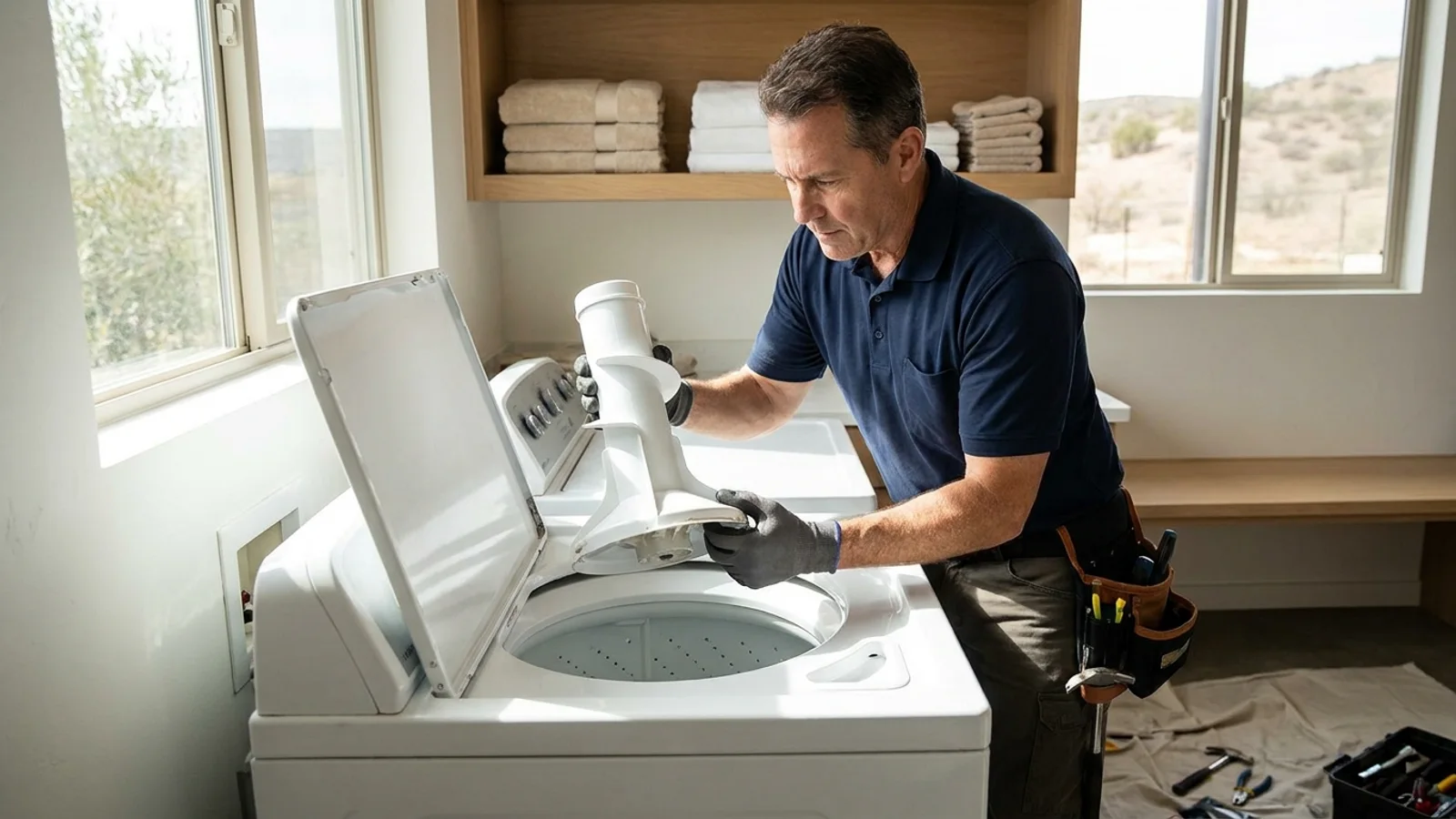
If your washer fills, runs, and drains but the agitator won’t twist back and forth, the part that’s usually broken is inexpensive: the agitator dogs (small plastic teeth or cams inside the agitator base) have worn down and are slipping instead of gripping. That’s an inexpensive repair in San Diego, not a new washer. A broken drive belt or worn motor coupler causes the same symptom and costs about the same to fix.
What makes a washer agitator stop working
Almost every non-agitating washer traces back to one of four parts, and which one it is depends on how the machine is built.
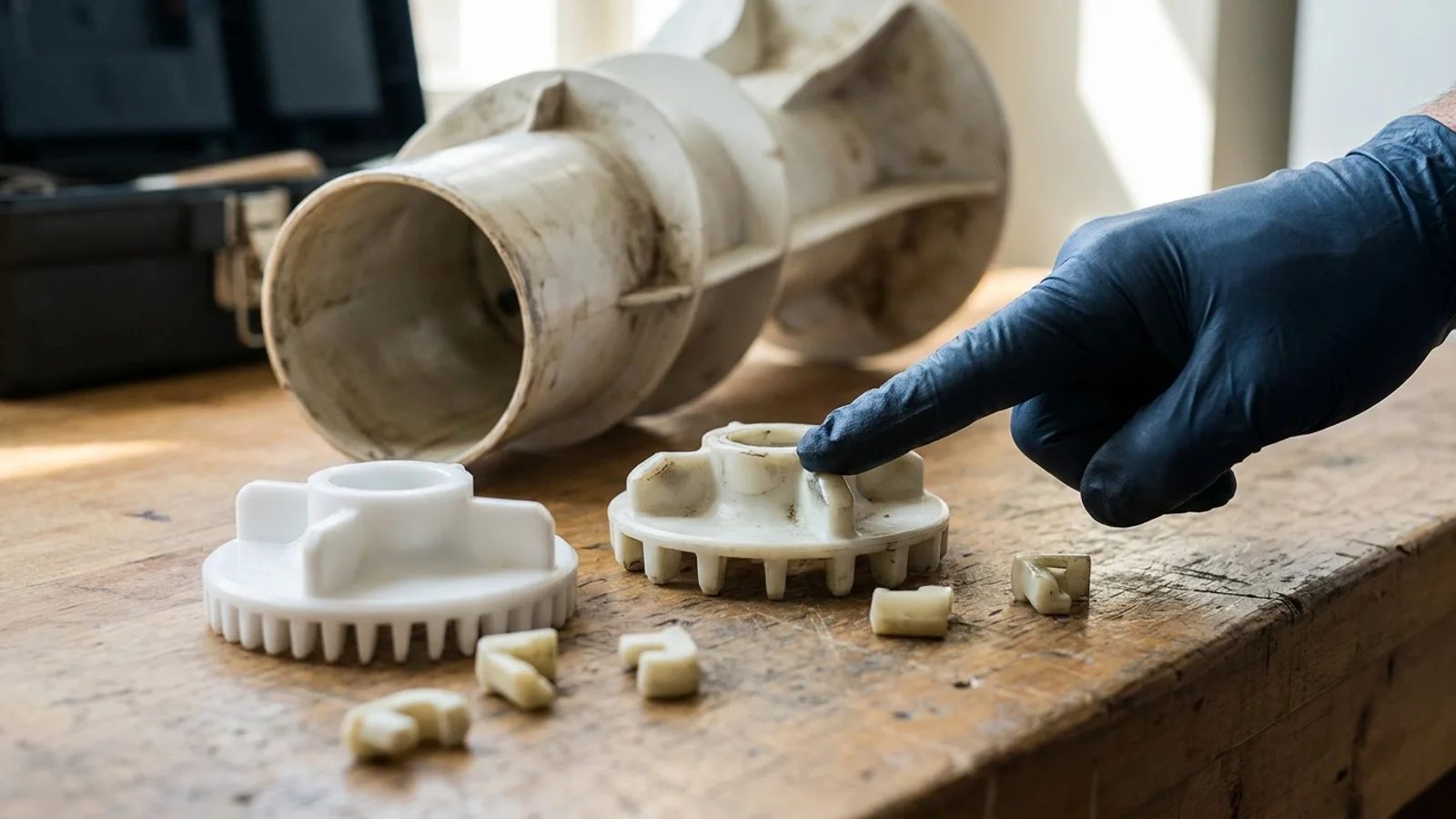
Worn agitator dogs or cam. On most top-load agitator washers, the agitator isn’t solid. Inside its base sits a set of small plastic teeth called dogs, or a cam kit, that grip a splined shaft and convert the motor’s spin into the agitator’s back-and-forth twist. Those teeth wear round with age and start slipping instead of catching, so the tub spins, the water churns a little, but the agitator barely moves or doesn’t move at all.
Broken or slipped drive belt. On belt-drive washers, a cracked or slipped belt keeps the drum spinning for the drain and spin cycles but can’t deliver enough torque to drive the agitator, especially with a full, heavy load.
Worn motor coupler. On direct-drive washers, particularly older Whirlpool and Kenmore models, a small plastic coupler connects the motor to the transmission and is designed to fail before the transmission does. A worn coupler often means the machine agitates weakly, or stops agitating but still spins.
Failed transmission. Less common and pricier to fix. If the dogs, cam, belt, and coupler all check out, the transmission itself may have stripped internally, and on many machines that repair cost gets close to replacement value.
How to tell which part failed
Unplug the washer first. Open the lid and grab the top of the agitator with both hands, then try to twist it side to side while holding the tub steady with your other hand. A healthy agitator resists and springs back. One with worn dogs or a stripped cam twists loosely with almost no resistance, like a stick in a socket that’s too big for it.
If the agitator feels tight by hand but still won’t move during a cycle, listen from outside the closed lid at the start of an agitation cycle. A clicking or ratcheting sound under the agitator points to dogs that are catching intermittently. A rhythmic slapping sound points to a slipping belt. Silence with the tub still spinning normally points to the motor coupler. Testing the washer live with the lid switch held open or bypassed is a technician’s job, not a DIY step.
Agitator not moving but the tub still spins
This combination almost always means the problem is isolated to the agitator’s drive linkage, not the main motor, since the motor is clearly working well enough to spin the tub for the drain and spin cycles. That’s good news for the repair bill: a motor or main control board replacement is among the priciest fixes on this list, close behind a transmission replacement, while an agitator dogs, cam kit, belt, or coupler swap costs noticeably less. If the tub isn’t spinning either, the fault is upstream at the motor or lid switch, and our washing machine repair in San Diego guide covers that separately.
Agitator vs. impeller washers
If you’re shopping for a replacement or just wondering why a newer washer in your house doesn’t have this problem, it’s worth knowing the difference. An agitator washer has a tall center post that twists clothes back and forth through the water. An impeller washer replaces that post with a low, cone-shaped plate at the bottom of the tub that spins to create currents, and clothes tumble against each other instead of around a post. Impeller and high-efficiency washers hold more laundry per load and are gentler on fabric, but agitator washers generally clean heavily soiled loads faster and are simpler, cheaper machines to repair when something does go wrong. Our top-load vs. front-load washer guide covers the fuller buying picture, including where impeller models fit in.
How much does washer agitator repair cost in San Diego?
| Repair | Relative cost |
|---|---|
| Agitator dogs or cam kit | Cheapest fix on this list |
| Drive belt replacement | Low, similar to a dogs or cam kit swap |
| Motor coupler replacement | Moderate, a bit more than a belt or dogs kit |
| Transmission replacement | The priciest of these repairs, high enough that it starts to approach the cost of replacing the washer |
Ask the technician about their diagnostic fee and whether it’s credited toward the repair, so confirming which part failed doesn’t cost extra on top of the fix. The matched technician diagnoses first and quotes in writing before work begins. For the full range of what other washer repairs run, see our washing machine repair cost guide for San Diego.
DIY replacement vs. calling a pro
An agitator dogs or cam kit is one of the more DIY-friendly washer repairs. On most top-load machines the agitator lifts straight off or comes free after removing a single cap and bolt at the top, and the dogs kit itself is a snap-in part that doesn’t require special tools. Look up the kit by your model number rather than by brand alone, since dogs and cams aren’t interchangeable across model lines.
A drive belt or motor coupler swap is a bigger job. Both usually mean pulling the cabinet or tipping the washer back to reach the motor and transmission from underneath, and a coupler replacement often requires removing the motor entirely. If you’re not comfortable working under a tipped washer, that’s a reasonable point to call in a washing machine repair technician instead of turning an inexpensive part into a cracked tub or a pinched hand.
Either way, a washing machine repair visit starts with the same hand-twist and listen test described above, so you’re not paying to have someone tell you what you already worked out.
Frequently asked questions
Why does my washer fill and drain but the agitator won’t move?
The motor and drain pump are working fine; the failure is isolated to the parts that transfer the motor’s power to the agitator itself, most often worn dogs inside the agitator base, a slipping drive belt, or a worn motor coupler. All three are common, inexpensive fixes rather than signs the machine is dying.
Can I fix a washer agitator myself?
Replacing the dogs or cam kit inside the agitator is a reasonable DIY job on most top-load washers since the agitator lifts off with basic tools. A drive belt or motor coupler replacement is more involved and usually means accessing the machine from underneath, which is where most DIYers hand it off to a technician.
How much does it cost to fix a washer agitator?
An agitator dogs or cam kit repair is the least expensive fix on this list, parts and labor included. A drive belt or motor coupler runs somewhat more. A full transmission replacement is the priciest of the four, high enough that it starts to approach the cost of a replacement washer.
Is a washer with a broken agitator worth repairing?
In almost every case, yes. Agitator dogs, cam kits, belts, and couplers are inexpensive parts, and the failure doesn’t indicate the machine’s motor or electronics are failing. It’s only worth weighing repair against replacement if the transmission itself has failed on a washer that’s already 10 or more years old.
Why does my washer agitate weakly instead of not at all?
Weak or partial agitation usually means the dogs or cam are partially worn rather than fully stripped, so they catch some of the time and slip the rest. It’s the same fix as a fully failed agitator, just caught a little earlier, and it won’t get better on its own.
When to call us
If you’ve done the hand-twist test and the agitator moves loosely, or you’re hearing a clicking or slapping sound during the wash cycle, the technicians in our network can confirm which part failed and get it swapped. The network covers all of San Diego County, from Chula Vista to North County, with emergency appliance repair available when a full laundry backlog can’t wait. If the washer isn’t spinning at all rather than just failing to agitate, our washer won’t drain guide covers that related failure separately.
Call (858) 988-7787 to get a technician scheduled.