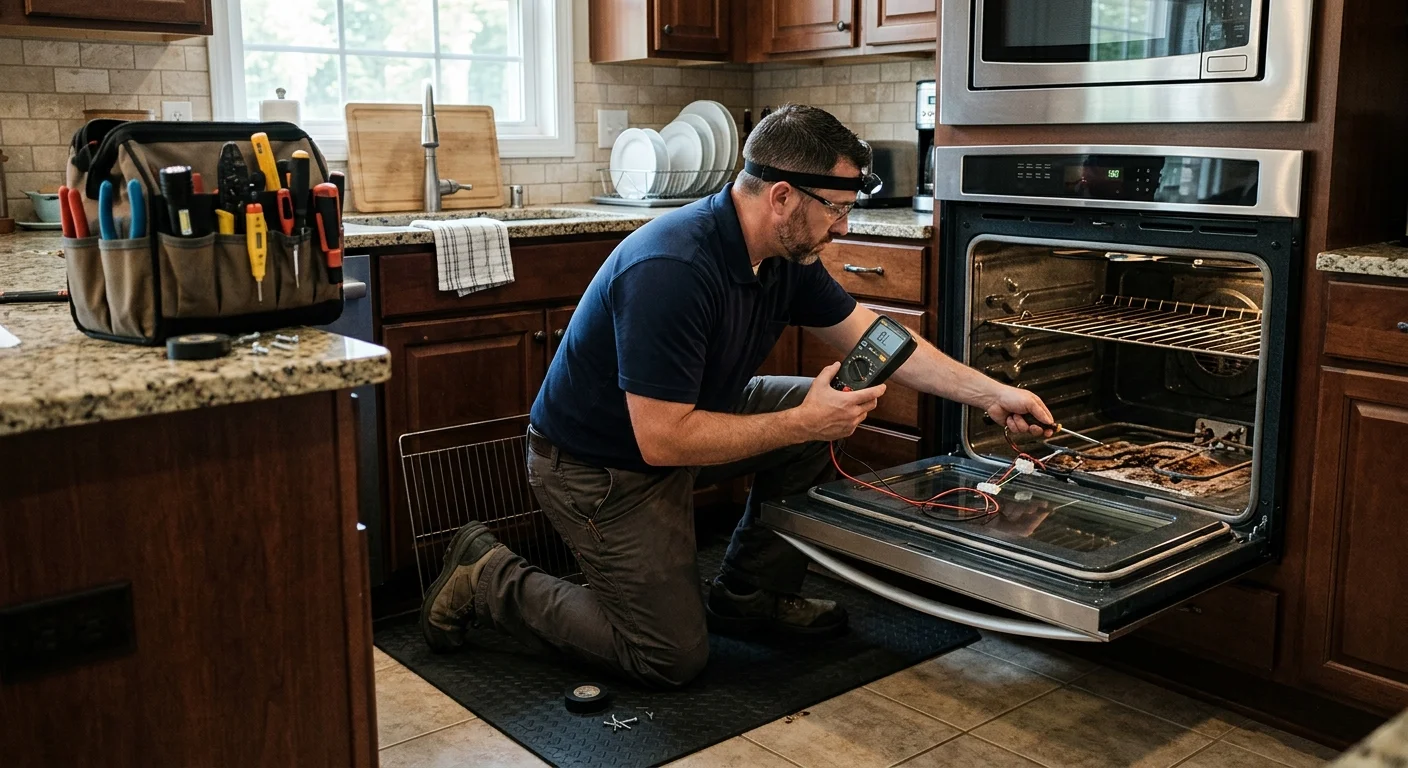
A Spring Valley oven that won’t heat may have a control, power, fuel, or component problem. Record what the oven does before requesting appliance repair in Spring Valley. Those details help a matched technician prepare for the correct model and complaint.
Confirm the model and exact no-heat pattern
Start with the model and serial numbers. Photograph the complete label instead of copying characters by hand. The owner’s manual should show where the manufacturer placed that label.
Next, describe the no-heat pattern precisely. “Oven won’t heat” can mean several different things:
- The display is completely dark.
- The controls work, but Bake produces no heat.
- Broil works, but Bake doesn’t.
- Bake works, but Broil doesn’t.
- The oven starts warming, then stops.
- Preheating takes longer than usual.
- The displayed temperature changes, but the oven stays cold.
- An error code appears.
- The problem began after an outage, cleaning cycle, or control change.
Write down every code exactly as shown. Don’t clear stored information until you’ve checked the manual. A letter, number, or flashing indicator may have a model-specific meaning.
Confirm whether the appliance is gas, electric, or dual fuel. Don’t decide from the cooktop alone. A dual-fuel range can pair gas surface burners with an electric oven. The model label and current manufacturer documentation are better sources.
Our broader oven troubleshooting guide explains how different heating patterns shape the next step. You can also search the model through the CPSC recall database. A recall result should be confirmed against the full model and serial range, not just the brand name.
What owners can observe without opening panels
Keep owner checks limited to the appliance’s manual. You shouldn’t remove panels, disconnect gas fittings, or test energized wiring to build a useful service request.
First, review the selected mode and temperature. Look for Delay Start, Control Lock, Sabbath mode, Demo mode, or an unfinished timed cycle. Names vary by manufacturer. Follow the model’s manual when canceling a setting or restoring normal operation.
Then note what happens during a fresh Bake command. Record whether the display accepts the temperature and whether the oven light works. Listen for clicks, fan noise, or repeated ignition attempts. Observe whether Broil behaves differently. These observations don’t identify the failed part, but they give the technician a clearer starting point.
Check the door from the outside. Note whether it closes evenly and whether the latch appears stuck. Look for a damaged gasket without pulling it loose. Remove cookware that prevents the door from closing. Don’t reach toward a heating element to judge whether it’s warm.
For a gas odor, stop the observation process and leave the area immediately. Call 911 or SDG&E at 1-800-411-7343 from a safe location, following SDG&E’s gas-appliance safety guidance. For smoke, sparking, or visible wiring damage, follow the appliance manufacturer’s instructions and guidance from emergency authorities.
Write down when the problem began. Include any recent outage, cleaning cycle, appliance movement, renovation, or control-panel change. If another household member saw the first failure, compare notes. A short symptom timeline is more useful than a guessed diagnosis.
What technicians inspect on gas and electric ovens
The inspection depends on the fuel type, model, and failure pattern. A matched technician should use current service information for that exact appliance.
On a gas oven, the technician may inspect the ignition sequence, igniter, burner, controls, wiring, and gas-related components identified by the manufacturer. The technician can compare the observed sequence with the model’s specifications. This work isn’t an owner-level panel check.
On an electric oven, the inspection may cover the bake element, broil element, temperature-sensing parts, wiring, controls, and incoming electrical supply. A working display doesn’t prove that every required electrical path is available. Testing determines where the heating sequence stops.
A wall oven also calls for installation details. Cabinet access, trim, mounting, and the documented electrical connection may affect how the unit can be inspected. A freestanding or slide-in range presents a different access situation. Tell the technician which style you have before the appointment is arranged.
The technician may reproduce Bake, Broil, and convection symptoms separately. That matters when one mode heats and another doesn’t. Error codes, heat patterns, and test readings must be interpreted using the manufacturer’s material for that model.
Don’t order a part from a symptom alone. Similar no-heat complaints can come from different points in the heating sequence. A model-specific diagnosis reduces the risk of replacing an unrelated component.
For more service context, see our oven and range repair overview and the broader guide to oven repair in San Diego. Repair Pro San Diego makes referrals. The independent technician handles diagnosis, repair decisions, and physical work.
Which Spring Valley property details need confirmation
A Spring Valley address doesn’t reveal the oven’s installation. Homes near Sweetwater Road, Jamacha Road, Bancroft Drive, Campo Road, and State Route 125 can still have very different kitchens and hookups. Use the exact property and appliance details instead of assuming from the neighborhood.
This research brief contains no approved Spring Valley housing-age percentage. That means this page won’t guess one. The U.S. Census Bureau’s place-level housing data doesn’t replace an inspection of a specific kitchen, either.
Tell the matched technician whether the appliance is:
- A freestanding range, slide-in range, or wall oven
- Gas, electric, or dual fuel
- Installed in original or remodeled cabinets
- Flush with the floor or surrounded by added flooring
- Connected beneath a cooktop or installed as a separate unit
- In a detached home, rental, condominium, or accessory unit
Include the nearest major cross street when requesting a match. A mailing label alone may not answer every service-area or property question. Confirm the actual service address and any access instructions.
If the address is within El Cajon rather than Spring Valley, the El Cajon appliance repair guide provides a better local starting point. Don’t choose a city page based only on the nearest landmark.
Renters should also identify who can authorize work. Condominium owners may need to confirm access procedures with their association. These steps don’t diagnose the oven, but they can prevent confusion when the independent technician reviews the job.
How to request a matched oven technician
Repair Pro San Diego connects homeowners with insured, independent local appliance technicians. It doesn’t perform repairs, employ the technician, set service prices, or provide the repair warranty.
After any emergency hazard has been addressed, prepare one short request containing the service address, appliance type, brand, model number, and fuel type. Add the exact no-heat pattern and every displayed code. Do not delay evacuation or the emergency call to collect details when you suspect a gas leak.
Include useful access details. Note whether the oven is built into cabinetry, paired with a cooktop, or located in a rental. Share clear photos of the label, controls, installation, and any visible damage. Don’t remove panels to take them.
Before authorizing work, ask the technician about their diagnostic fee and whether it is credited toward the repair. The matched technician diagnoses first and quotes in writing before work begins. Ask what the quote includes, which parts are proposed, and what warranty that independent business offers.
You can check a service dealer through the California Department of Consumer Affairs lookup. The lookup confirms registration status. It doesn’t establish an individual technician’s skill or predict the result of a repair.
Also review any current manufacturer warranty or service plan. Use the model and serial numbers when contacting the responsible company. Repair Pro San Diego doesn’t decide whether a repair is covered and doesn’t issue a warranty for the technician’s work.
When to call us
A no-heat oven needs an appliance repair pro when manual-approved checks don’t restore heat or the symptom returns. Repair Pro San Diego can record your request and seek a local match. Call (858) 988-7787 to leave a voicemail requesting a match with a local appliance repair pro.