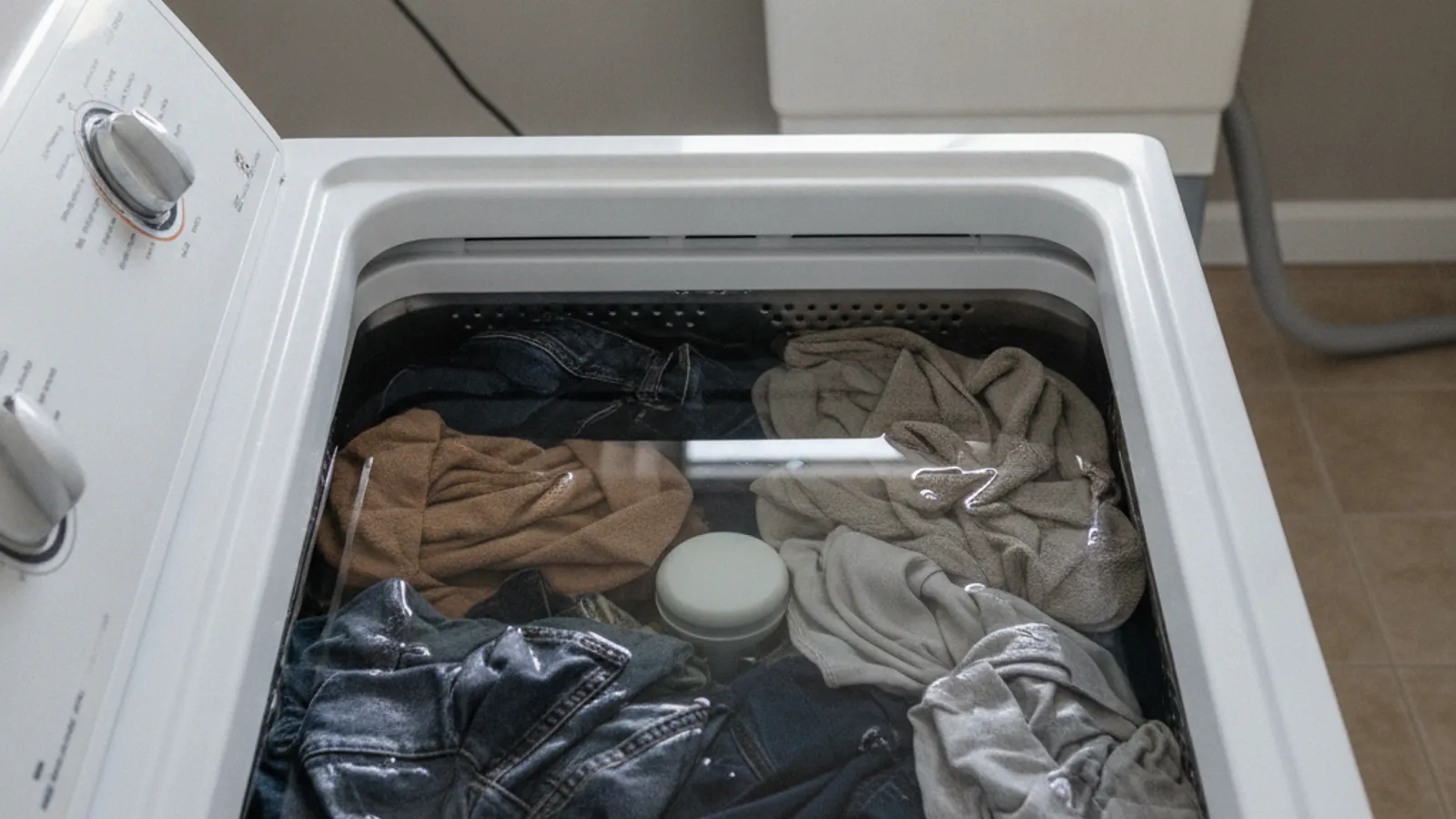
A Maytag washer not spinning usually comes down to an unbalanced load, a failing lid lock, a clogged drain, or a worn belt or motor coupler. Most causes are easy to narrow down at home.
When your Maytag finishes a cycle and the clothes come out heavy and dripping, the spin step didn’t happen. The good news is that the most common reasons are simple. Here’s how to find yours and decide what you can fix yourself.
Start with the load and the level
The first suspect is always the load itself. Maytag top-loaders like the Bravos and Centennial lines ride on suspension rods inside the cabinet. When a heavy comforter or a tangle of towels bunches to one side, the tub wobbles. The machine senses that wobble and refuses to spin fast, since a hard spin could damage it.
Open the lid, spread the load out evenly, and run a spin-only cycle. If your Maytag flashes dL, Ld, or an F7E1 code, those point to lid lock or motor or load issues, and a redistributed load often clears the simple ones.
Also check that the machine sits level. San Diego laundry rooms and garages aren’t always flat. A washer that rocks will throw off the balance sensor every time. Adjust the feet until it sits solid with no rock.
Check the lid lock and lid switch
This is the single most common no-spin cause on Maytag top-loaders. The machine won’t spin with a lid lock it can’t confirm is closed. It’s a safety design. If the lid lock is broken, stuck, or its wiring has failed, the washer fills and agitates but never spins.
Listen at the start of the spin step. A healthy lid lock makes an audible click as it engages. No click, or a flashing lid light, points right at the lock assembly. The worn lock is a frequent repair on older Bravos and Centennial machines, and it’s a defined part swap rather than a guess.
Confirm it actually drains
Here’s the rule that trips people up: a Maytag that won’t drain won’t spin either. The control board won’t spin a tub full of water. So if you open the lid and see standing water, your problem is the drain, not the spin motor.
Check the drain hose for kinks first. Then suspect the drain pump, which can clog with lint, coins, or a sock, or simply wear out. A washer that hums but doesn’t drain usually has a jammed or failed pump. If you hear that draining noise but the water sits there, the pump is your target.
Belt, motor coupler, and the shift mechanism
If the load is balanced, the lid locks, and the tub drains but still won’t spin, the problem moves to the drive parts. On belt-drive Maytag models, a worn or broken drive belt means the motor turns but the tub doesn’t. You’ll often smell rubber or hear a labored whir.
The direct-drive Bravos use a different setup. They rely on a shift actuator and a splutch, or shift mechanism, to switch between agitate and spin. A bad actuator leaves the machine stuck in one mode, so it agitates but never engages spin. The motor coupler, a small plastic and rubber part, can also wear out and break the connection between motor and transmission. And a worn clutch can let the tub slip so it spins weakly or not at all.
These parts make grinding, clunking, or labored sounds. If your washer has gotten loud lately, our guide on a washing machine making loud noise can help you match the sound to the part.
Front-load Maxima differences
If you own a Maytag Maxima front-loader, the diagnosis shifts a bit. Front-loaders depend on a door lock that has to latch fully before any spin. A failing door lock is a top cause of no-spin on these machines, much like the lid lock on a top-loader.
Front-loaders are also sensitive to drainage. A clogged drain pump filter, common with lint and small items, will stop the spin cold. Most Maxima models have an access panel at the bottom front where you can reach and clean that filter.
What you can fix and what needs a pro
You can handle the easy half yourself. Redistribute the load, level the machine, clean a clogged drain filter, and clear a kinked hose. These cost nothing and solve a real share of no-spin calls.
The deeper repairs are where a qualified technician earns their keep. Replacing a lid lock, drain pump, drive belt, motor coupler, shift actuator, or clutch means opening the cabinet and working around the transmission. If you’re not sure the repair is worth it on an older machine, our breakdown of washing machine repair cost in San Diego lays out the numbers.
A note on San Diego hard water
San Diego County has some of the hardest water in the country. Over years, mineral buildup wears on pump seals, valves, and moving parts faster than it would elsewhere. Older Maytags here tend to show drain and pump trouble sooner. If your machine is past the ten-year mark and acting up, hard water has likely played a part. Routine washing machine repair keeps a good machine running well past its warranty.
Frequently asked questions
Why is my Maytag washer not spinning?
The most common reasons are an unbalanced load, a failed lid lock, a clogged drain that stops the spin, or a worn drive belt or motor coupler. Start by redistributing the load and confirming the tub drains.
Why won’t my Maytag spin or drain?
A washer that can’t drain won’t spin, since the control board won’t spin a full tub. The usual culprit is a clogged or failed drain pump, or a kinked drain hose. Clear the hose first, then check the pump.
What does the dL or F7E1 code mean on a Maytag?
A dL or Ld code points to the lid lock failing to lock, and F7E1 is a motor or load fault. Both often follow a bad lid lock or an unbalanced load, so check those before replacing electronics.
When to call us
Call us at (858) 988-7787 to get matched with a technician.