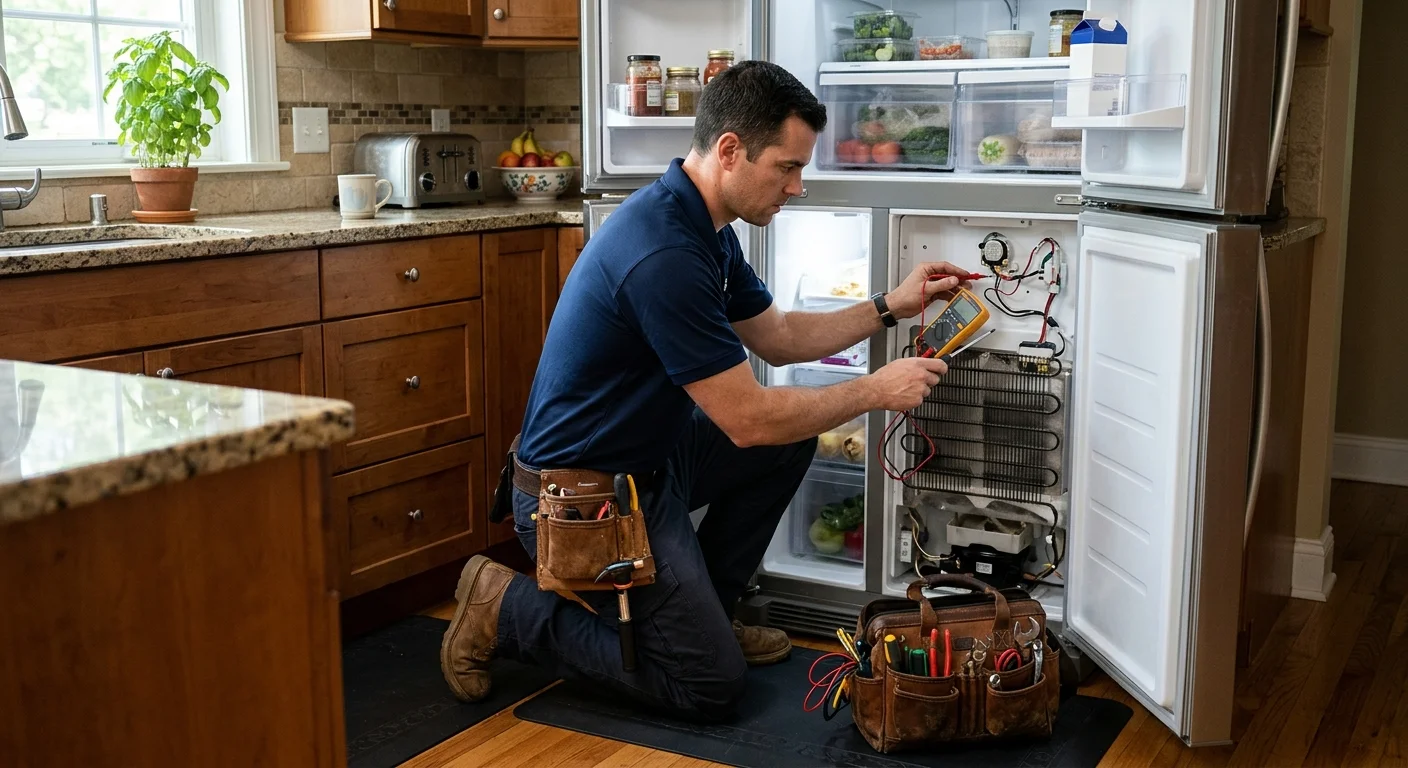
A KitchenAid refrigerator that stops holding cold puts food on a clock. In San Diego County the useful first fact is the pattern: warm fresh food with a still-frozen freezer is a different repair than both compartments rising together. Photograph the model sticker, write both temperatures, then match with an independent technician who can test airflow, defrost, and the sealed system.
Confirm the model and exact cooling pattern
KitchenAid refrigerators in this county are not one machine. French-door units sit in newer kitchens from Carlsbad to Mission Hills. Side-by-sides are common in older East County houses. Built-in and panel-ready columns show up in downtown and coastal condos, where the cabinet is the airflow path. The badge on the door does not tell a technician which evaporator, damper, or ice system is inside. The model number does.
Find the sticker on the left wall of the fresh-food section or on the door frame. Photograph the full model and serial in one frame. KitchenAid uses that string for any remaining factory coverage. A parts house uses it to pick the right fan, board, or gasket. Repair Pro San Diego does not claim manufacturer authorization. Coverage is between you, the seller, and KitchenAid.
Then measure. Do not guess with a hand on a jar. The FDA ceiling for the refrigerator compartment is 40°F. The freezer should sit at or below 0°F. Practical manufacturer guidance aims near 37°F in the fresh-food box, often in a 35-38°F band. Put a thermometer on a middle shelf, close the door, and wait. Repeat in the freezer. Do it again after several hours. Write the control-panel setpoints next to those readings.
Four notes split the job. First, is the freezer still hard-frozen while milk on an upper shelf is dull and warm. Second, does the cabinet run without ever cycling off. Third, is there a frost sheet on the back freezer wall. Fourth, do the doors actually pop closed on a packed French-door shelf. Airflow and defrost live on one path. Compressor and start components live on another. Door seal and installation live on a third.
Local heat changes the load. A garage-wall kitchen in El Cajon or Escondido dumps more heat on the condenser in August than a shaded Encinitas galley. Tight toe-kick gaps in Pacific Beach condos starve the condenser fan. Overfilled door bins on a French-door KitchenAid block the vents that return air to the evaporator. Those are San Diego installation problems wearing a KitchenAid badge. Run the generic fridge not cooling checklist for owner steps that apply to any brand. Stay on this page for the KitchenAid cooling pattern.
What owners can record without opening components
Leave the sealed system alone. Do not pull the evaporator cover. Do not pierce a line. Do not jump a relay. You can still hand the technician a useful packet.
Confirm power first: the plug, the outlet, and the breaker. Confirm the display is on. Confirm the setpoints did not drift after a blip on the SDG&E feed. Confirm both doors latch and the gaskets are not folded, torn, or packed with crumbs. Slip a bill in the gasket and close the door. If it slides out with no drag, the seal is tired. That is an owner observation, not a parts order.
Stand at the kick plate and at the freezer. A steady hum with warm cabinets is one note. A click, a brief hum, then silence, repeating, is another. A lit panel with a silent machine is a third. Do not name the failed part from the sound. Write the sound down.
If the front grille lifts without tools, look at the condenser coils. Pet hair, dryer lint, and dust sit on those fins and hold heat in the machine. Inland houses collect dry dust. Coastal houses collect a finer film. Coil cleaning is an owner job when access is open. If the grille is clipped behind trim, leave it for the tech.
A heavy frost wall in the freezer is a clue, not a carving project. Do not chip ice with a knife. Moving food to coolers and letting the box thaw can show whether cooling returns for a day and then fails again. That rebound pattern often points at defrost, not a dead compressor.
Food safety sets the clock while you record. Perishables that have been above 40°F for more than 2 hours should be discarded. That window is 1 hour if the kitchen itself is above 90°F, a real indoor reading in uncooled East County rooms during a heat wave. With the door kept shut, a full freezer holds temperature around 48 hours in an outage. A half-full freezer is closer to 24 hours. Those figures are from the FDA and FoodSafety.gov. They are not a KitchenAid spec.
If the ice maker or dispenser still runs while the box is warm, write that down. Running water does not prove the refrigerant circuit is healthy. It only tells the tech the water path is still alive.
What technicians inspect during diagnosis
The independent technician you match with should follow the notes, not a parts list. Power, then airflow, then defrost, then the sealed system. That order keeps a fan or a dirty coil from being billed as a compressor.
On many KitchenAid cabinets the condenser sits behind the toe kick. The tech cleans it, checks the condenser fan, and confirms the machine can reject heat before anyone talks about refrigerant. They check the evaporator fan in the freezer. If that fan is dead, cold air stays in the freezer and the fresh-food section drifts. They look for a packed evaporator. A frost block there points at a defrost heater, a bi-metal, or a control that never runs defrost.
Sealed-system work is certified work. Technicians who attach gauges, add or recover refrigerant, or open the circuit must hold EPA Section 608 certification under the Clean Air Act. You can keep using the KitchenAid already in the kitchen. The EPA HFC phasedown limits new production and new equipment. It does not ban repair of a refrigerator already installed. If a leak is confirmed, that finding belongs in a written quote before any recharge or compressor work.
National cost guides such as HomeGuide put a full refrigerator compressor replacement at $700-$1,250 on average. That is a named national guide from the claims ledger, not a San Diego market average and not a Repair Pro San Diego fee. The matched technician diagnoses first and quotes in writing before work begins. A relay, fan motor, or defrost part is a different job.
California appliance repair businesses register with the Bureau of Household Goods and Services under the Department of Consumer Affairs. You can confirm a dealer’s registration on the state’s public lookup. That lookup confirms registration status. It does not grade an individual technician’s skill.
Repair Pro San Diego is the match, not the shop. We do not stock parts, run trucks, or perform the repair. The licensed, insured pro you are matched with performs the refrigerator repair. Ask that person about their diagnostic fee and whether it is credited toward the repair.
How controls and ice or water features change the next step
Ice and water on a KitchenAid French-door or side-by-side can steal the story. A door ice maker that stopped, a frozen fill tube, or a solid bin can block a damper or a return path. It can also be a separate water-path failure on a fridge that still cools. Split those two before anyone orders an ice maker.
If the fresh-food section is warm and cubes are still dropping, cooling is uneven, not dead. If ice and temperatures collapsed together, the tech should look at the evaporator, damper, and fans before the inlet valve. When the box is still cold and only ice has failed, that is an ice-maker visit. When the box is warm, ice is a clue.
Electronic controls add a fork. A blank display with a compressor that still runs is not the same as a live display with a compressor that never starts. Photograph any code on the panel. Do not sit at the board resetting it every hour. One reset that brings cooling back for a few hours, then fails, is useful. Ten resets are not a repair.
Water filters and inlet valves matter for leaks, no water, or hollow ice. They rarely explain a uniformly warm refrigerator. Keep a KitchenAid refrigerator not cooling complaint on cooling. Park a stand-alone ice complaint on ice service.
Warranty status changes who pays. It does not change the failed part. KitchenAid’s remaining coverage, if any, is in your packet and on KitchenAid’s site. Independent technicians in this network are not described here as factory-authorized. If the refrigerator is still under a manufacturer’s express warranty, California’s Song-Beverly Consumer Warranty Act requires the warrantor to start service in a reasonable time and to complete repairs within 30 days unless the delay is beyond their control. That duty sits with the manufacturer or seller. Ask them where that service is supposed to happen before a sealed-system repair that could affect coverage.
When to request KitchenAid refrigerator repair
Request KitchenAid refrigerator repair when recorded temperatures stay above the FDA limits after the owner checks, when frost returns after a careful thaw, when the compressor clicks and never runs, or when food is already in the danger zone. Another night of 45°F milk is how a cooling call becomes a grocery loss.
This page is the not-cooling sibling, not the brand hub. Broader KitchenAid coverage lives on KitchenAid appliance repair in San Diego. A dishwasher that will not drain or an oven that will not heat is a different visit.
Repair versus replace comes after diagnosis. The site’s typical refrigerator service-life range is 10-15 years, longer for some built-ins, presented as a typical band. It is not a measured government figure. Read how long appliances last for that context. Do not use a rule that says replace when a repair hits half the cost of a new machine. No primary source on file supports that threshold. Get the written diagnosis, then decide.
Check the CPSC recall list for your model if you have not already. Do not treat an internet rumor as a recall. If nothing lists your serial, say so and move to diagnosis.
Move perishables first when the kitchen is already hot and the fridge has been warm. Then request the match. The phone line records a voicemail. It does not dispatch a truck on a timer.
When to call us
If a KitchenAid refrigerator in San Diego County will not hold 40°F after the checks above, match with a licensed local appliance repair pro for diagnosis. Call (858) 988-7787 to leave a voicemail requesting a match with a local appliance repair pro. The technician you are matched with inspects the unit, quotes in writing, and does the work.