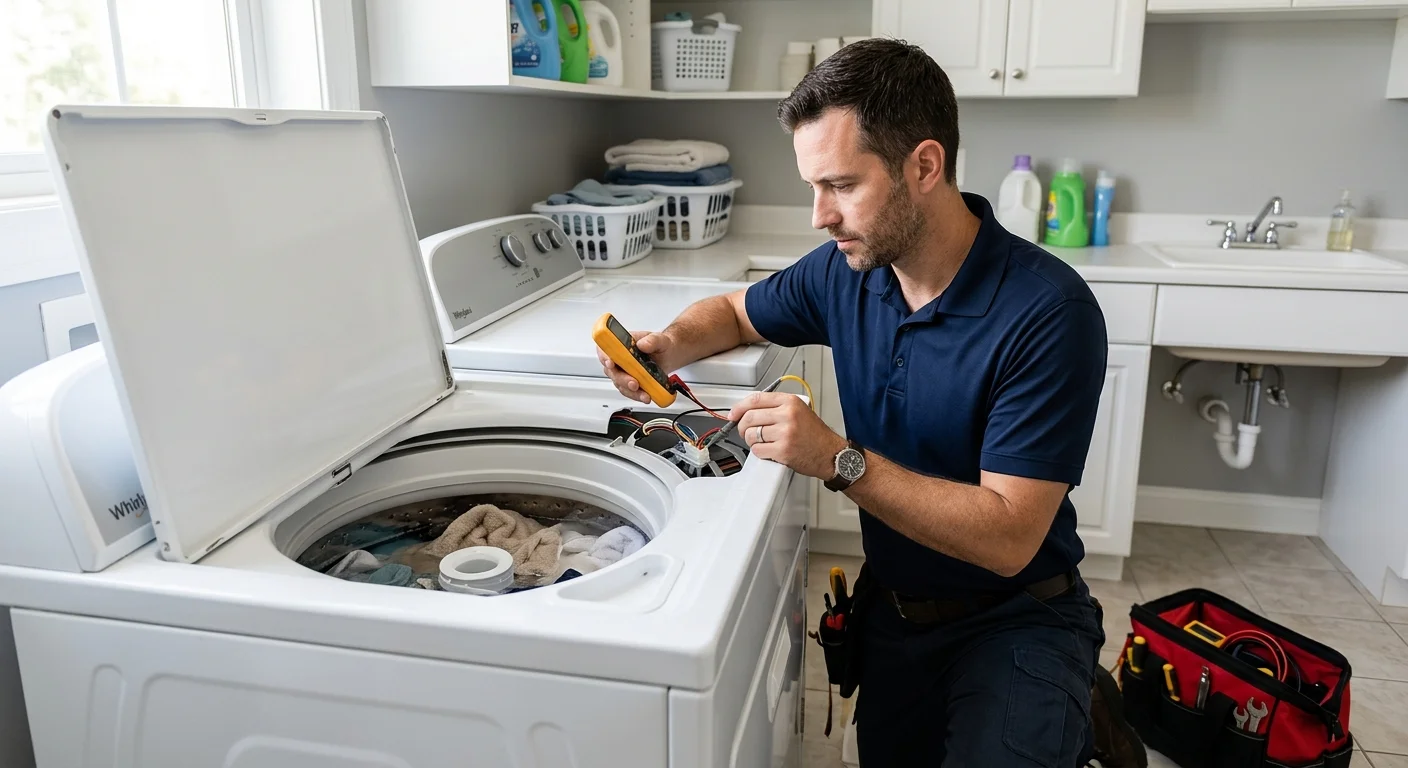
Clothes come out of a Kenmore washer soaking wet after a cycle that seemed to run. The tub filled, it may have agitated, and the high-speed spin never happened. That complaint is the one San Diego County owners bring when they search for Kenmore washing machine repair.
Confirm the model and failed spin stage
Kenmore is a house brand. Other factories built the machine and put a Kenmore badge on it. The full model number on the sticker is the first fact a technician needs, because the drive, lock, and control layout follow the builder. Look on the lid underside, the door jamb, or the cabinet frame. Copy every digit, including the three-digit prefix before the period.
Parts catalogs commonly group Kenmore laundry by that prefix. Whirlpool-built top-loaders show up under prefixes such as 110. LG-built front-loaders often use 796. Other prefixes exist. Treat the prefix as a starting map, then confirm against the full sticker and the serial. Guessing the platform from the word Elite on the console is a weak shortcut. Elite is a trim name. Two Elite washers can still use different locks, motors, and error lists.
Name the failed stage next. A useful note looks like this: Normal cycle, cold wash, medium load of towels, filled, agitated, drained, then sat with a locked lid and a full tub of wet clothes. Another useful note: filled, hummed, never turned the basket. A third: spun on Rinse & Spin with an empty tub, then failed again with a mixed load. Those three stories point a tech at different tests. Write down the cycle name, soil level, spin speed if the console shows one, and whether the machine is a top-load agitator, a top-load impeller, or a front-loader.
San Diego housing changes how that sticker gets read in the room. A 1960s ranch in El Cajon often keeps the washer in a hot garage on a slab, with a short standpipe and a shared 120-volt circuit. A Mission Valley stacked pair sits in a tight closet with a high drain line and little room to pull the cabinet. A Pacific Beach condo laundry closet holds humidity against a front-loader door lock. The model still decides the parts. The room decides how the tech reaches them.
If the washer is still under a written manufacturer warranty, keep the original paperwork with the model and serial. California’s Song-Beverly Consumer Warranty Act requires covered repairs to be completed within 30 days unless a delay is outside the maker’s control, and the warranty clock pauses while the unit is in for repair. An independent washing machine repair visit is the usual path once that coverage has ended. For the rest of the Kenmore lineup in the county, start with our Kenmore appliance repair guide, then come back to this spin complaint with the model number in hand.
What owners can observe without opening the washer
Stay outside the cabinet. Unplug the washer before you move it even a few inches, and keep hands out of the tub while it is powered. The goal is a clean log for the technician, not a home repair.
Watch one full cycle, or a short Drain & Spin if the console offers it. Confirm the lid or door latches and stays shut. Many Kenmore top-loaders will fill and agitate with a tired lid lock, then refuse to ramp into spin. Front-loaders need a locked door before the basket is allowed to turn at speed. Listen for a single click at the lock, a repeated click, or silence. Note any code in the display. Photograph it. Do not clear it until you have the photo.
Feel the floor and the cabinet as spin should start. A machine that walks on a garage slab in Escondido or Santee may be out of level, or the suspension may be worn. A machine that stays planted and simply hums is a different clue. Open the door or lid only after the cycle has stopped and the lock has released. Clothes that are standing in water belong on the drain path. Clothes that are wet but sitting in an empty tub point at spin torque, a belt or coupler, a rotor, or a control that never commanded high speed.
Redistribute one overloaded towel load and try a small, balanced load of sheets. An out-of-balance trip is common on Kenmore platforms with a unbalance sensor. If a small, even load spins and a mixed load of towels does not, write that down. If every load fails, say so. Check that child lock or control lock is off. On a recently installed unit, look for shipping bolts still in the back of a front-loader. Those bolts keep the tub from spinning on purpose.
Leave the rest of the cabinet closed. Bypassing a lid switch, reaching under a moving basket, or pulling a drive belt from the bottom is how people get hurt. A countywide washing machine repair visit starts faster when you already have the model, the cycle, the lock sound, the water level at the end, and a photo of any code.
San Diego tap water is on the harder side in much of the county. That shows up more on fill valves and screens than on a spin motor. If the washer is slow to fill, mention it. A hardness number from your water district is useful. A guessed grains-per-gallon figure is not. Coastal salt air around Ocean Beach and Imperial Beach is harder on door boots and lock hardware than inland dry heat. Inland garage laundry rooms cook control boards and plastic lids in August. Those are observations a tech can use. They are not a diagnosis by themselves.
Before you book, you can also scan the CPSC recall list for your exact model. A recall is a specific notice. It is not a generic Kenmore warning.
How drain and control symptoms narrow the complaint
A Kenmore washer is built to keep a heavy, water-filled basket from spinning. If the control still thinks the tub is full, spin is blocked on purpose. That is why drain clues belong in this conversation, and why they should stay short.
Look at the window or lift the lid after the lock releases. Standing water means the pump, filter, hose, or standpipe never finished its job. Follow that path on our Kenmore washer won’t drain page, then return here once the tub empties and spin still fails. Suds that climb the glass on a front-loader, or a Sud-style code on a Whirlpool-built Kenmore, can also keep the basket from ramping up. HE detergent in the right amount matters in San Diego hard water. Extra soap does not rinse cleaner. It stalls spin.
An empty tub with soaking clothes is the spin complaint this page is for. From there, split the control story. Did the cycle advance on the lights or the estimated minutes. Did it freeze on Spin. Did it chirp, flash a lid or door code, then sit. A control that never leaves Agitate is one test tree. A control that claims it spun while the clothes stay heavy is another. Write the last status the console showed.
Power glitches are part of San Diego summers, especially inland when air conditioners kick on. A washer that lost power mid-cycle may need a simple reset after you unplug it for a few minutes. If the same no-spin returns on the next load, the reset only cleared a temporary state. The lock, shift, drive, or board still needs a meter.
Do not treat every Kenmore the same because the badge matches. A 110-prefix top-loader often uses a lid lock and a shifter to move from agitate to spin. A 796-prefix front-loader often uses a door lock, a drain pump, and a direct-drive motor with its own fault list. The matched technician reads those in the builder’s order. Mixing an LG-style boot inspection onto a Whirlpool-style direct-drive top-loader wastes the visit.
If you already know the washer drains slowly into a low laundry sink in a City Heights bungalow, or into a high standpipe in a downtown stacked unit, put that in the note. Drain height and venting are building facts. They change whether the pump can finish before spin is allowed. They do not replace a model-specific test of the lock and drive.
What technicians inspect during diagnosis
The technician we match brings a meter, the builder’s service sequence, and the model number you copied. Repair Pro San Diego does not send a house tech, stock parts, or set a diagnostic fee. The independent pro quotes in writing after the tests, then does the work if you approve it.
Expect the visit to start at the lock. On a top-loader, that is the lid lock or lid switch circuit. On a front-loader, it is the door lock and the signal that tells the control the door is safe. A lock that clicks and still reads open on the board will stop spin while fill and agitate still look normal. Next is proof that the tub is empty: pump, filter pocket on some front-loaders, drain hose, and standpipe. Only then does the tech command a spin in service mode, if the platform has one.
Drive parts follow the builder. Belt, motor coupling, shifter, clutch, rotor, stator, and tub bearing are not a single Kenmore kit. A humming motor with a still basket on a belt machine is a different finding from a dead shifter on a direct-drive top-loader. The tech checks the basket by hand only with power off, feeling for a seized bearing or a loose spline. They inspect suspension rods or dampers when the cabinet walked, or when the unbalance sensor kept aborting spin. They read the control board last when every mechanical path already tested good.
San Diego rooms shape those tests. Garage laundry in East County puts dust on belt paths and heat on boards. Coastal closets keep moisture on door locks and boots. Older 120-volt laundry circuits in mid-century homes can sag when the motor tries to ramp. A tech who finds a weak receptacle or a loose neutral will say so. That is an electrical finding at the outlet, and it belongs to a qualified electrician if the washer itself tested sound.
Ask the pro about their BHGS registration as an appliance service dealer. California registers those businesses through the Bureau of Household Goods and Services. You can confirm a shop on the state’s license lookup. Registration is not a skill exam. It is the consumer check that is actually on the books. The matched technician’s own workmanship warranty is the one that covers the repair. The brand that connected you does not warrant the job.
Most of these visits finish in one trip when the failed part is identified and available for that prefix. Parts follow the original builder’s supply line, which is why the sticker comes first. A written quote before any repair starts is the rule. There is no Repair Pro price list to compare it against.
When to request Kenmore washer repair
Request a match when the washer fills or agitates and still leaves a tub of wet clothes after you have checked the latch, the load balance, and the water level. Request one when a code returns after a power reset. Request one when the cabinet walks, the lock never clicks, or you can hear a motor hum with a basket that never turns. Those are diagnosis jobs. They are past owner observation.
Keep using the machine only if it still drains and you can wring or air-dry a small load. A basket that will not spin puts extra strain on the drain pump if you keep stacking soaked loads. A leaking hose at the back is a stop-now problem. Shut the supply valves and unplug the set. Supply-hose failures flood finished floors. That risk is separate from the spin complaint, and it is the one to treat as urgent.
Skip year-count rules of thumb. A government-sourced Kenmore-only lifespan figure is not on our claims file. Wear follows the platform, the water, the room, and how hard the machine has been run. For a broader read on age and replacement, see how long appliances last. If a manufacturer warranty is still in force, start with that channel. Independent service is the path after it lapses. Sears-branded service networks have changed as the Kenmore brand changed hands. Confirm the current support path on your original documents and Kenmore’s own site. Do not assume a mall Sears counter is still the routing.
Coastal front-loaders that sit closed between loads pick up odor in the boot. Leaving the door ajar between cycles is a free habit. It does not restore spin. Inland garage top-loaders that sit in heat need a level cabinet and a clear drain more than they need a new detergent. Neither habit replaces a lock, shifter, or motor that has already failed.
When you are ready, we match you with an insured local appliance technician who works Kenmore platforms by model, not by badge. You get a written diagnosis on the spin path, then a decision on the repair from there.
When to call us
A Kenmore that fills or agitates and never completes spin needs a matched, independent appliance repair pro in San Diego County, not a guess at the lock or drive. Call (858) 988-7787 to leave a voicemail requesting a match with a local appliance repair pro. Include the model number, the cycle that failed, and whether the tub was empty or still holding water.