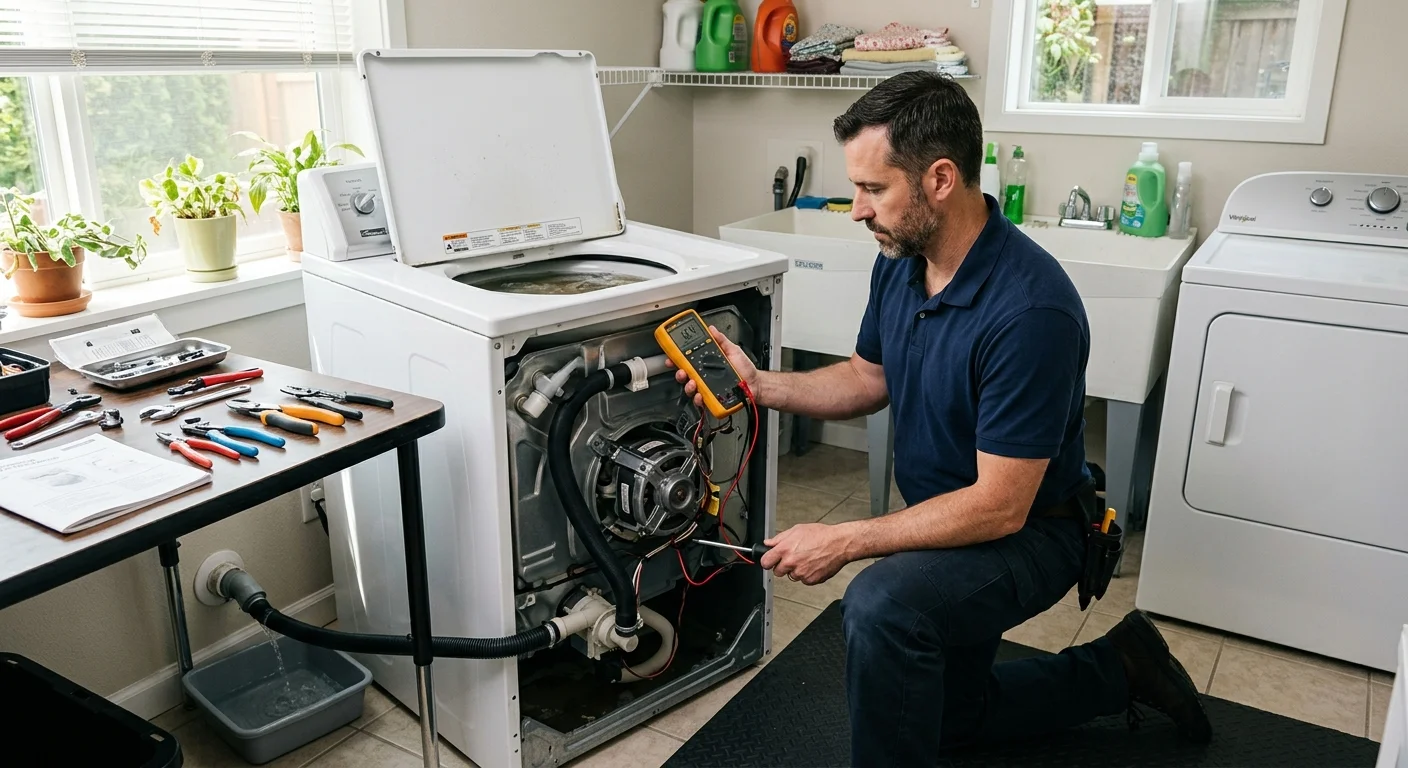
Standing water in a Kenmore washer often points toward the drain path, but the exact cycle behavior matters. Start by checking the selected cycle, load, drain hose, and household drain. If water remains, a technician can inspect the pump, internal hoses, wiring, and control signals.
Confirm the model and exact drain symptom
The Kenmore name alone doesn’t identify the washer’s internal design. The full model number determines the correct parts diagram, service information, and diagnostic path. Find the identification label without opening the cabinet. If the label isn’t obvious, check the owner’s manual for its location.
Record the model and serial number exactly as shown. A missing digit can point toward the wrong pump or hose arrangement. This information also helps separate washer-specific service from the broader issues covered in our Kenmore appliance repair guide.
Next, describe what “won’t drain” means for your machine:
- The tub stays full after the cycle stops.
- Water leaves, but much more slowly than expected.
- Some water remains while the washer shows an error code.
- The pump makes a humming or rattling sound.
- The washer stops before reaching the drain or spin stage.
- Water drains during one cycle but not another.
Record any displayed code before clearing it. Also note the selected cycle and whether the problem began suddenly. A technician needs the sequence, not just the final symptom.
Don’t assume a no-spin washer has a bad drain pump. Likewise, a tub with standing water doesn’t prove the pump itself has failed. The obstruction, hose, household drain, latch, wiring, or control system may change the diagnosis.
What owners can check without opening the washer
Keep the first checks outside the cabinet. Your goal is to document the problem and rule out visible causes. You don’t need to remove panels or disconnect water-filled hoses.
Start with the controls. Confirm that the selected cycle has ended rather than paused. If the model’s manual lists a Cancel/Drain or Drain/Spin option, try that cycle once. Watch the washer and listen for the pump.
Then check these accessible areas:
- Look for a drain hose pinched behind the washer.
- Confirm that stored items aren’t pressing against the hose.
- Check whether the lid or door closes without clothing trapped around it.
- Redistribute a bunched or uneven load, then follow the manual’s restart instructions.
- Look for water rising from the standpipe or utility sink.
- Note whether nearby drains are also slow or backing up.
- Photograph any error code and the remaining water level.
A standpipe backup shifts attention toward the household drain. A clear standpipe with water trapped inside the washer points the diagnosis back toward the machine. Neither observation identifies a failed part by itself.
Laundry access also matters across San Diego County. A stacked unit in a Downtown condo may hide the hose completely. An inland garage setup may leave the hose visible but place the standpipe behind storage. Don’t drag the washer out if doing so strains the connections.
Our general washer drain guide covers the broader symptom across brands. For a Kenmore washer, keep the full model number beside your notes. That detail helps the matched technician use the right documents.
What technicians inspect in the drain path
A technician usually follows the path water takes out of the washer. That begins at the tub outlet and continues through the internal hose, filter or trap when equipped, drain pump, external hose, and household drain connection.
The inspection may uncover fabric, coins, small clothing, or debris restricting that path. The technician also checks whether the pump impeller moves as designed and whether the pump produces the expected response during a drain command. A pump can make noise without moving water correctly. Silence can also have several causes, including the pump, a connection, or the signal controlling it.
Filter access varies by model. Some washers have an owner-accessible pump filter described in their manual. Other designs require service access. Don’t assume an online video for a similar-looking Kenmore applies to your machine. The control layout can look familiar while the pump location and disassembly steps differ.
A technician may also inspect internal hoses for blockage, damage, or a loose connection. Electrical testing can help separate a pump problem from wiring, latch, or control trouble. The current service information for the exact model guides those checks.
The household drain remains part of the diagnosis. If the washer moves water through its hose but the standpipe overflows, appliance work alone may not solve the problem.
Repair cost depends on the failed part, access, model, and whether the household drain is involved. Repair Pro San Diego doesn’t set technician prices or diagnostic fees. Ask the independent technician about their fee and whether it is credited toward the repair. The matched technician diagnoses first and quotes in writing before work begins.
How spin and control symptoms change the diagnosis
Drain and spin happen close together, so owners often report them as one problem. A technician separates the sequence. What the washer does before, during, and after the drain command narrows the inspection.
These patterns provide useful clues:
- Water drains, but the basket doesn’t spin.
- Water remains, and the washer never attempts high-speed spin.
- A manual drain cycle works, but the regular wash cycle stops.
- The lid or door doesn’t lock as expected.
- The pump runs intermittently during repeated attempts.
- An error code returns at the same stage each time.
A washer that drains but doesn’t spin may need a different diagnostic path than a washer holding a full tub. Standing water with no spin can keep attention on the drain system, but the technician may also check the lid switch, door latch, wiring, and control inputs.
Sound helps, but it isn’t a final diagnosis. A humming pump may be blocked, worn, or unable to move water through a restricted hose. No pump sound doesn’t automatically prove the pump has failed. The machine may not be sending the drain command.
Avoid ordering a part from an error code alone. The same visible symptom can follow different failures, and model-specific definitions matter. Record the code, cycle, water level, and sounds instead.
This is where professional Kenmore washing machine repair becomes more focused than basic troubleshooting. The technician can compare the observed sequence with the correct model documentation, then test the relevant components before recommending work.
When to request Kenmore washer repair
Request service when standing water returns after the visible checks. It’s also time to call when the washer repeatedly stops before draining, makes an unusual pump noise, displays a recurring code, or needs cabinet access.
Have these details ready for the referral and technician:
- Full model and serial number
- Top-load or front-load configuration
- Cycle selected when the problem occurs
- Approximate water level when the washer stops
- Error codes shown on the control panel
- Pump sounds during a drain command
- Visible condition of the external drain hose
- Any standpipe or nearby drain backup
Access notes can prevent confusion. Mention whether the washer is stacked, inside a tight closet, or behind built-in shelving. A Downtown laundry closet requires different access planning than a garage installation in El Cajon or Escondido. Homeowners farther inland can also review our guide to appliance repair in Escondido.
Repair Pro San Diego matches homeowners with licensed, insured independent technicians across the county. We don’t perform repairs, employ technicians, or stock Kenmore parts. Our washing machine repair referral service helps connect you with a local pro for model-specific diagnosis.
California appliance repair businesses must register with the Bureau of Household Goods and Services. Ask a service dealer for their registration details before approving work.
When to call us
A Kenmore washer that keeps water in the tub after basic exterior checks needs an appliance repair pro to inspect the drain system and controls. Repair Pro San Diego is a referral service, and we’ll connect you with a licensed, insured independent local technician. Call (858) 988-7787 to leave a voicemail requesting a match with a local appliance repair pro.