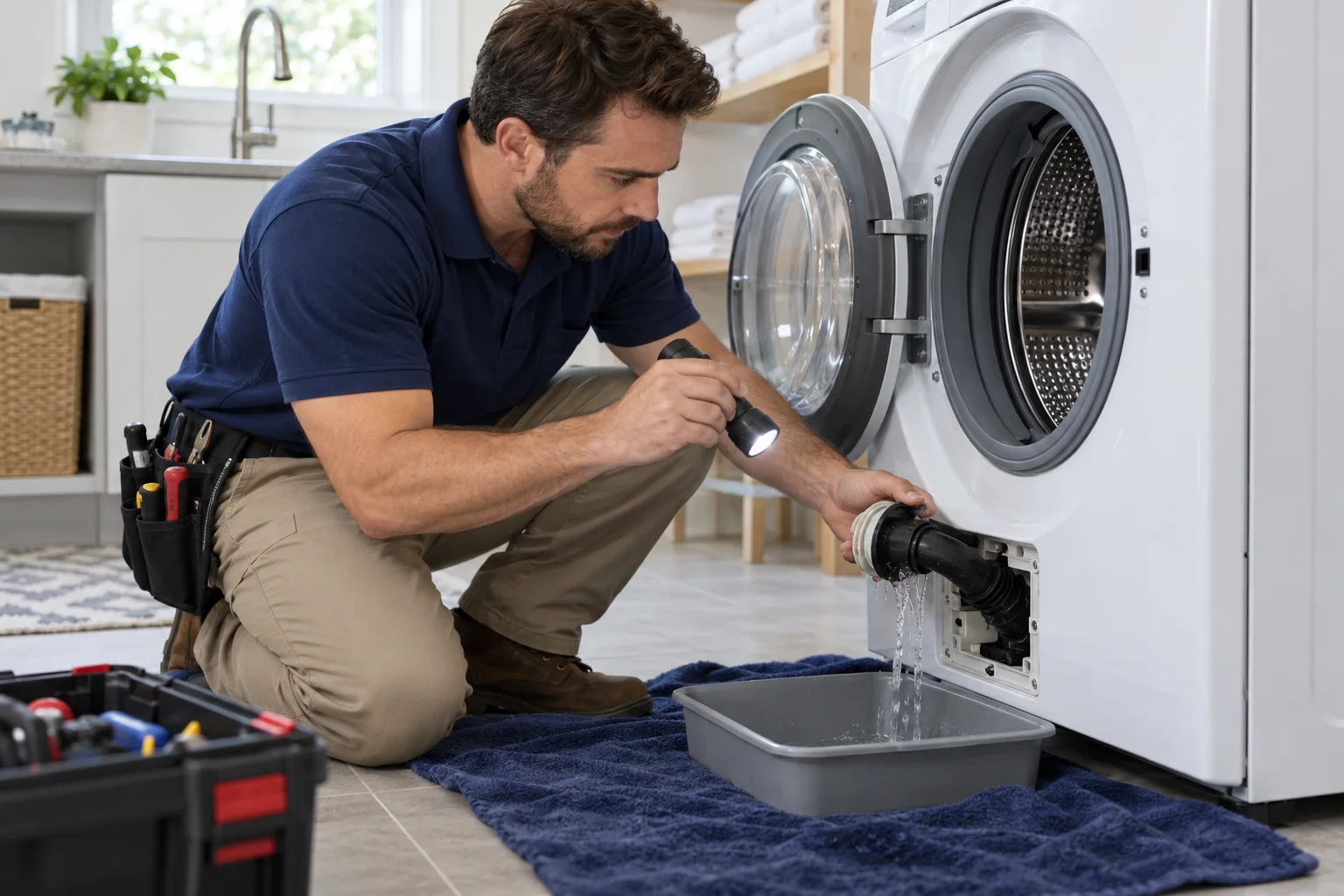
Standing water after agitation points to a focused GE washer drain problem. The model, failed cycle stage, and control behavior help a technician decide where to inspect first.
Confirm the model and exact no-drain pattern
Start with the complete model number, not just “GE top loader” or “GE front loader.” GE has produced washers with different controls, access points, and drain arrangements. The technician needs the label information to find material for that specific machine.
Photograph the model label while it’s readable. Its location varies by design, so check the opening, frame, rear area, or product paperwork without removing panels. Include the serial number in the photo, but don’t publish it online.
Next, describe exactly what happens:
- The washer fills and agitates, then stops with water inside.
- Water remains, but the basket spins.
- The controls pause at the drain or spin stage.
- The washer drains partly, then stops.
- A humming, clicking, or grinding sound starts during draining.
- The failure happens on every cycle or only certain selections.
- An error message or indicator appears.
These patterns aren’t interchangeable. A washer that never attempts to drain presents a different diagnostic path from one that hums while water remains. Partial drainage also differs from a complete no-drain complaint.
Record the chosen cycle and load type. Note whether the problem began after washing a bulky item, handling a small load, or changing a setting. That history gives the technician context without turning your notes into a diagnosis.
Our broader guide to common GE washer problems covers several complaints. This page stays with one: a GE washer that fills or agitates but won’t remove the water.
What owners can observe without opening the washer
You can collect useful evidence without reaching inside the cabinet. Begin with the water level. Is the tub full, partly drained, or holding only a shallow pool? Take a photo before changing settings.
Look at the visible drain hose behind the washer if access is clear. Note whether it appears pinched, crushed, sharply bent, or displaced. Don’t pull a tight washer from a wall or disconnect plumbing just to inspect it. A stacked unit or closet installation can be awkward to move safely.
Also check the drain opening you can see. Report visible overflow, backed-up water, or water around the laundry area. A household drain issue and a washer failure can produce similar symptoms from across the room. The technician will need to separate those possibilities.
Listen during one normal drain attempt, but don’t keep repeating cycles. Useful observations include silence, a steady hum, intermittent clicking, or the sound of water moving slowly. Record a short video if the controls and sound can be captured from a safe position.
The matched technician can inspect the pump, internal hoses, panels, and electrical components. Tell the technician about any steps you already took before requesting service.
San Diego laundry access varies by home. A washer in a tight Mission Valley condo closet presents different access constraints from a garage installation in El Cajon. Tell the technician about stairs, stacking, cabinets, narrow doors, or limited rear clearance when requesting washing machine repair.
How cycle and control clues narrow the complaint
The last successful stage matters. Write down whether the washer completed filling, washing, rinsing, draining, or spinning. If the display freezes, changes, or shows a code, photograph it before pressing buttons.
Don’t translate the code from memory. Give the technician the exact letters, numbers, and indicator pattern. The same-looking control behavior may have different meanings across GE model families. Model-specific product material should guide the interpretation.
Try to answer these questions:
- Does the washer respond when a drain or spin option is selected?
- Does the remaining cycle time change?
- Does the lid or door appear to complete its normal closing action?
- Does the machine stop immediately or run before stopping?
- Did power interruption occur before the complaint began?
- Does the problem repeat with the tub empty of clothing?
These clues help distinguish a drain-path complaint from a control, sensing, locking, or cycle problem. They don’t confirm a failed part on their own. For example, hearing a hum doesn’t prove that the pump needs replacement. The sound only shows that something happens when the machine reaches that stage.
Avoid repeated resets found in generic videos. A reset sequence for another model may not apply to yours. If you already tried a control action, tell the technician exactly what you pressed and what changed.
For a wider look at non-brand-specific causes, see the washer won’t drain guide. Keeping your GE notes model-specific makes the eventual GE washing machine repair visit more efficient and easier to explain.
What technicians inspect along the drain path
The matched independent technician starts by confirming the complaint. That usually means checking the model information, cycle behavior, remaining water, visible installation, and any stored or displayed control clues.
The physical drain path can include several model-dependent components. A technician may inspect the tub outlet, internal hoses, pump area, exterior drain hose, and connection to the household drain. The exact order depends on washer design and access.
The goal is to locate where water movement stops. A restriction, damaged hose, foreign object, pump problem, installation issue, or control-side fault can create similar symptoms. Testing helps prevent replacing a part based only on standing water.
A technician may also check whether the washer is sending the expected command during the drain stage. Those checks can separate a powered component that isn’t moving water from a component that never receives the command.
Door, lid, and water-level information may matter on some models because the control uses inputs to manage the cycle. Those parts shouldn’t be blamed from symptoms alone. The technician should compare findings with information for the exact model.
Ask for the diagnosis in plain language. You should understand the failed point, proposed work, parts involved, and written quote before approving repair. Repair Pro San Diego has no fee schedule. The matched technician diagnoses first and quotes in writing before work begins.
For other GE appliance categories and referral details, visit the GE appliance repair San Diego guide.
When to request GE washer repair
Request GE washer repair when water remains after a normal cycle and basic observations don’t reveal a simple external issue. Service also makes sense when the machine repeatedly stops at the same stage, produces a new mechanical sound, shows a recurring control message, or leaves water near the appliance.
Repeated cycles won’t identify the failed point. Note the remaining water, control behavior, and any sounds for the technician.
Before requesting a match, gather:
- The complete model and serial information
- A photo showing the remaining water level
- The exact cycle and stage where operation stops
- Any displayed code or indicator pattern
- A short recording of unusual sounds
- Notes about prior repair attempts
- Details about stacking, stairs, and laundry-space access
If the washer may have warranty coverage, check your purchase records and current GE warranty material before authorizing paid work. Repair Pro San Diego doesn’t provide or administer a manufacturer warranty. The independent technician can explain any warranty they offer for their own work.
California appliance service dealers can be checked through the state’s Department of Consumer Affairs license search. Repair Pro San Diego matches homeowners across San Diego County with licensed and insured independent local appliance technicians. The matched pro, not the referral service, performs the diagnosis and repair.
When to call us
A washer holding water, repeatedly stopping before drain, or making new drain-stage noises needs a licensed Appliance Repair pro when observation doesn’t identify the cause. We can match you with an independent local technician who diagnoses the machine and performs any approved repair.
Call (858) 988-7787 to leave a voicemail requesting a match with a local appliance repair pro.