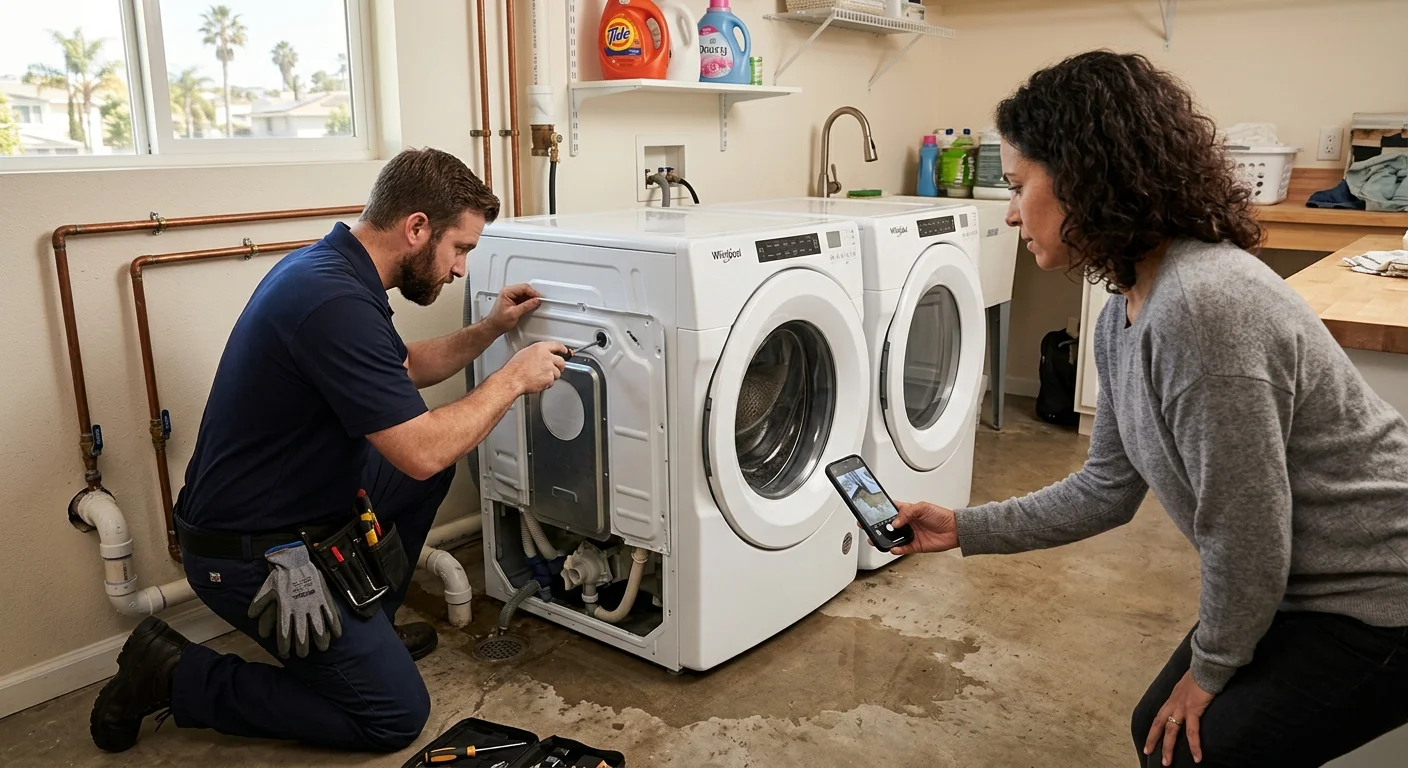
Emergency washer repair in San Diego starts with a clear record of the problem. Note any visible leak, display code, noise, smell, and the cycle stage when the machine stopped. These details help a matched independent technician understand the request before diagnosing it.
Which washer symptoms need prompt attention
An urgent washing machine repair request should describe what’s happening now. The word “emergency” alone doesn’t give a technician enough information. Lead with the condition that changed and whether it’s continuing.
Put these observations near the top of your request:
- Water visible near, beneath, or behind the washer
- Smoke, sparking, a burning smell, or unusual heat
- Repeated banging or movement from the washer’s normal position
- A door or lid that won’t release
- Clothes and water remaining inside after the cycle stopped
- A blank, flickering, or unresponsive control panel
- A code that returns after a manufacturer-approved step
- Filling, draining, spinning, or locking that behaves differently than usual
Describe only what you can observe. “Water appeared near the front-left corner” is more useful than “the pump broke.” The first statement is evidence. The second is a diagnosis that still needs testing.
If the condition involves immediate danger, contact the appropriate emergency authority instead of waiting on an appliance referral. This page can’t provide a model-specific safety procedure. Washer designs, hookups, and manufacturer instructions differ.
Urgent status also doesn’t guarantee a particular arrival window. Technician availability varies by location, workload, appliance, and access. Our guide to what counts as an appliance emergency explains how to separate an active problem from a repair that can be scheduled normally.
What to check without opening the machine
Start with information you can gather without removing panels or moving the washer. Look for the brand, model number, and serial number. These may appear around the door opening, beneath the lid, or on an exterior label. Check the owner’s manual if the label isn’t readily visible.
Write down the selected cycle and its last completed stage. Note whether the washer stopped during filling, washing, rinsing, draining, or spinning. Copy every displayed code exactly, including letters, numbers, and punctuation. A clear photo is often better than a handwritten version.
Check which indicator lights remain on. Record the displayed time and any lock symbol. Note whether the controls respond, but don’t invent a testing sequence. Follow only the instructions published by the manufacturer for that exact model.
The approved claims file doesn’t contain a verified universal water or electrical shutdown procedure for washing machines. Because that procedure couldn’t be confirmed across models, this article doesn’t prescribe one. Consult the manufacturer’s manual or support channel for model-specific directions. Don’t treat advice for a different washer as interchangeable.
The model and serial number can also help with recall research. Search the Consumer Product Safety Commission recall database before requesting service, especially when the symptom involves heat, smoke, or unexpected movement.
Finally, describe the installation. Tell us whether it’s a top-loader, front-loader, stacked unit, or compact washer. Note whether it sits in a garage, closet, shared laundry room, or upstairs space. That context helps the matched technician understand access without guessing.
What to document about leaks and controls
A good leak record shows location and timing. Take one wide photo of the washer and surrounding area. Then take a closer photo showing where the water first appeared. Don’t label a component as the source unless a technician has confirmed it.
Record the leak using plain observations:
- The cycle stage when you first noticed it
- Whether water appeared at the front, side, rear, or hookup area
- Whether it appeared during filling, agitation, draining, or afterward
- Whether the amount changed while you watched
- Whether the washer displayed a code at the same time
- Whether this happened before and under which cycle
Avoid statements such as “the drain pump is bad” or “the door seal failed.” Water can travel before becoming visible. The place where you see it may not identify the failed part.
Controls need the same careful record. Photograph the full display before changing any settings. Write down the order of lights, tones, or messages. If a code disappears, note what happened immediately before it cleared. Include any manufacturer-approved steps you already tried.
If the tub still contains water or the cycle stopped before draining, read the washer won’t drain guide for additional details worth recording. Use that guide for observation, not as permission to open the cabinet.
San Diego location details matter too. A technician needs to know whether access involves a Pacific Beach apartment, a gated Chula Vista complex, or a garage entrance in El Cajon. Include stairs, elevator access, parking instructions, and whether another appliance blocks the washer.
What the matched technician needs to know
The matched technician needs a short timeline, not a long theory. Begin with the washer type, brand, model, and location. Then state what the machine was doing when the symptom began.
A useful summary follows this order:
- Washer type and exact model
- Cycle selected
- Last normal action
- First unusual sound, smell, movement, code, or visible condition
- Current control display
- Manufacturer instructions already followed
- Photos or video available
- Access details for the laundry area
Mention recent changes without deciding they caused the problem. These might include a different load type, a moved machine, a newly noticed sound, or service performed by another company. State the date when possible.
Repair Pro San Diego makes the referral. We don’t inspect the washer, employ the technician, stock parts, or perform the repair. The independent professional we match diagnoses the problem and discusses the available work with you.
Ask the technician about their diagnostic fee and whether it’s credited toward the repair. The matched technician diagnoses first and quotes in writing before work begins. Also ask who provides any warranty and what its written terms cover. Repair Pro San Diego doesn’t set prices or provide repair warranties.
California appliance service dealers have a state registration system. You can check a business through the California Department of Consumer Affairs search. Our network matches homeowners with licensed and insured local technicians.
Homeowners farther inland can also review our guide to appliance repair in El Cajon for location-specific service information.
How to request emergency washer repair
Start your request with the condition that makes the washer problem urgent. Follow it with the model, cycle stage, code, and visible location of any leak. Mention smoke, smells, movement, or control changes exactly as observed.
A concise request could read:
Front-load washer, model number available. It stopped during the rinse stage and shows code [exact code]. Water was observed near [exact location]. Photos are available. No panels were removed.
Add your San Diego County location and access details. Name the city or neighborhood rather than writing only “San Diego.” Include whether the washer is stacked, built into cabinetry, behind a narrow doorway, or reached by stairs.
Our emergency appliance repair service matches urgent requests with independent local professionals. The washing machine repair service provides more information about the referral process and common washer symptoms.
Don’t base the request on a promised response time. Repair Pro San Diego doesn’t promise round-the-clock coverage, priority dispatch, or an arrival window. Availability and scheduling come from the independent technician.
The phone line is voicemail. A recording-consent notice plays before your message is recorded and transcribed. Leave the appliance type, city, model if known, current symptom, and a callback number. Don’t leave the message at “my washer is broken.” Specific details help us understand the referral you need.
You can also say whether the machine is in a home, rental, shared laundry room, or business. That context helps identify the right type of independent appliance technician without implying that a repair has already been diagnosed.
When to call us
Call when manufacturer instructions haven’t resolved the symptom and the washer needs professional diagnosis. Repair Pro San Diego connects homeowners across San Diego County with licensed, insured independent technicians but performs no repairs itself. Call us at (858) 988-7787 and leave a voicemail with your appliance type, city, symptom, and callback number.