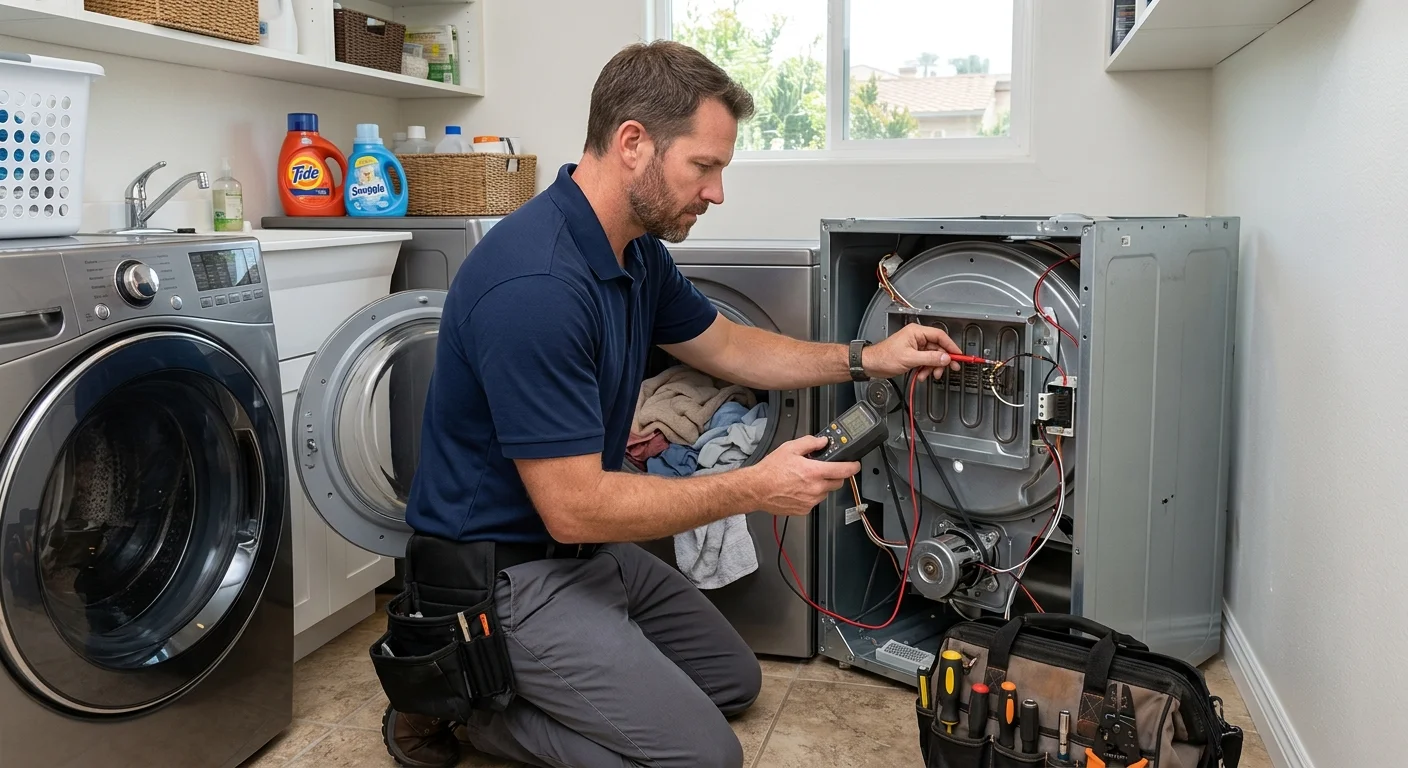
Clothes still damp, the drum dead, the cycle clock frozen. That mid-cycle stop is the complaint behind most appliance repair Del Mar searches on this stretch of coast. A dryer that cuts out halfway is a diagnosis, not a guess. Write down what it did, then match with an independent technician who inspects the machine and the vent path before quoting in writing.
Record when the dryer stops during the cycle
The most useful note you can leave a technician is the minute it failed. Start, heat-up, steady tumble, cool-down, and wrinkle-prevent are different jobs inside the same cabinet. A stop in the first two minutes often points at power, the door switch, or a control that never commits to a run. A stop after the drum is warm often points at heat limits, airflow, or a moisture sensor that never sees dry clothes. A stop only on heavy loads is a different story than a stop on a towel cycle that used to finish.
Write the clock time and the cycle name. Note whether the display went dark, froze, or flashed a code. If there is no display, note where the timer knob sat. Say whether the drum was still turning when it quit, or whether it stalled and then the heat died. Those two patterns are not the same repair.
Listen once, from outside the room. An electric dryer that was heating will often go quiet when the element drops out. A gas dryer that was heating will lose the burner sound. Do not keep restarting it to “see if it comes back.” Repeated aborted heats cook lint in the cabinet and in the vent. If you smell scorching, see smoke, or the breaker will not reset, stop using the machine. That is closer to what counts as an appliance emergency than a nuisance pause.
Capture the pattern across a few loads if it is safe to run short ones. Once is a fluke until it repeats. Every load, at the same point, is a map. Only on long cycles is another map. Only after a storm, a marine-layer morning, or a day the laundry room felt damp is worth writing down on this coast. Del Mar’s gray mornings load extra moisture into a tight laundry closet. That does not prove a part failed. It does tell the technician the machine may be fighting wet air as well as a fault.
Photograph the model sticker on the door jamb or the rear panel. Brand, model, and serial save a second trip for parts. Note gas or electric. If you are not sure, look at the fuel line or the big 240-volt cord, and leave that as a question for the visit rather than guessing.
What owners can observe without opening panels
You can learn a lot without removing a single screw. Leave the cabinet closed. Live voltage, gas valves, and high-limit circuits are not home tests.
Pull the lint screen and look at it in daylight. A packed screen is an easy restriction. A screen that looks clean while the machine still overheats or quits is a clue the restriction is farther down the vent. On ocean-facing Del Mar walls, step outside and look at the hood. A flap stuck shut by lint, paint, or salt crust will starve the fan. You should see the flap move when someone starts a cycle. If it stays shut, write that down. Do not yank the hood apart on a stucco wall. That is finish work, not a lint wipe.
With the machine unplugged, open the door and turn the drum by hand. It should move with steady resistance. A drum that will not budge, or that scrapes, belongs on the same list as a dryer that will not spin. A belt that has walked off, a seized roller, or a foreign object will stop a cycle as surely as a dead board. Plug it back in only if you plan a short observation run, and stay in the room.
Press the door switch with the door open, if the design lets you, and see whether the control wakes. Do not tape the switch. Feel for heat at the door glass or the outgoing vent after a few minutes, from a safe distance. No heat, some heat then a hard stop, and heat that never quits are three different reports. Look at the outlet and the cord. A scorched plug, a warm 240-volt receptacle, or a breaker that feels hot is an electrical problem. Leave it for the technician. Do not reset a breaker that trips twice.
Check CPSC recall listings if the dryer is a model you have seen in news about overheating or fires. A recall does not prove your unit is the one in the notice. It does belong in the notes you hand the technician.
Skip any advice that says to jumper a thermal fuse, foil a vent, or run the dryer with the hose off in a closet. Those shortcuts hide the fault and raise fire risk. The dryer vent safety basics still apply in a Del Mar condo stack: short, smooth, clean, and actually exhausting outdoors.
What technicians inspect after an interrupted cycle
The technician we match does the opened-cabinet work. Repair Pro San Diego is a referral service. We do not send a branded truck, stock parts, or perform the repair. The independent, insured pro you are matched with diagnoses on site and quotes in writing before any repair starts.
After an interrupted cycle, that inspection usually follows the path the air and the power actually take. On electric units, that means the heating element, cycling thermostat, high-limit thermostat, and thermal fuse. A blocked vent or a failed blower will overheat those safeties and kill the cycle. On gas units, the same airflow path matters, plus igniter, flame sensor, and gas valve coils. Gas work stays with the technician. If you smell gas, leave the home and call 911. Then notify SDG&E through its published gas emergency channel.
The drive system is next when the drum died mid-tumble: belt, idler, motor, and rollers. Controls come after the cheap, visible failures are ruled out. A moisture sensor coated with fabric softener can lie to the board and end a cycle early, or never end it. A failing board or timer can drop out at the same program step every time. None of that is a verdict you can make from the lint screen.
Venting gets extra attention on this coast. Bluff and village houses often hide a long run through a garage, a joist bay, or a tight closet. Condos along Camino Del Mar and in Del Mar Heights often share a chase. A crushed flex hose, a bird nest in the hood, or a damper that will not open will look like a “bad dryer” until someone measures airflow. The technician should say what they found in plain words: airflow, heat, drive, or control.
Ask whether the business is registered with California’s Bureau of Household Goods and Services. Appliance repair dealers register with BHGS under the Department of Consumer Affairs. You can check a business on the state lookup. That lookup confirms registration status. It does not grade an individual technician’s skill. Ask the technician about their diagnostic fee and whether it is credited toward the repair. The brand has no fee schedule and no hourly rate to quote.
There is no approved dollar range in our claims file for a typical dryer job, so this page will not invent one. National cost guides publish figures for some other appliances. Dryer work still lands on parts, access, and whether the vent must be cleared as part of the same visit. The matched technician diagnoses first and quotes in writing before work begins.
Which Del Mar property details need confirmation
Del Mar is a San Diego County beach city, not the Orange County village with a similar name. It sits west of I-5, south of Solana Beach, and north of Torrey Pines, with the fairgrounds and Via de la Valle on the inland edge. That geography is the point. A page that could be copied to El Cajon would miss the marine layer, the salt on west-facing hoods, and the tight laundry rooms in village and bluff housing.
Confirm where the dryer lives. A garage on a slope lot, a stacked closet on a second floor, and a ground-floor laundry off the kitchen are three different access notes. Confirm how exhaust leaves the building: rear wall to the ocean breeze, roof jack, or a shared chase. Confirm gas or electric, and which breaker or shutoff serves the unit. Confirm parking and stairs so the technician is not guessing from a map pin.
Housing here is mixed. The village along Camino Del Mar and the streets around the fairgrounds include older cottages next to rebuilt coastal homes. Del Mar Heights sits above that, still in the marine air, with more planned streets and many laundry closets instead of wide garage bays. We do not publish a Census share for pre-1978 housing on this page. Treat age as something you confirm from your own records, the model tag, and what the technician sees on the hookups.
Salt air and morning damp do not automatically mean “replace the dryer.” They do mean the exterior flap, the last few feet of duct, and the room’s moisture are part of the complaint, not extras. Inland East County heat cooks a different failure list. Coastal north county cooks this one: restricted vents, stiff plastic hoods, and controls in a closet that never dries out.
If the dryer is in an HOA building, note any rules about roof or chase access. The technician cannot open a locked common chase without the association’s path. Put that in the voicemail. It saves a wasted visit. If a second appliance in the same closet is also acting up, say so. Shared outlets and shared vents show up on this coast more often than people expect.
For broader county context on how techs approach heat, tumble, and vent faults, see our guide to dryer repair in San Diego. The Del Mar visit still turns on your notes, your vent path, and the model in front of them.
How to request a matched dryer technician
Leave a voicemail that a person can act on. The line records. It does not connect you to a dispatcher who books on the spot. Say you are in Del Mar, give the street and any gate or unit number, and name the appliance. Add brand, model if you have it, gas or electric, and the cycle stage when it stops. Add heat yes or no, drum yes or no, any code, and where the vent exits. Mention smoke, scorch, or a tripping breaker first.
We match you with a licensed, insured local pro. That technician inspects, explains the fault, and quotes in writing. They do the repair if you approve it. Warranty, if any, is theirs, on the work they perform. The brand does not hold a contractor license, does not warranty repairs, and does not promise an arrival window.
People also ask who is “best,” what an hour costs, and whether a fix is worth it. There is no honest ranking we can publish. Check BHGS registration, ask for proof of insurance, and compare the written diagnosis. Hourly rates are not a figure this brand can state. Diagnostic practices vary by technician. Repair-versus-replace has no government percentage test. Ignore any “50 percent of a new machine” rule you have heard. Age, parts availability, cabinet condition, and the vent are the real inputs. Our repair or replace explainer walks through that decision without a fake cutoff. Efficiency comparisons belong on ENERGY STAR’s appliance pages and the Department of Energy’s appliance guidance, not on a guessed savings number.
Refrigerator pricing is a different job and a different diagnosis. If that is the machine that failed, say so in the message instead of mixing it into a dryer complaint.
When to call us
Call when the dryer stops mid-cycle and your notes still leave the cause inside the cabinet, the vent, or the fuel and power path. A matched local appliance repair pro should open that up, not a guess from a parts diagram. Call (858) 988-7787 to leave a voicemail requesting a match with a local appliance repair pro.