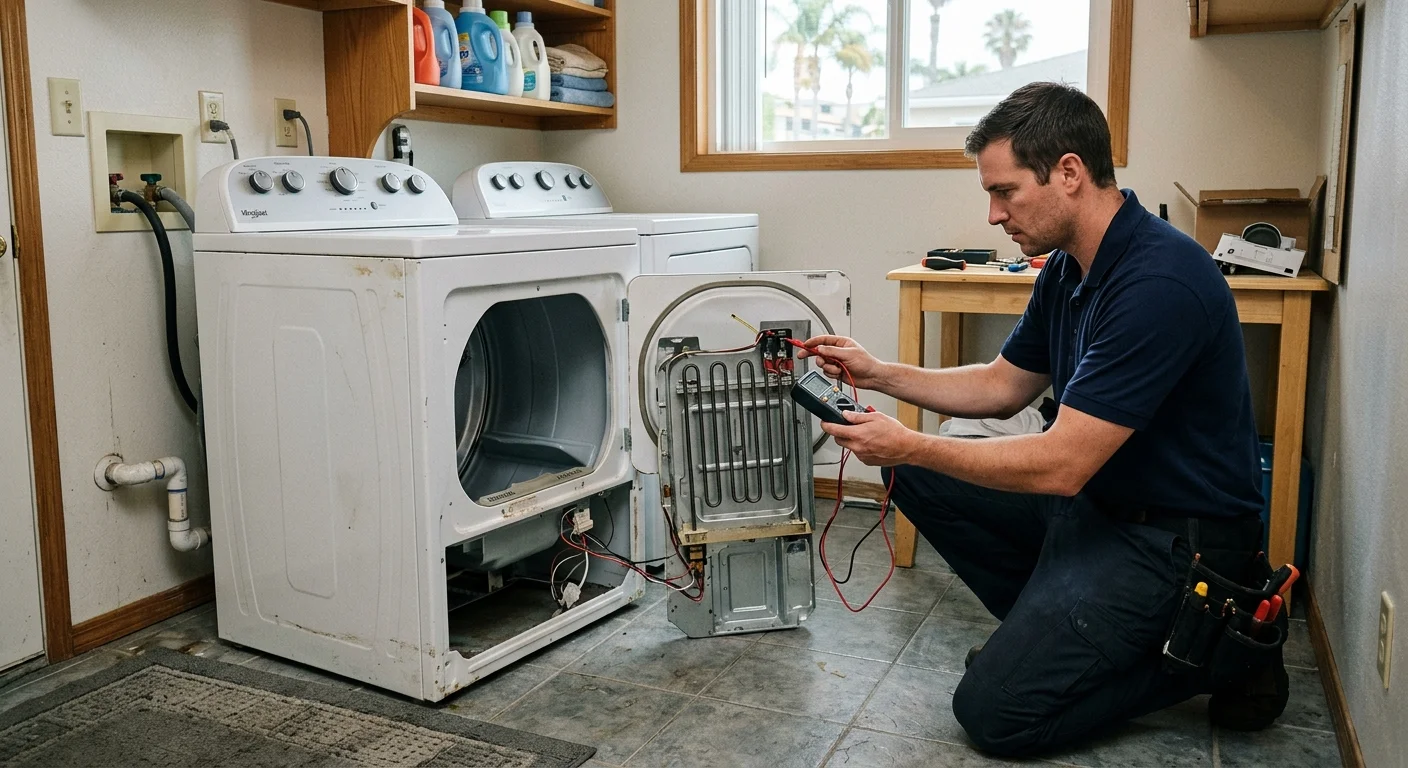
When an Imperial Beach dryer tumbles and the load comes out cold, the motor ran and the heat did not. That is a no-heat complaint, and it is a different job from a dryer that never starts or one that dies mid-cycle. Repair Pro San Diego matches you with an independent, licensed, insured local technician who diagnoses the heat path on site. We do not send a brand truck, and we do not perform the repair ourselves.
Confirm the model and exact no-heat pattern
Write down the brand and the full model number before anyone moves the machine. On most dryers the tag sits in the door opening, on the frame, not behind a rear panel. Open the door, take a photo in daylight, and keep that photo with your notes. If the tag is worn, photograph the control panel and any energy guide sticker you can see without sliding the cabinet. Frigidaire electric models usually carry FED or FFED prefixes. Gas models from that brand usually carry FGD or FFGD prefixes. Treat those letters as a hint, then still copy the whole string.
Name the fuel type in the same note. An electric dryer uses a cord and a wall receptacle. A gas dryer has a gas supply line at the back. If you cannot see the hookup without pulling the unit, leave it in place. Pulling a gas line or a tight 240-volt cord is work for the matched technician, not a hallway experiment.
Then describe the no-heat pattern in one sentence. The useful versions are specific. The drum turns, the cycle finishes, and the clothes are room-temperature. The drum turns, the first minutes feel warm, then the rest of the cycle is cold. Timed dry feels warm and sensor dry does not. A gas unit clicks and never lights. A gas unit never clicks. The display shows a code. Those are different heat-path failures, and they keep this Imperial Beach visit distinct from a mid-cycle shutdown.
Add what the load was doing. Towels that stay wet after a long cycle point at missing heat or blocked airflow. A small load that feels cool after a short cycle can be a control or thermostat issue. Note the cycle name you used, how long it ran, and whether the interior drum felt warm when you opened the door. Do not reach past the drum into the heater housing.
If the dryer is still under a manufacturer’s express warranty, say so in the intake. California’s Song-Beverly Consumer Warranty Act requires the manufacturer to start service in a reasonable time and to finish repairs within 30 days unless the delay is beyond the manufacturer’s control. Warranty periods also pause while the unit is in for repair. The matched technician can tell you whether the work should go through the maker or stay a local repair. Check the model against the CPSC recall list as well. A recall is a manufacturer notice, not a diagnosis.
For the countywide symptom map, use our dryer not heating guide. This page is the Imperial Beach version: South Bay address, fuel type, and the exact cold-tumble pattern.
What owners can observe without opening the dryer
Stay outside the cabinet. You can gather a clean intake without removing a rear panel, a blower cover, or a gas valve. The goal is a record the technician can trust, not a parts guess.
Run one empty timed cycle with the lint screen out, cleaned, and seated. Stand by the door. Confirm the drum turns. After five minutes, open the door and feel the drum wall with the back of your hand. Warm metal with wet clothes later still points at airflow. A drum that never warms points at the heat circuit. Do not keep restarting the same load all afternoon. Extra cycles on a blocked vent or a failed fuse do not help.
Check the wall controls you can see. For an electric dryer, look at the breaker panel for a double-pole breaker that is half-tripped. A dryer can tumble on one leg of a 240-volt circuit and produce no heat. Reset only if you know which breaker belongs to the laundry. If the handle will not stay on, leave it off and put that in the notes. For a gas dryer, confirm other gas appliances in the home still operate. If you smell gas, do not start the dryer. Leave the building and call 911 and SDG&E. Do not open the cabinet, and do not tighten fittings.
If you already know where the outdoor vent cap is, look at it from outside. Seacoast Drive homes, Palm Avenue interiors, and garage laundry rooms all terminate in different places. You are only checking what is visible: a flap that never moves, a cap packed with lint, or a hood you cannot find. Do not climb a roof. Do not pull the dryer to inspect the hose. If the termination is unknown, write “vent outlet not located” and stop.
Listen from the doorway. A gas dryer that never ignites may stay quiet at the burner. An electric dryer with a dead heater can sound like a normal tumble. A sharp buzz from the motor with no heat is worth recording. Do not interpret the sound as a named part.
Write the room. Interior closet, garage, stacked closet, or a tight hallway alcove. Note whether the door was closed during the cycle. Note pets, kids, and whether the unit is a rental. That is observation, not a theory about Imperial Beach housing stock.
Skip YouTube teardowns. Heating elements, igniters, thermal fuses, and gas coils sit behind live voltage or fuel. The safe owner list is lint screen, breaker, outdoor cap if you can see it, model photo, and the cold-tumble pattern.
What technicians inspect after a no-heat complaint
The independent technician we match does the diagnosis. Expect a walk-through of your notes, then tests on the heat path with the power (and gas, if present) controlled. Most of these jobs finish in one visit when the failed part is identified before any order is placed. The tech quotes in writing before work begins. Ask about that technician’s diagnostic fee and whether it is credited toward the repair. Repair Pro San Diego has no fee schedule.
On an electric dryer the heat path is the supply, the controls, the high-limit and cycling thermostats, the thermal fuse, and the heating element. A drum that turns with no warmth often means one supply leg is missing, a fuse is open, or the element is open. Those are meter readings, not a parts swap from the driveway. On a gas dryer the same complaint often lands on the igniter, the flame sensor, or the gas valve coils, after the tech confirms the shutoff is open and the machine is calling for heat. Gas work stays with that technician. Do not ask a neighbor to “check the valve.”
Airflow is part of a no-heat call even when the heater is the failed part. A clogged transition hose or a packed termination can overheat the cabinet and open a thermal fuse. The fuse then leaves you with a dryer that tumbles cold. The matched tech will inspect the visible duct, the blower, and the outlet they can reach. Rigid questions about city vent code belong to the City of Imperial Beach building division. We could not confirm a specific Imperial Beach dryer-vent ordinance in the claims file for this site, so the technician works from the manufacturer instructions and what is on the machine. For general vent hygiene, use our dryer vent safety guide.
Controls and sensors come next if power and the heater circuit test good. A moisture sensor that reads a dry load as wet can stretch a cycle. A failed operating thermostat can cut heat early. An error code on the display is a starting point, not a parts list. The tech compares readings to the service data for your exact model, which is why the door-frame photo matters.
If you want the wider county picture of how these calls run, read dryer repair in San Diego. Imperial Beach jobs still turn on the same physics. The local difference is access, fuel type, and where that vent actually ends.
California appliance repair businesses register with the Bureau of Household Goods and Services under the Department of Consumer Affairs. Registration is not a skills exam. It confirms the business is on file. You can look up a dealer at the state’s license search. That lookup reports registration status. It does not grade the individual at your laundry closet.
Which Imperial Beach property details need confirmation
Imperial Beach is San Diego County’s southernmost beach city. The Pacific is west. The Tijuana River Estuary and the border sit south. Palm Avenue carries you east toward Chula Vista. State Route 75 runs the Silver Strand north toward Coronado. Seacoast Drive is the beachfront street. The pier and Portwood Pier Plaza are public landmarks. Those are the geography the technician needs, because a “South Bay” pin is not an address.
Confirm the city on the intake. Blocks near Palm Avenue sit against the City of San Diego and against Chula Vista. A wrong city in the request delays the match. Give the street, the ZIP if you have it (91932 is the Imperial Beach ZIP), gate codes, and where to park. Do not assume a beach-block driveway is obvious from a map pin.
Confirm where the dryer lives in the building. A garage unit, a stacked closet, and an interior first-floor closet are three different access jobs. Say whether the machine is on a pedestal, whether the washer is stacked on top, and whether the closet door closes against a flex hose. If you rent, say whether the owner must approve a repair. If an HOA controls the laundry room, say that too. None of that is a claim about how most Imperial Beach homes were built. It is the layout of your unit.
Confirm fuel and vent as facts you can see, not as climate stories. Do not treat salt air, marine layer, or estuary moisture as a diagnosed cause. Those are not verified failure rates in the claims file, so they do not belong in the work order as if they were. What belongs: gas or electric, vent cap found or not found, breaker behavior, and the cold-tumble pattern.
If the matched tech is already working a South Bay day, neighboring appliance repair in Chula Vista is the inland next city along Palm Avenue. The referral still has to name Imperial Beach when that is where the dryer sits. Cross-city guessing creates the wrong parts run.
Leave building-age percentages off the form unless you have your own records. This page does not publish a Census housing-age figure for Imperial Beach. A permit history, a remodel year, or “original laundry hookup, never moved” is more useful than a guess.
How to request a matched dryer technician
Repair Pro San Diego is the match, not the crew. You request dryer repair for an Imperial Beach no-heat dryer. We connect you with an independent local pro who is licensed and insured. That pro inspects, quotes in writing, and performs any agreed repair. The brand does not stock parts, does not warrant the work, and does not hold a trade license for the cabinet.
Leave a voicemail that a technician can act on. Include your name, Imperial Beach street address, a callback number, brand and model, gas or electric, and the one-sentence no-heat pattern. Add breaker notes, vent-cap notes, and whether the unit is stacked. Add warranty status if you know it. The line records the message. A greeting and a recording-consent notice play first. California is an all-party consent state, so that notice is required. Nobody picks up live.
Do not wait on the message for a price. There is no brand price list for Imperial Beach dryer repair. National cost guides are not a substitute for a written quote on your machine. The matched technician diagnoses first.
If the dryer is a gas unit and you smell fuel, this is not a match request. Leave, then call 911 and SDG&E. After the utility clears the scene, you can request a technician for the appliance itself.
Bring the same notes to the visit. Model photo, cycle name, how the clothes felt, and where the vent exits if you know. That is enough for a South Bay no-heat call. The rest is meter work inside the cabinet, and that is the technician’s job.
When to call us
Call when the drum turns and the clothes stay cold, when a gas dryer will not ignite, or when a half-tripped laundry breaker leaves you with tumble and no heat. A licensed, insured independent appliance repair pro has to test the heat path before anyone replaces a part. Call (858) 988-7787 to leave a voicemail requesting a match with a local appliance repair pro.