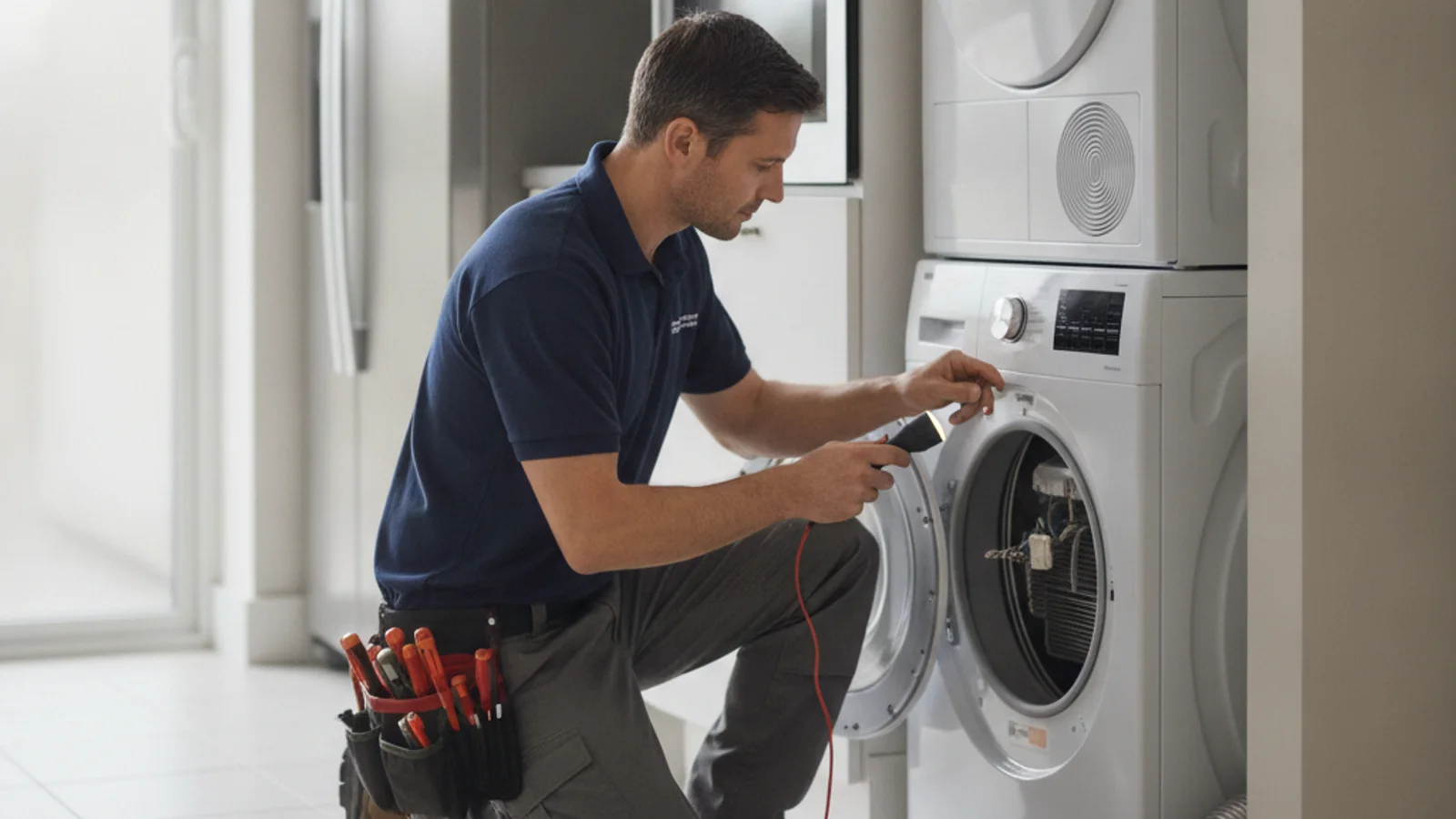
If your dryer runs through a full cycle but the clothes come out cold and damp, possible causes include a restricted exhaust vent, a thermal fuse, a heating element on electric models, an igniter or gas valve path on gas models, or a tripped leg of a 240V breaker on electric dryers. Those are inspection points, not a ranked “most common” list. Owner checks stay at the lint screen, the exterior vent hood, and the breaker panel. Panel removal and meter tests belong to the model procedure or a matched technician.
Why a clogged vent is worth checking first
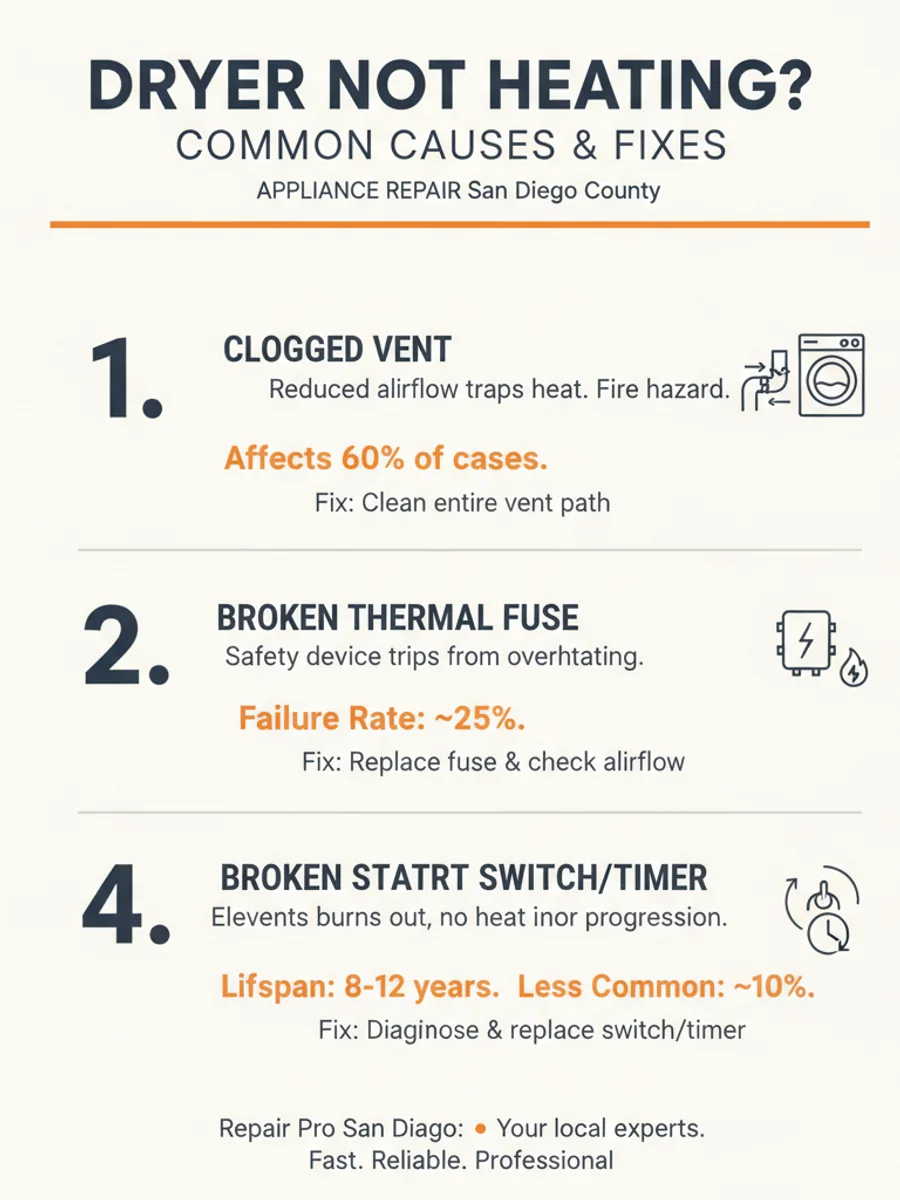
A dryer needs a clear path to exhaust hot, humid air. When lint builds up in the vent hose or the wall duct, airflow slows, heat can back up inside the drum, and a high-limit thermostat may shut off the heating circuit. The drum can keep spinning without heat.
The homeowner check: Clean the lint screen. Look at the exterior vent hood. If lint is packed around the louvers, or the flap barely moves, record that for the technician. Do not pull the dryer off the wall, disconnect the vent hose, or run a heat test if you smell smoke. Longer duct runs through walls or a roof belong to a vent specialist or the appliance technician.
Blown thermal fuse
The thermal fuse is a one-time safety device. It can open when the dryer overheats, often with a restricted vent. Once it is open, the dryer may not heat until the fuse is replaced and the restriction is addressed.
The homeowner check: Stay outside the cabinet. Do not remove the back panel or meter the fuse from this page. Describe the no-heat symptom, the lint-screen condition, and the exterior vent for the technician. Continuity testing is electrical work inside the machine.
Failed heating element (electric dryers)
On electric dryers, the heating element is a coiled resistance wire inside a metal housing. When a coil is open, heat can stop while the drum still tumbles.
The homeowner check: Same boundary as the thermal fuse. With the dryer unplugged, stay outside the cabinet. Do not disconnect element terminals or interpret a universal ohm range. For how this site treats meter tests, see dryer heating element testing.
Replacing a heating element is quoted after diagnosis. If you’re not comfortable with electrical components inside an appliance, request dryer repair.
Gas dryer: igniter, flame sensor, and gas valve coils
Gas dryers heat differently. A gas valve opens, an igniter glows hot enough to light the gas, and a flame sensor confirms the burner is lit. Any one of these parts failing means no heat, even though the drum spins normally.
The igniter is one possible failure point on a gas dryer. Glow through an observation window, if the model has one, is an observation. It does not confirm a healthy igniter or an open gas valve.
Safety note for gas dryers: Do not open or test the gas valve or supply line yourself. If you see, hear, or smell signs of a gas leak, leave immediately and call 911 or SDG&E at 1-800-411-7343 from a safe location. Follow SDG&E’s gas-appliance safety guidance before arranging igniter or coil diagnosis.
Tripped 240V circuit breaker (electric dryers only)
Electric dryers run on a 240V circuit, which uses two separate 120V “legs.” If one leg trips in the breaker panel, the dryer gets power to run the motor and controls, but the heating circuit goes dead. The drum spins. Nothing heats. This is an easy thing to miss.
The check: Go to your breaker panel and look for the double-pole breaker labeled for the dryer. Even if it doesn’t look fully tripped, flip it all the way off, then back on. Run a cycle. If it trips again immediately, there’s a wiring fault that needs an electrician, not an appliance tech.
When to call a professional
Check this against where you are. None of these rows is a completed diagnosis.
| Symptom | Possible next check | Owner-safe? |
|---|---|---|
| Drum spins, no heat, long cycle times | Restricted vent | Lint screen and exterior hood only |
| Drum spins, no heat, vent hood looks clear | Thermal fuse or another heat-circuit part | Technician or model procedure; not a home meter test from this page |
| Electric dryer, no heat, vent already checked | Heating element or related parts | Technician |
| Gas dryer, burner doesn’t light | Igniter, coils, or flame sensor | Call a pro |
| Electric dryer, drum spins, no heat | Breaker panel | Check the double-pole dryer breaker; call an electrician if it re-trips |
| Any sign of a gas leak | Possible gas leak | Leave immediately; call 911 or SDG&E at 1-800-411-7343 from a safe location |
If you’re in San Diego and need a professional look, the technicians in our network handle dryer repair across the county. Call (858) 988-7787 and we’ll match you with a local tech.
You can also check our guides on gas vs. electric dryer considerations for San Diego homes and dryer vent safety for more context. Or if you’re in North County, we serve dryer repair in Encinitas and surrounding cities.
Frequently asked questions
Why is my dryer running but not heating?
Possible reasons include a restricted exhaust vent that triggered a safety cutoff, a thermal fuse that does not reset itself, a heating element on electric models, or an igniter path on gas models. On electric dryers, a partially tripped 240V breaker is also worth checking before requesting a visit.
Can a clogged vent stop a dryer from heating?
Yes. Restricted exhaust can keep heat from leaving, and a safety thermostat can cut power to the heating circuit. The drum can keep running. Clear what you can see at the lint screen and exterior hood. Hidden ductwork is not an owner chase from this page. If the vent was badly restricted, a thermal fuse may also have opened and will need a technician.
Does this problem affect gas and electric dryers the same way?
Not quite. Both types can suffer from clogged vents and blown thermal fuses. But the heat source is different. Electric dryers use a resistance heating element that can break or burn out. Gas dryers use a burner assembly with an igniter, flame sensor, and gas valve coils, any of which can fail independently. If your gas dryer runs but won’t heat, start with the vent, then call a technician for the burner components.
How much does it cost to fix a dryer that’s not heating?
It depends on the cause. Clearing a short vent run yourself costs almost nothing. A thermal fuse, heating element, or gas igniter and coil set are all relatively inexpensive parts, so labor is usually the bigger factor in the total. A failed control board or motor costs more to fix, since those parts are pricier and the diagnosis takes longer. Every tech in the network sets their own diagnostic fee, and the matched technician quotes the total in writing before any work starts.
When should I repair vs. replace the dryer?
Compare the written repair quote with a real replacement. There is no approved 50% rule and no age cutoff that applies to every dryer. A technician can quote the diagnosed part. You decide with those numbers.