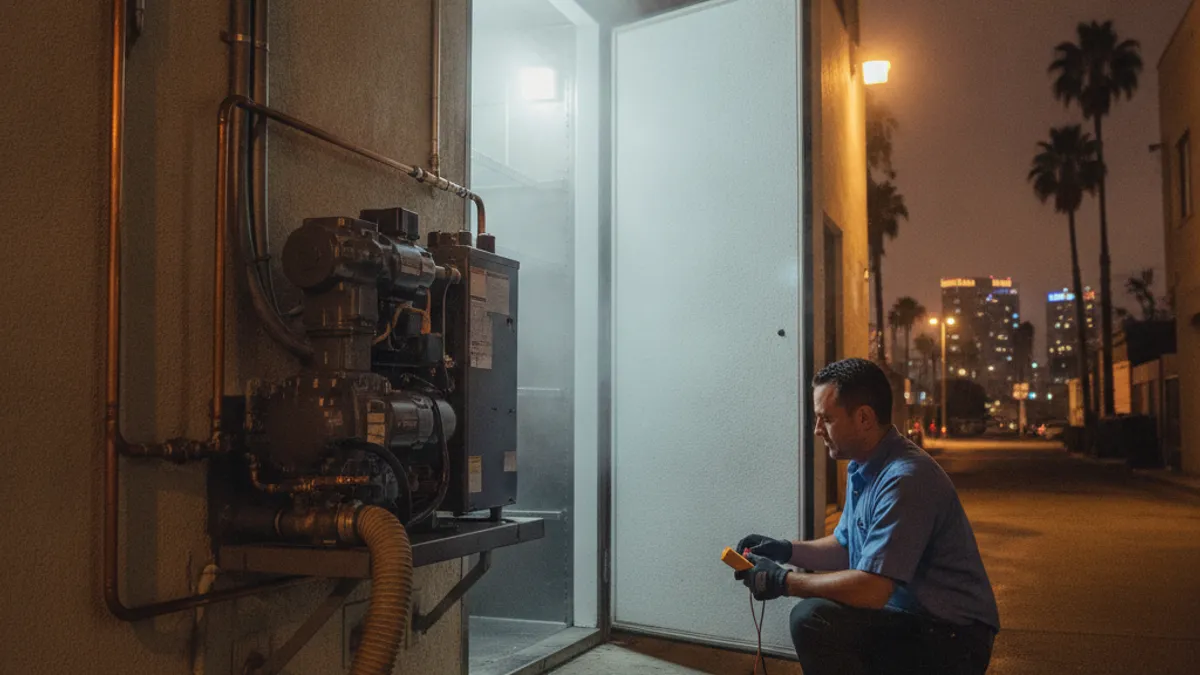
A commercial freezer that fails overnight is a different problem than a home fridge running warm. Restaurants and grocers may be holding a large frozen inventory, and a walk-in or reach-in that is no longer holding temperature needs a documented response, not a guess. We cover general commercial refrigeration failures in our commercial refrigeration repair guide. This page is about what to do while you request a match and wait for a confirmed visit.
Why commercial freezer failures need fast documentation
A walk-in or reach-in holds a large thermal mass of frozen product, which can slow how quickly food warms through. Air temperature inside the box can still climb while product still feels firm. Note the time you noticed the change, the measured air temperature if you have a working thermometer, and whether the door has stayed closed.
FDA food-safety guidance treats 0°F as a storage target for frozen food, not a universal discard rule by itself. Discard and hold decisions belong in your written food-safety plan and in current local or official guidance. San Diego County Environmental Health can advise on local enforcement. Appearance or smell is not a substitute for that plan.
What to do in the first hour
Keep the door closed. Opening a walk-in or reach-in lets warm air in and speeds the temperature climb. Resist repeated checks unless your plan requires a logged reading.
Move the most temperature-sensitive and highest-value product first, if you have backup cold storage. A second freezer or another approved cold-holding option can reduce loss while you wait for a confirmed technician visit.
Log the temperature and the time you noticed the failure. Record the reading, the thermometer used if known, and the steps you took. If a health inspector later asks about product that was discarded or held, a timestamped record is more useful than a verbal account.
Request repair and ask the matched provider to confirm availability. Repair Pro San Diego is a referral service. We match businesses with independent local technicians. We do not dispatch a crew on a guaranteed night-or-day timeline. Leave a voicemail with the equipment type, location, measured temperature, and a callback number, then confirm with the independent provider when they can actually arrive.
What to report so a technician can diagnose later
Describe what you can observe without opening sealed systems or guessing the failed part.
Power. Confirm the breaker has not tripped and the unit is receiving power before assuming a mechanical failure.
Sounds and run pattern. Note whether the unit is silent, cycling, or running continuously. Those observations help the technician. They are not a remote diagnosis of a compressor, leak, or defrost fault.
Door and gasket condition. Photograph a torn, flattened, or ice-packed gasket if you can do so safely.
Frost and airflow. Note heavy ice on an evaporator, weak airflow, or a floor that feels warmer than usual. Do not chip ice off coils unless the manufacturer instructions for that unit say to.
Scheduled commercial service before you are in an emergency is covered in our commercial appliance repair guide and commercial ice machine repair if ice production is part of the same operation.
What emergency commercial freezer repair typically costs
After-hours and weekend pricing is set by the independent technician, not by Repair Pro San Diego. There is no approved commercial dollar range in our claims file. Ask whether an after-hours or urgent visit carries a different diagnostic fee or labor rate, and get the diagnosis and price in writing before work begins. Inventory at risk is a business decision for the operator. It is not a substitute for a written quote.
Frequently asked questions
How long can a commercial freezer stay off before food needs to be discarded?
There is no single safe number on this page. Ambient temperature, how full the unit is, and how long the door stays closed all matter. Follow your food-safety plan and current FDA, FoodSafety.gov, or San Diego County Environmental Health guidance. Log time and measured temperature rather than judging by how food looks.
What’s the fastest way to know if it’s the compressor or something simpler?
A silent unit that still has power, or a unit that runs constantly and still will not hold temperature, are useful observations. Only on-site testing can tell a compressor fault from a leak, a defrost ice-up, or an electrical problem. Do not treat sound as a confirmed diagnosis.
Should I move product to a backup freezer during a failure?
If you have approved backup cold storage, moving high-value and temperature-sensitive product can reduce loss while you wait. Keep that move in your log.
Is there a line to call for a commercial freezer emergency in San Diego?
Call (858) 988-7787 to leave a voicemail requesting a match with a local commercial refrigeration technician. The line is voicemail. A recording-consent notice plays before your message is recorded. Availability is confirmed by the independent provider, not promised at intake.
When to call us
When a commercial freezer is not holding temperature, leave a voicemail with the site address, equipment type, measured temperature, time noticed, and a callback number. Ask the matched technician to confirm when they can arrive. Call (858) 988-7787 to request that match.