When your Whirlpool washer stops mid-cycle and flashes an error code, it’s frustrating. You need to understand what those cryptic letters and numbers mean so you can get your laundry moving again. Some codes point to simple fixes you can handle, while others signal a more serious issue that needs a professional.
This guide covers Whirlpool washer error codes that owners ask about. Frequency is not ranked here. Confirm every code on the chart for that exact model. We’ll explain what they mean, what steps you can take yourself, and when it’s time to call an appliance repair technician here in San Diego. Knowing the difference can save you time and money.
How to read your Whirlpool washer’s error codes
The “F” and “E” pair is a fault index. Confirm F7 E1 and every other code in the chart for that model. Do not treat a blog example as the meaning.
Your washer’s display panel is where these codes appear. If your machine has a digital display, the code will show directly. Older models might use flashing lights on certain cycle indicators or status lights to convey the code. To interpret these, you usually need to consult your washer’s owner’s manual. The manual will have a chart that translates the flash patterns into specific F/E codes. If you don’t have your manual, you can often find a digital version on the Whirlpool website by entering your model number.
Before you jump to conclusions about a major breakdown, always try a basic reset first. Sometimes, a temporary glitch or power fluctuation can trigger an error code. Unplugging the washer for a minute or two, then plugging it back in, can clear many transient errors. If the code persists after a reset, then it’s time to dig deeper into what it means. Understanding these codes is the first step in diagnosing and resolving your washing machine’s issues.
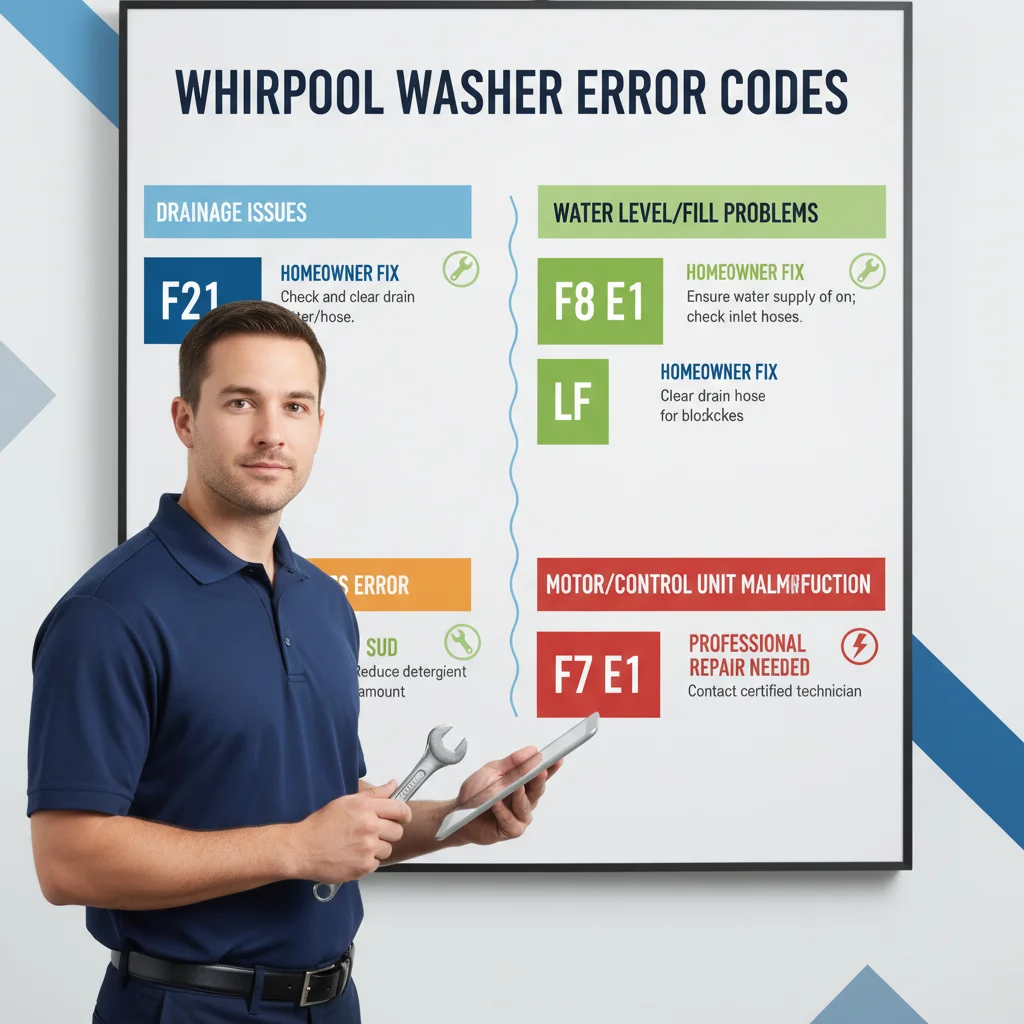
Confirm F21, F8 E1, LF, Sud, and F7 E1 in the Whirlpool chart for that exact model. Shared blog meanings are examples, not the chart.
These letters appear on some Whirlpool washers. Confirm each in the model chart. Frequency is not ranked here. Each one points to a specific type of problem, from drainage issues to water supply and motor malfunctions. Knowing these common codes helps you quickly understand the nature of your washer’s complaint.
F21: Water not draining
The F21 code can involve drain problems on some models. Confirm it in the model document. A clogged filter or hose can be involved. Do not assume the pump has failed. See washer won’t drain.
F8 E1 or LF: Water level or long fill issues
These codes can involve fill or water-level sensing on some models. Confirm F8 E1 and LF in the model chart. Visible kinks in hoses you can see are worth noting. Do not unscrew hoses.
Sud: Excessive suds
Sud or Sd can mean excess suds on some HE machines. Confirm in the model document. Use HE detergent if that washer’s manual requires it. A clean-washer cycle belongs in the same manual. Vinegar is allowed only if the maker says so.
F7 E1: confirm in the model chart
This code can involve the motor or motor control on some models. Confirm F7 E1 in the chart. It is not a shared meaning.
What you can reset yourself
Many Whirlpool washer error codes can be cleared with simple troubleshooting steps right from your San Diego home. Often, the washer detects a temporary fault, and a quick reset is all it needs to get back on track. Don’t immediately assume the worst; start with these basic checks.
If the model manual allows a power cycle, unplug for the time it names, then restore power. Sud cautions stay with an HE-manual qualifier. Do not run a vinegar clean unless that document allows it.
For fill-related codes, confirm the meaning in the model chart. Check that supply valves you can see are open. Do not unscrew inlet hoses from the washer. Clearing inlet-filter debris is a technician step unless the exact manual names that external procedure.
Codes that may still need a technician after a reset
While many error codes point to something you can quickly clear or adjust, others are clear indicators that an internal component has failed. When you’ve tried basic troubleshooting and the code persists, it’s usually a sign that professional washing machine repair is necessary. These issues often involve replacing a specific part, which requires specialized tools, diagnostic equipment, and experience to do safely and correctly.
A returning F21 after the manual’s drain checks is a reason to request diagnosis. It does not prove the pump failed. Do not disconnect hoses to replace a pump.
F7 E1 is listed as a motor-control family on some Whirlpool charts. Confirm it in the chart for your serial. It is not a shared meaning across every model. This is a complex electronic component that regulates the washer’s main drive motor. Diagnosing and replacing a motor control board requires technical expertise to test the board and the motor itself to pinpoint the exact failure. Improper installation or diagnosis here can lead to further damage to the appliance or even safety hazards. These types of repairs are not typical DIY projects for homeowners and are best handled by a qualified professional who understands Whirlpool’s specific systems. If you’re encountering these persistent, part-related errors, it’s a good time to consider calling an expert.
San Diego Whirlpool washer repair
Dealing with a broken washer is never convenient, especially in a busy household. When your Whirlpool washer throws an error code that you can’t resolve yourself, you need reliable service. At Repair Pro San Diego, we understand the urgency of appliance breakdowns. We match you with Whirlpool appliance repair in San Diego and the surrounding areas, to get your laundry routine back on track.
Repair Pro San Diego matches independent technicians. We do not carry genuine Whirlpool parts or promise a first-visit finish. Washer emergencies are not flagged priority at intake. The matched technician diagnoses and quotes in writing.
Frequently asked questions
What does an F21 error code mean on a Whirlpool washer?
Confirm F21 in that model’s chart. A drain filter or hose can be involved. It does not prove the pump burned out.
Can I fix a Sud error myself?
Often, if the model document treats Sud as a detergent issue and you use the HE detergent it names. Do not treat vinegar as a shared clean-washer recipe.
Does unplugging a Whirlpool washer reset error codes?
A power cycle may clear transient codes if the model manual allows it. If the code returns, request diagnosis.
What does F7 E1 mean and can I fix it myself?
Confirm F7 E1 in the model chart. Do not treat it as a proven motor-control failure from the display alone.
When to call us
When your Whirlpool washer’s error code won’t clear, or if you suspect a part like the drain pump, water inlet valve, or motor control unit has failed, it’s time to call in the professionals. Attempting complex repairs without the right knowledge can lead to further damage or safety risks. Call us at (858) 988-7787 and we’ll match you with a technician.