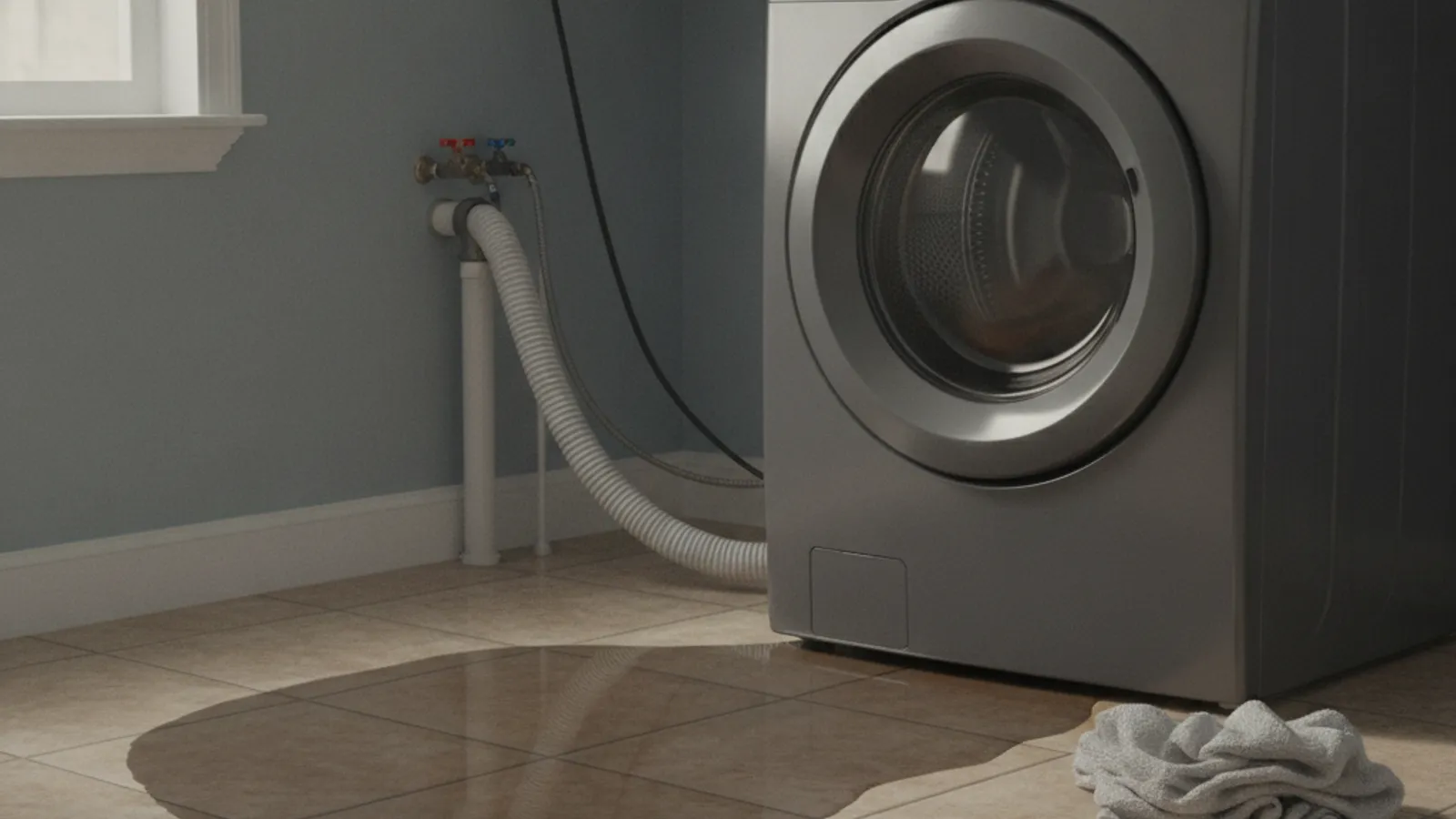
A washer leaking from the bottom is often leaking from higher up. Water can start at a hose, pump, boot, or tub and run down to the floor. Finding the source is the technician’s job once you have cut power and water and recorded when the puddle appeared.
Kill the power and water first
Before you touch anything, unplug the washer or flip its breaker. Then shut off both supply valves behind the machine. Water and electricity in the same puddle is a real hazard, and you can’t inspect hoses with pressure still in the lines. This takes two minutes and it’s not optional.
The drain pump
The drain pump sits low in the cabinet, so a failure there can drip straight to the floor. Possible issues include a cracked housing, a worn seal, or debris in the impeller. Those are possible inspection points, not a ranked cause.
A leak that shows up during drain and spin is a timing clue. Tell the technician. Do not remove panels to feel the pump. A washer that also struggles to empty overlaps with our guide on a washer that won’t drain.
Internal hoses and clamps
Inside the cabinet, hoses move water between the tub, pump, and dispenser. Any of them can split with age, and clamps can loosen or corrode. A pinhole can spray a fine mist that collects under the machine. Feeling hoses with the panel off is a technician step. Record only what you can see from the exterior: fill versus drain timing, and photos of the puddle.
The tub-to-pump bellows
On many washers a short rubber bellows connects the outer tub to the drain pump. It flexes and can crack at the folds. Inspecting it means opening the cabinet. Leave that to the technician.
Door boot and gasket (front-load)
Front-loaders have a flexible rubber boot sealing the door to the tub. Mineral buildup can collect in the folds, and the boot can tear. A leak during spin is a timing clue. If the manual shows how to inspect the visible inner fold without tools, you can look. Do not peel hardware to replace a boot from this page.
The tub seal and bearing
A failed tub seal can let water reach the bearing. Grinding during spin and rusty water are clues, not a confirmed diagnosis. Splitting the machine to replace a seal is a technician job. On older washers, repair versus replace is a written quote, which is the kind of math our washing machine repair cost guide helps you run.
The detergent dispenser hose
The dispenser assembly feeds water through hoses to flush soap into the drum. These connections clog with detergent residue and back up, or the hose works loose. The leak shows during the fill cycle, when water runs through the dispenser. If your puddle appears only as the machine fills, check here.
An overflowing tub
A bad pressure switch or water-level sensor can let the tub overfill. Water spills over the top edge and runs down inside the cabinet to the floor, mimicking a bottom leak. If the tub keeps filling past its normal line and won’t stop, the switch or its air tube is the problem, not a cracked part.
External causes
Not every leak is inside the machine. A drain hose pushed too far into the standpipe can siphon and back water out onto the floor. Supply hoses at the wall connections loosen and weep, especially the rubber ones that should be swapped for braided steel. Check these before you open the cabinet, since they’re the simplest fixes and easy to miss.
How to diagnose it in order
Start by noting exactly when the water appears. A leak during fill can point toward supply hoses or the dispenser. A leak during wash can point toward the tub or door boot. A leak during drain and spin can point toward the pump, bellows, or tub seal. Timing is a clue. It is not a confirmed part.
Do not tilt the machine or run a cycle with the panel off. Photograph the puddle, the model sticker, and any visible hose at the wall. Check drain-hose placement in the standpipe and the supply connections you can see. Pump, bellows, and tub-seal work belong with a qualified technician.
Why San Diego laundry rooms matter here
Where your washer sits changes the stakes. A unit on a garage or ground-floor slab gives water somewhere to spread without much damage. A second-floor closet or a unit stacked over finished living space is a different story. A slow leak there soaks subflooring and drywall below before you notice, turning a cheap pump fix into a water-damage claim. If your washer lives upstairs, treat any puddle as urgent.
Frequently asked questions
Why is my washer leaking from the bottom?
Possible sources include a drain pump, a split internal hose, a torn door boot on a front-loader, or a failing tub seal. The water can start higher and drip to the floor. Trace what you can see from the outside. Leave panel work to the technician.
Is a leaking washer dangerous?
It can be. Water near electrical components is a shock risk, and a slow leak under a second-floor unit causes structural and mold damage. Unplug the machine and shut off the water until you find the cause.
Can I keep using my washer if it leaks a little?
No. Even a small leak gets worse and the water can reach wiring or soak into flooring. Stop using it, find the source, and fix it before running another load.
When to call us
If the leak traces to the tub seal or bearing, or you’ve checked the easy parts and water still pools, it’s time for a pro. Tub repairs and pump swaps go faster and safer with the right tools, and you can read more about our washing machine repair service.
Call us at (858) 988-7787 to get matched with a local technician.