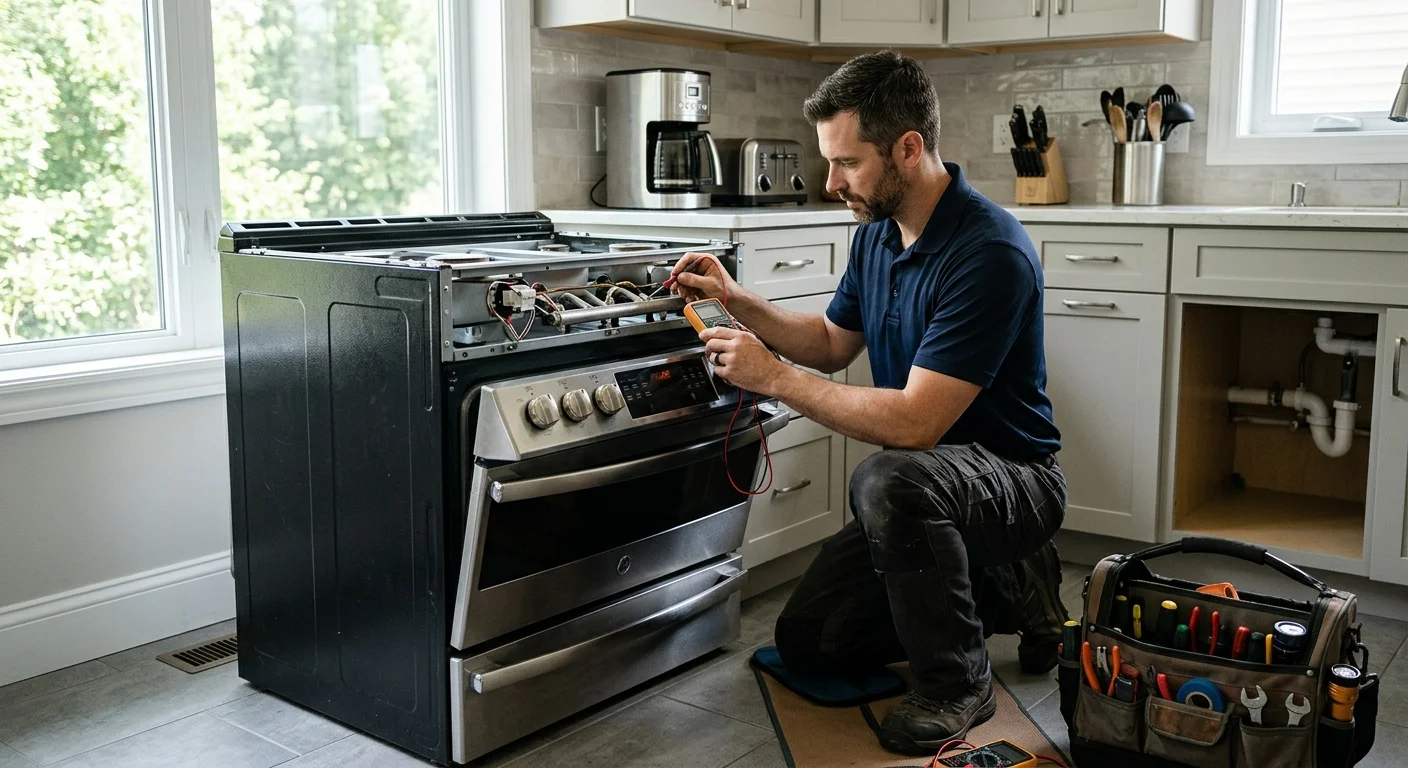
A Samsung range that powers on but produces no heat may have a setting, supply, or component problem. First separate an oven-only failure from a cooktop failure, then record exactly what the controls and burners do. Those details give the matched technician a clearer starting point without you opening the appliance.
Confirm the model and no-heat pattern
Start with the full model number shown on the appliance label. Photograph the label, the control panel, and any displayed code. Samsung changes controls and menu steps across model families. A button sequence from another range may not fit yours.
Next, describe “won’t heat” more precisely:
- The display is completely blank.
- The display works, but the oven stays cold.
- The cooktop works, but Bake and Broil don’t.
- One surface burner or element fails while the others heat.
- Bake fails, but Broil or another oven mode responds.
- The oven warms slightly but never completes preheating.
Don’t turn these observations into a parts diagnosis. One symptom can have several causes. Instead, keep the result tied to the exact model and selected mode.
Samsung’s official oven temperature guide says Demo mode can show “tESt,” “tE 5t,” a lowercase “d,” or a D icon. In that mode, the oven and cooktop don’t heat, although a gas cooktop may still ignite. The correct exit steps depend on the model, so use its manual.
Also note whether the problem began after installation, a power interruption, cleaning, or a control change. Copy an error exactly, including spaces and capitalization. A photo is better than memory.
San Diego County homes can have gas, electric, induction, or dual-fuel ranges. Record what’s actually installed. Our Samsung appliance repair guide explains how referrals work across the county.
What owners can observe without opening panels
Stay at the normal controls and viewing surfaces. Don’t pull the range out, remove panels, or disconnect wiring or gas fittings. The goal is a clean symptom record, not a home repair attempt.
Close the oven door fully. Choose Bake, enter a normal cooking temperature, press START or START/SET, and watch the display. Note whether preheating begins, whether the displayed temperature changes, and whether a code appears. Samsung says a display stuck at 150°F well beyond the start of preheating indicates the oven isn’t heating.
Check the display for Demo mode indicators. Look for a padlock icon or “Loc” if buttons don’t respond. Samsung notes that Control Lock appearance and release steps vary by model. Follow the wording on your panel or the model’s manual.
A blank panel is a different pattern. Record whether it went blank after an outage or during normal use. Don’t assume the heating part failed merely because the screen is dark.
For a radiant electric cooktop, note whether one zone or every zone is affected. Surface elements normally cycle while maintaining their selected setting. For induction, test only with suitable magnetic cookware containing water. Center it on the correct zone and use a size allowed by the manual. Samsung says an empty pan or incompatible cookware can cause an induction zone to shut off.
On a gas cooktop, note whether a selected burner clicks, lights, and holds a flame. Don’t remove or adjust gas parts. Bring the same notes to our broader oven no-heat checklist, which helps separate control, cooktop, and oven symptoms.
What technicians inspect on gas ranges
A matched technician starts with the model information and your symptom pattern. The first split is simple: does the cooktop fail, the oven fail, or do both fail? That directs the inspection without assuming the igniter or control is bad.
For a Samsung gas range repair, the pro can check power at the appliance, control response, ignition behavior, gas supply, and gas pressure. The inspection can also cover burner assembly, the oven ignition path, connections, and model-specific controls. These checks belong with the technician because they go beyond owner-visible observations.
Samsung says a gas oven ignites and turns off more than once while cooking. That cycling maintains temperature, so it isn’t automatically a defect. Its no-heat guidance also compares oven behavior with a surface burner operating. Depending on the result, Samsung points owners toward the gas company, a professional installer, or appliance service. The matched pro can interpret that pattern in context.
Surface burners tell a different story. Normal clicking during lighting shows the spark sequence is active. Samsung also says continuous clicking with no knob at LITE can follow moisture around ignition switches. A technician can inspect the assembly instead of treating every click as the same failure.
Tell the pro whether the range was recently installed or converted for another gas type. Share any installer paperwork you already have. A condo in Chula Vista and a home near Alpine may have different access or fuel arrangements, so describe your actual setup. For more service context, see our San Diego stove repair guide.
What technicians inspect on electric ranges
Electric ranges include radiant and induction cooktops, plus several oven layouts. The technician confirms the type before testing. Cookware compatibility matters on induction, but it doesn’t explain a radiant element or oven that stays cold.
Samsung’s no-heat guidance specifies a 240-volt supply for its electric ranges. A technician can measure the supply at the appliance and inspect the range connection. That distinguishes an incoming-power problem from a fault inside the range. A lit display alone doesn’t replace those measurements.
The pro then compares functions. Bake, Broil, convection modes, and surface zones provide separate clues. A mode that works doesn’t prove which part failed elsewhere. It simply identifies the heating path that needs testing.
For a radiant cooktop, the technician can compare the failed zone with operating zones. Samsung says normal elements cycle on and off to hold a selected temperature. Cycling isn’t the same as a zone that never heats. If only part of a multi-zone element responds, record that distinction too.
For induction, the pro first rules out pan material, placement, size, and an empty-pan shutoff. That avoids opening the range for a cookware mismatch. If the zone still won’t heat, the technician can follow the model documentation through its power, zone, sensor, and control checks.
Inside the oven, testing may cover the heating circuit, connections, temperature input, and control output. Results determine the repair, not a generic “common failure” list. Our oven, range, and cooktop repair service connects San Diego County owners with independent pros for that diagnosis.
When to request Samsung range repair
Request a match when the model-specific owner checks don’t restore heat. Service also makes sense when one burner stays dead, the oven won’t preheat, controls remain blank or unresponsive, or the same fault returns. Stop at observations when diagnosis would require moving the range or opening a panel.
Before requesting Samsung range repair, gather four items: the full model number, fuel or cooktop type, exact no-heat pattern, and any displayed code. Add what changed before the failure. Recent installation, a power interruption, cleaning, or a settings change can help the technician choose the first checks.
Repair Pro San Diego is a referral service. We match homeowners with licensed, insured, independent local appliance technicians. The matched pro diagnoses the range and performs any approved work. We don’t perform repairs, set technician fees, or issue a warranty.
California requires appliance repair businesses to register with the Bureau of Household Goods and Services. You can check a business through the state’s Department of Consumer Affairs lookup. That lookup confirms registration status, not an individual technician’s skill.
We couldn’t confirm a published San Diego market range for this repair, so we won’t invent one. Ask the technician about their diagnostic fee and whether it is credited toward the repair. Cost can depend on the range type, affected system, access, diagnosis, and model-specific parts. The matched technician diagnoses first and quotes in writing before work begins.
When to call us
Persistent no heat, repeat control failures, or work behind panels call for a licensed appliance repair pro. We can match homeowners across San Diego County with a licensed, insured independent technician for Samsung range repair. Call (858) 988-7787 to leave a voicemail requesting a match with a local appliance repair pro.