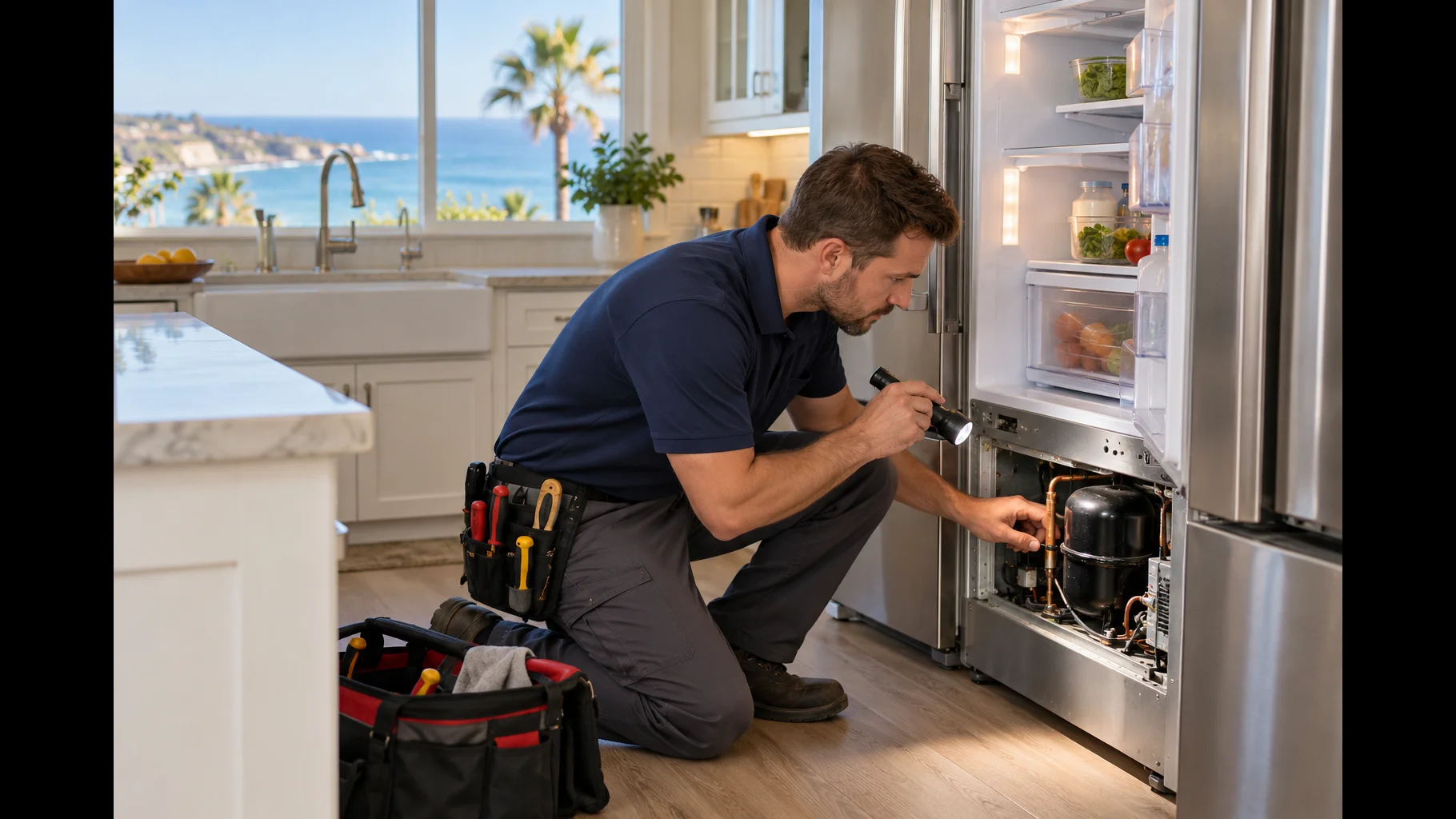
A warm refrigerator in Carlsbad needs attention before food temperatures climb further. Check the fresh-food and freezer sections separately, protect perishables, then record exactly what the appliance is doing.
Identify the exact cooling pattern
Start by checking whether the refrigerator and freezer have the same problem. That distinction gives a technician a much clearer starting point.
Use an appliance thermometer instead of judging by touch. The FDA says a refrigerator should stay at or below 40°F. A practical target is about 37°F. The freezer should stay at or below 0°F.
Write down the measured temperature in each compartment. Note when you took each reading. Also record whether the temperature is steady, rising, or changing after the door opens.
Common patterns include:
- The refrigerator is warm, but the freezer remains cold.
- Both compartments are warmer than their settings.
- Cooling returns briefly, then stops again.
- One area freezes food while another stays warm.
- The appliance runs constantly without reaching its setting.
- The display works, but neither compartment cools.
Keep the doors closed while you assess the problem. The FDA says perishables held above 40°F should be discarded after two hours. That window drops to one hour when the surrounding temperature exceeds 90°F.
During an outage, a closed, full freezer can hold its temperature for about 48 hours. A half-full freezer can hold it for about 24 hours. Food may be refrozen when a thermometer still reads 40°F or below.
Our broader fridge cooling checklist explains how to organize these first observations. Use the thermometer readings and FDA time limits above when deciding what to discard.
What owners can record without opening components
Useful notes don’t require tools or access to internal parts. Begin with the refrigerator’s brand, complete model number, and serial number. Photograph the label so every character remains readable.
Record the control settings and displayed error codes. Don’t clear a code before photographing it. If the display alternates between a code and temperature, capture both screens.
Listen from outside the cabinet. Note any clicking, buzzing, rattling, or periods of silence. Describe where the sound seems strongest without removing a panel. A short video can preserve an intermittent noise.
Check and record these visible details:
- Whether the interior lights turn on
- Whether the digital display has power
- Whether either compartment feels cooler than the other
- Whether frost or ice is visible inside
- Whether water appears under or inside the refrigerator
- Whether the doors close without packages blocking them
- Whether the door gasket looks folded, torn, or displaced
- Whether the problem began after an outage or control change
You can also note how tightly food is packed. Keep your notes to visible details and leave internal components for the technician to inspect.
These observations help separate a cooling complaint from an electrical, door, airflow, or control problem. They also give a Carlsbad refrigerator repair pro better description before diagnosis.
What technicians inspect during diagnosis
A technician should verify the reported temperatures before replacing parts. The diagnosis may then follow power, controls, airflow, heat transfer, and the sealed cooling system.
The exact sequence depends on the refrigerator’s design. A top-freezer model, French-door refrigerator, built-in unit, and dual-compressor model won’t share every test.
The technician may inspect accessible fans, sensors, controls, door switches, defrost components, and visible wiring. They may also evaluate frost patterns and airflow between compartments. These checks help identify whether cold air is being produced, moved, and regulated correctly.
Other possible checks include the compressor starting circuit and condenser area. A professional should test components rather than select a part from one symptom alone. Similar cooling patterns can have different causes.
Refrigerant work needs additional credentials. Technicians who attach gauges, add or remove refrigerant, or otherwise open a refrigerant circuit must hold the appropriate EPA Section 608 certification. Those credentials don’t expire. You can ask the matched technician which certification applies before sealed-system work begins.
California appliance repair businesses must register with the Bureau of Household Goods and Services. This registration is separate from a CSLB contractor license. Consumers can check a business through the California Department of Consumer Affairs lookup.
Ask for the diagnosis and proposed repair in writing. The matched technician should explain the failed system, planned work, parts, labor, and any warranty they personally offer. Repair Pro San Diego doesn’t set the fee or provide the repair warranty.
For more context on diagnosis and service choices, see our San Diego refrigerator repair guide.
Which Carlsbad property details need confirmation
Carlsbad stretches from coastal areas near Carlsbad Village to inland neighborhoods such as La Costa and Bressi Ranch. Aviara and the area near LEGOLAND California also present different home layouts. An address alone doesn’t confirm the refrigerator setup, building age, access, or installation type.
We couldn’t confirm a single housing pattern that applies across Carlsbad. Don’t assume a coastal address proves salt-related damage. Don’t assume an inland home has newer appliances or different electrical service. Those details need an on-site inspection.
Instead, tell the matched technician what’s actually present. Useful property notes include:
- A detached home, condo, apartment, or managed rental
- A freestanding, counter-depth, built-in, or panel-ready refrigerator
- The floor where the appliance sits
- Stairs, gates, elevators, or restricted parking
- Cabinets or panels surrounding the refrigerator
- Limited clearance beside or above the appliance
- A water line connected to the refrigerator
- Recent remodeling near the appliance or outlet
For built-in or panel-ready models, share photos showing the full installation from its current position. A technician can decide how it should be accessed.
If the refrigerator serves a rental, identify who can approve the diagnosis and repair. Also tell the technician whether food is still inside. Vacation schedules and guest occupancy don’t prove the cause, but they can affect access.
Our article on coastal appliance care in Encinitas and Carlsbad addresses maintenance separately. This cooling complaint still requires diagnosis based on the actual appliance and property.
How to request a matched refrigerator technician
Prepare a short service summary before requesting a match. Include the Carlsbad ZIP code, refrigerator type, brand, model number, and measured temperatures. State whether the freezer still works and when the problem began.
Mention visible frost, water, error codes, or unusual sounds. Say whether the appliance is built into cabinetry. Include any access limits that could affect an independent technician’s visit.
Repair Pro San Diego is a referral service. We match homeowners and businesses with licensed, insured, independent local appliance technicians. We don’t employ technicians, perform repairs, stock parts, set diagnostic charges, or issue repair warranties.
Before agreeing to service, ask the matched technician:
- What diagnostic fee applies?
- Is that fee credited toward an approved repair?
- Will the diagnosis and quote be provided in writing?
- Does the proposed work involve refrigerant?
- What warranty does the technician offer?
- Are parts ordered only after approval?
- What payment methods are accepted?
No verified Carlsbad-wide refrigerator repair price is available in the approved claims record. The final amount depends on the diagnosis, refrigerator design, part, labor, and installation access. The matched technician diagnoses first and quotes in writing before work begins.
If sealed-system work is proposed, ask about EPA Section 608 certification. You can also verify the service business through the state lookup before approving work.
When to call us
Request a match when temperatures keep rising, cooling repeatedly stops, or the diagnosis requires opening components. Call (858) 988-7787 to leave a voicemail requesting a match with a local appliance repair pro.