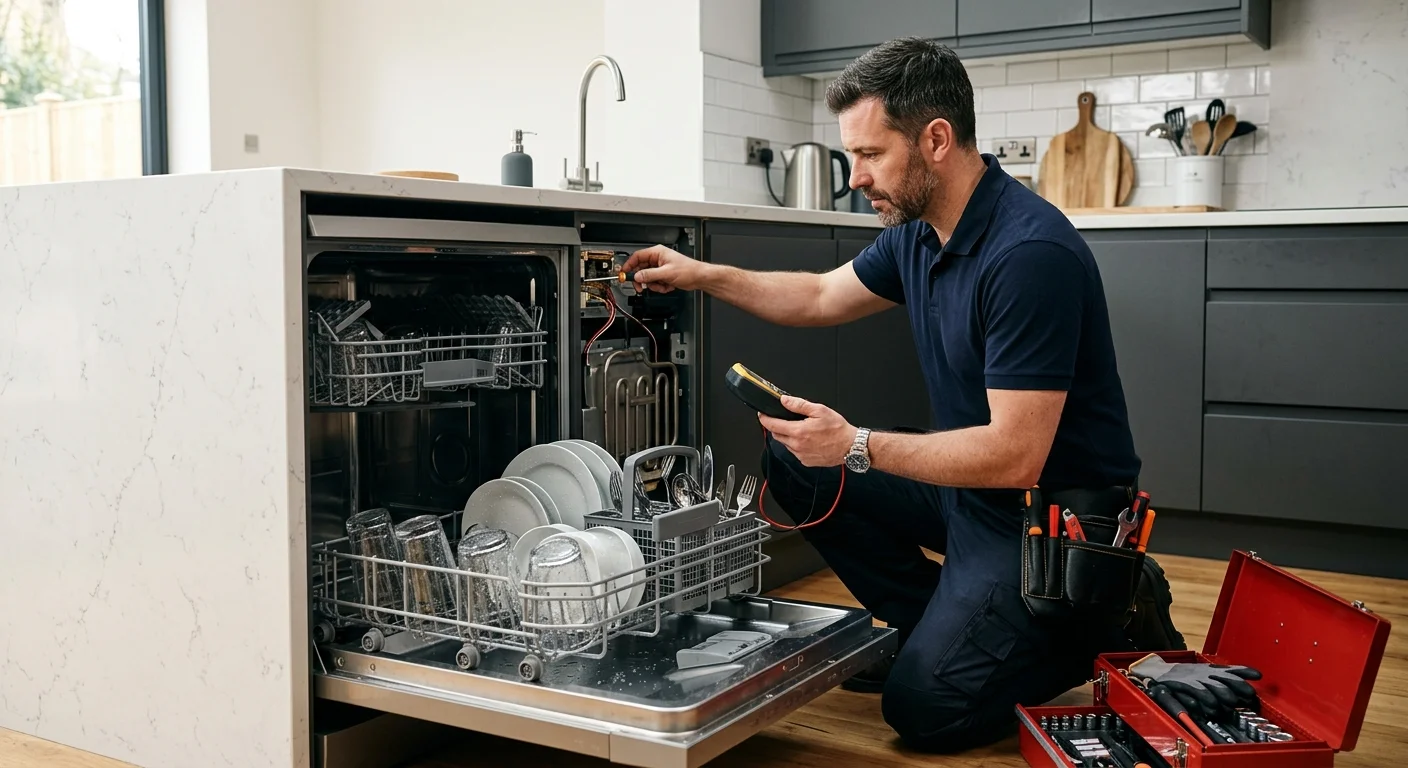
Wet dishes don’t identify one failed Miele part. First confirm whether the cycle reached End, how the door behaved, and which items stayed wet. If the cycle stopped early or displayed a fault, the complaint may involve more than drying.
Confirm the model and drying complaint
Start with the full model and serial number. Miele says both appear on the appliance data tag. Its online manual finder accepts either identifier. That matters because programs, settings, displays, and AutoOpen behavior differ by model.
Next, define what “won’t dry” means in your kitchen. Record these details after the cycle:
- Did the display reach End?
- Did the door open automatically?
- Were plates and glasses wet, or mainly plastic items?
- Did water collect inside bowls or recessed cup bases?
- Did drops fall from the upper rack during unloading?
- Did the dishes feel warm or cool?
- Was the load clean, or did detergent remain?
- Did the display show a message or fault code?
These observations separate a drying complaint from an interrupted wash, drain problem, or loading issue. They don’t identify a failed part by themselves.
A little moisture inside the tub also isn’t the same as soaked dishes. Miele describes a film on the inner door and cabinet walls as part of normal drying-system operation. Water pooled across plates, glasses, and silverware is a different pattern.
Take a photo of the display before pressing another button. Photograph the wet-item pattern too. If the unit has a custom cabinet panel, mention that when requesting service.
Our Miele appliance repair overview covers broader appliance problems. This guide stays focused on dishwasher drying and the evidence a technician needs.
What owners can check without opening panels
Keep the first checks visible and tied to the model manual. Don’t remove the toe kick, door panel, wiring cover, or control housing.
Look at the load before changing settings. Bowls, cups, and containers need enough angle for water to run off. Items shouldn’t nest together. Check whether a tray or upper basket dripped onto dry dishes while you unloaded. Miele advises unloading the lower basket first, followed by the upper basket and cutlery tray.
Check the rinse-aid indicator and dispenser. Miele lists an empty container or low dosage among the causes of wet dishes. The manufacturer also warns that too much rinse aid can leave a soapy residue. Follow the dosage instructions for your exact model instead of turning the setting to its maximum.
Review the selected program. Miele notes that some programs don’t include a drying cycle. Extra Dry is available on certain models, but not every model or program. Miele’s drying guidance says plastics can remain wetter when the drying phase is too short.
Check AutoOpen in the settings if your model has it. Don’t assume every cycle activates that feature. If it is enabled but the door doesn’t open, record the cycle name and display status.
Run one controlled comparison using the manual’s drying guidance. Use a mixed load with ceramic, glass, silverware, and plastic. Avoid changing the detergent, loading pattern, rinse-aid setting, and cycle all at once. One change at a time produces better evidence.
How cycle and control behavior narrow the issue
Cycle completion is the most useful dividing line. A dishwasher that reaches End but leaves several materials wet presents a different complaint from one that stops, drains poorly, or shows a fault.
If the display reaches End, note whether the load feels warm. Warm dishes with scattered droplets may direct attention toward loading, rinse aid, or moisture release. A consistently cool load may give the technician reason to test the heating process. Neither observation proves which component is responsible.
AutoOpen timing can also be misleading. On certain Miele models, the door may open while drying continues. Miele specifically says that automatic opening during the ECO program doesn’t mean drying has finished. Its ECO AutoOpen guidance tells owners to use the display to confirm completion.
Don’t fully open the door early just to inspect the load. Doing so can interrupt the remaining drying period on models and programs that continue after AutoOpen begins.
Write down any fault code exactly as shown. Include letters, numbers, flashing indicators, and the point when they appeared. A code copied from memory can send the diagnosis in the wrong direction.
Cleaning results provide another clue. Undissolved detergent, food remaining on dishes, or unusually cool washware can indicate a broader cycle problem. Our dishwasher not cleaning guide explains how to document that separate complaint.
There isn’t one universal reset or electrical test for every Miele dishwasher. We couldn’t confirm one through the approved claims file. Use the operating instructions for the full model number, and don’t treat a generic reset video as model-specific guidance.
What technicians inspect for wet dishes
The matched independent technician starts with the symptom record and model information. That prevents a normal program behavior from being mistaken for a failed component.
Depending on the model, the technician may inspect the heating circuit, temperature sensing, water circulation, rinse-aid dispenser, drying fan, door-opening system, wiring, and electronic controls. Not every Miele dishwasher uses the same arrangement. Testing should follow the service information for that unit.
The technician may also confirm whether the dishwasher fills, circulates, drains, and completes its final rinse. A drying complaint can overlap with another cycle problem. The display history, exact program, and condition of the load help narrow that boundary.
AutoOpen deserves a model-specific check. The technician can compare the selected program and settings with the actual door movement. If the locking rail or opening mechanism doesn’t behave as directed, that observation becomes part of the diagnosis. It still doesn’t prove the mechanism alone caused the wet load.
Before independent repair begins, check any current manufacturer warranty or service contract tied to the serial number. The approved claims file doesn’t establish model-specific Miele coverage. Ask Miele how its current terms apply before authorizing outside work.
California appliance service dealers must register with the Bureau of Household Goods and Services. Homeowners can check a business through the state Department of Consumer Affairs lookup. Registration confirms status, not an individual technician’s technical ability.
Ask for the diagnosis, proposed repair, parts, and labor terms in writing. The matched technician diagnoses first and quotes in writing before work begins.
When to request Miele dishwasher repair
One damp plastic container doesn’t establish a machine failure. Neither does water trapped on a recessed mug base. Request repair when the same drying problem continues across repeated, fully completed loads after the visible checks are settled.
Useful reasons to schedule diagnosis include:
- Plates, glasses, silverware, and plastics all remain wet
- The display never reaches End
- AutoOpen is enabled but doesn’t behave as the manual describes
- A drying option makes no noticeable difference
- Fault messages return on later cycles
- The load remains cool after a completed program
- Cleaning, draining, and drying symptoms appear together
- Rinse aid is present, yet broad wetness continues
Provide the model, serial number, cycle name, detergent type, rinse-aid setting, and fault code when requesting a match. Mention whether the unit is integrated behind a cabinet panel. Those details help the independent pro prepare for the correct machine.
Access notes matter across San Diego County too. A UTC high-rise may require parking and elevator instructions. Homes in El Cajon, Chula Vista, or North County may need gate or driveway details. Include those notes with the appliance information.
Repair Pro San Diego is a referral service. We match homeowners with licensed, insured, independent local technicians. The matched pro diagnoses the dishwasher, performs any approved repair, and provides their own work terms.
Review the dishwasher repair service for referral details. The broader San Diego dishwasher repair guide explains what information to gather for other dishwasher symptoms.
When to call us
Persistent wet loads, failed AutoOpen behavior, recurring faults, or incomplete cycles need a licensed appliance repair pro. Repair Pro San Diego can match you with an independent local technician who diagnoses and repairs the dishwasher. Call (858) 988-7787 to leave a voicemail requesting a match with a local appliance repair pro.