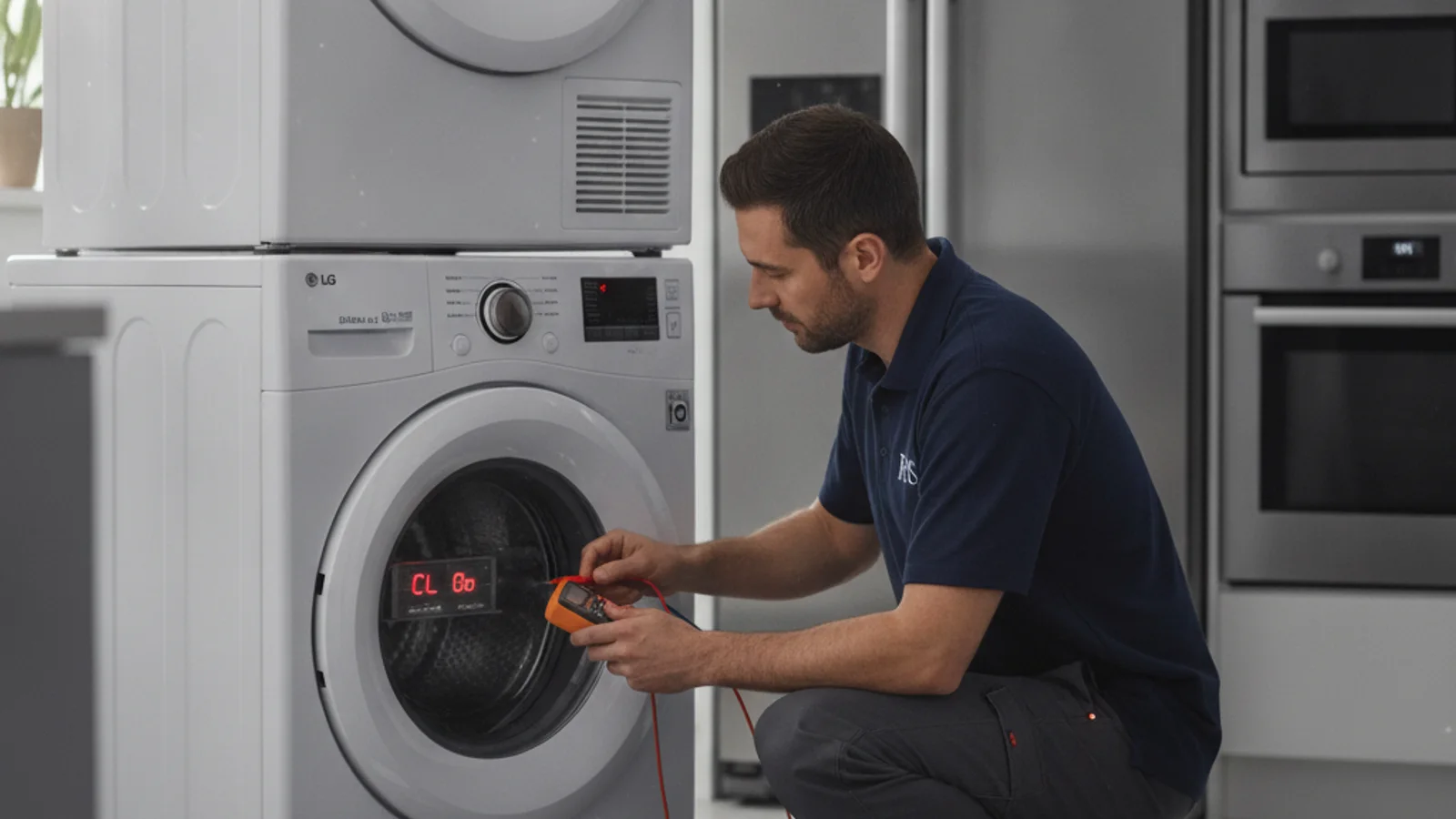
LG washers often communicate problems through two-letter codes on the display. OE, UE, IE, dE, and LE are common examples, but meaning and reset steps come from the exact model manual, not a universal chart. Some codes clear with an exterior check. Others need a technician.
This guide walks through each LG washer error code, what causes it, and what to do first. It’s written for San Diego homeowners who want a straight answer before deciding whether to grab a screwdriver or pick up the phone.
How to read your LG washer’s error codes
LG uses two-letter codes rather than the alphanumeric fault codes you see on some other brands. The codes appear on the digital display on the door or control panel. One detail worth knowing: letter case matters. A lowercase uE means the washer is still trying to auto-correct an unbalanced load, while uppercase UE means it gave up and stopped the cycle. If your model doesn’t have a digital display, check your owner’s manual for the light-flash pattern chart.
Your model number is printed on a sticker inside the door opening on most LG front-loaders, or on the lid rim on top-loaders. With that number, you can pull the full service manual from LG’s website if you need code details specific to your machine.
Before troubleshooting anything, try a power-cycle reset first. Unplug the washer, wait a full minute, and plug it back in. A temporary glitch or a brief power fluctuation can trigger a code that has no underlying hardware cause. If the code comes right back, keep reading.
Common codes: OE, UE, IE, dE, LE
These five codes appear often in LG manuals. They are not a majority ranking of service calls. Confirm meaning in the exact model chart. Each one points to a specific system in the machine.
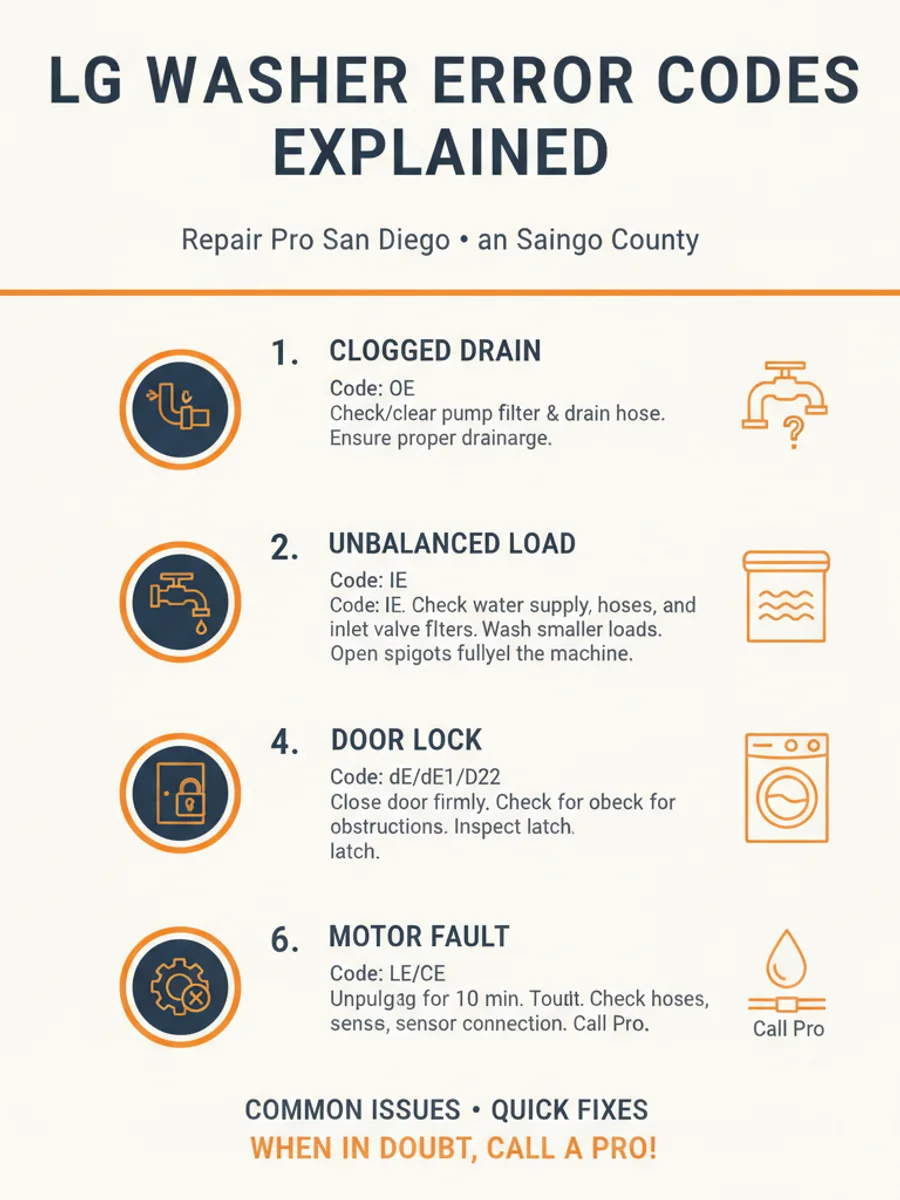
OE: Water not draining
OE is a drain (Outlet) error. It means the washer tried to drain but couldn’t finish within its allowed time window. One possible cause on a front-loader is a clogged drain pump filter. If the model’s manual shows a filter behind an access panel, follow those water-release limits. Do not open a housing this page does not prove for your model.
Other causes include a kinked or clogged drain hose and a drain hose that’s been pushed too far down the standpipe, which creates a siphon that pulls water back in as fast as the pump pushes it out. If you’ve ruled all of that out and OE keeps returning, the drain pump is one possible next inspection. The technician confirms. For a deeper look at drainage troubleshooting, our guide on washer won’t drain walks through the full sequence.
UE or uE: Unbalanced load
LG uses two versions of this code and the difference matters. Lowercase uE means the machine detected an imbalance, added water, and is trying to redistribute the load on its own. You don’t need to do anything yet. Uppercase UE means it ran through multiple redistribution attempts and gave up.
The most common cause is a load that bunched to one side of the drum. Washing a single bulky item, like a comforter, a bath rug, or a heavy jacket, is the typical trigger. The fix is usually to open the door, rearrange the items evenly, and restart. If UE shows up repeatedly on balanced loads, check that all four feet of the machine are touching the floor and that the machine is level front-to-back and side-to-side. Adjustable feet spin in or out by hand.
IE: Water inlet error
IE means the washer didn’t fill with water within its allowed time. Start with the most obvious checks: are the hot and cold water faucets behind the machine fully open? A shutoff valve that’s only turned halfway will restrict flow enough to trigger this code.
Next, look for kinked inlet hoses. Then unscrew the hoses from the back of the washer and check the small mesh screens inside the inlet ports. Mineral film can clog inlet screens. County water chemistry is not a measured clog rate on this page. Clean them with a small brush under running water. If your home’s water pressure is low for other reasons, that can also cause IE. A failing water inlet valve can be behind chronic IE codes. Confirm with a meter, not this page.
dE, dE1, or dE2: Door error
dE means the washer either couldn’t lock the door or senses the door as open when it should be closed. On a front-loader, the door boot seal (the rubber gasket around the door opening) can catch a sock or a small item between the door and the drum, preventing a full seal. Check the boot and the door rim before assuming anything is broken.
If the door closes cleanly and dE still shows, the door lock assembly is one possible failure. dE1 and dE2 can point at the door-lock circuit on some models. Confirm in the model’s fault chart.
LE: Motor or locked-rotor error
LE means the motor isn’t turning freely. The first thing to check is whether the drum is overloaded. An overstuffed drum can stall the rotor and trigger LE. Remove some items, run a short cycle, and see if the code clears.
If the drum turns freely when you spin it by hand with the machine unplugged but LE keeps returning under load, the problem is internal. Possible inspection points include the rotor position sensor, the stator winding, or the wiring harness. These require a technician with a multimeter.
What you can reset yourself
Several LG error codes look alarming but resolve with a simple user action. Here’s what you can clear on your own.
Power-cycle the machine first for any code. Unplug the washer, wait one full minute so the control board fully discharges, and plug it back in. This clears a surprising number of transient codes.
For UE or uE, open the door, redistribute the load so items are spread evenly around the drum, and restart. If you’re washing one bulky item, add a few towels to balance the weight.
For SUD or Sd (excessive suds), you’ve used too much detergent or a non-HE formula in an HE machine. Switch to HE detergent and cut the amount you use per load. The machine will clear the suds on its own and resume the cycle.
CL on the display is not a fault code. It stands for Child Lock, and it means the control buttons are locked. Hold the child-lock button for about three seconds (the exact button varies by model; check your manual) to toggle it off.
tCL is a periodic reminder to run a Tub Clean cycle. It’s a maintenance prompt, not a malfunction. Run a Tub Clean cycle (or a hot cycle with a washing machine cleaner tablet) and it will clear.
For OE, use only the owner steps the exact model manual shows. Do not open a housing this page does not prove for the model. For IE, make sure both water faucets are fully open and check the inlet screens.
Codes that mean a part has failed
When a code returns after you’ve run through the basic checks, a component has failed and the washer needs hands-on diagnosis.
A persistent OE after cleaning the filter (if the manual allows it) and checking the hose can mean the drain pump. A persistent IE after a good supply can point to the inlet valve. Returning dE codes can involve the door lock. LE on a normal load can involve the motor sensor, stator, or wiring. A tech tests rather than treating those as almost-always swaps.
A few additional codes worth knowing: FE is an overfill error, meaning water keeps entering when it shouldn’t. It usually points to a stuck-open water inlet valve or a bad pressure sensor. PE is a water-level pressure sensor fault. tE is a thermistor or heater error on models that heat water internally. All three require professional washing machine repair because they involve testing electrical components with a meter and sourcing the correct LG replacement parts.
LG washer repair across San Diego
The technicians in the Repair Pro San Diego network work on LG front-load and top-load washers across San Diego County. Ask the matched technician about drain pumps, water inlet valves, and door lock assemblies for your model. First-visit stock is their availability. Ask about the diagnostic fee and whether it’s credited toward the repair.
Coverage includes Chula Vista, Carlsbad, El Cajon, Escondido, Oceanside, and dozens of other cities throughout San Diego County. For background on LG appliance work specifically, see our overview of LG appliance repair in San Diego.
Frequently asked questions
What does OE mean on an LG washer?
OE is often a drain error on LG charts. Confirm in your model manual. If the manual shows a drain pump filter, clean it as written and straighten the drain hose. If OE returns, the drain pump is one possible next check.
Why does my LG washer keep showing UE?
UE means the load is too unbalanced for the machine to spin safely. Redistribute clothes evenly around the drum and restart. Washing a single heavy item like a comforter without anything else in the drum is the most common trigger. If UE keeps showing on balanced loads, check that all four machine feet are level on the floor.
Does unplugging an LG washer reset error codes?
A power cycle clears many transient codes. Unplug the washer for a full minute so the control board discharges completely, then plug it back in. If the same code returns right away, the underlying problem is a real hardware fault, not a glitch, and the machine needs a proper diagnosis.
What is the LE code on an LG washer?
LE is a motor error. The drum motor isn’t turning freely. First, check whether the drum is overloaded and remove some items. If LE comes back on a normal load, the rotor position sensor, stator winding, or motor wiring has failed. Those components need to be tested with a meter by a technician before any parts are ordered.
When to call us
When an LG error code won’t clear after basic troubleshooting, or when the code points to a failed part like a drain pump, door lock, inlet valve, or motor sensor, it’s time to bring in a tech. Call us at (858) 988-7787 and we’ll get you matched with a technician.