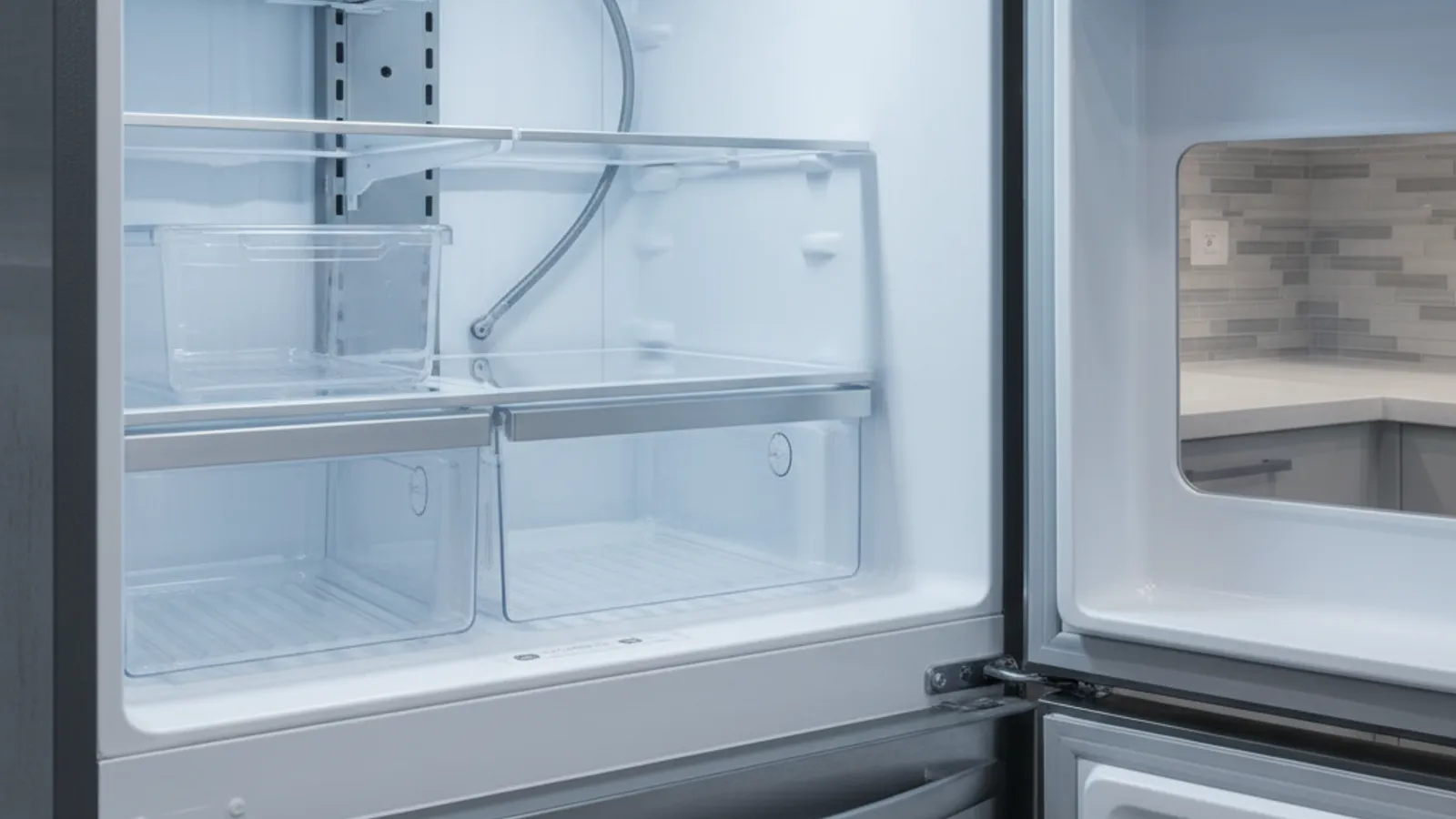
LG French-door ice systems often use Slim SpacePlus in the door and, on some models, a separate Craft Ice maker in the freezer. Those two can fail independently. Confirm freezer holding at or below 0°F (FDA freezer target). Thaw, pressure, filter interval, and reset steps belong in the exact LG manual. Do not use a hair dryer or a universal psi rule.
How LG ice makers are built
Most LG French-door models put the ice maker in the left door. LG calls it the Slim SpacePlus design. It saves shelf space, but it packs water lines, a fill tube, and the ice mold into a tight box.
Newer LG models add a second maker in the freezer drawer. That’s the Craft Ice unit, the one that makes the slow-melting round balls. The two run on separate motors, so one can quit while the other keeps going.
Each maker fills a mold with water, freezes it, then an ejector arm or twist mold drops the cubes into the bin. A motor drives that cycle. If water can’t get in, or the cubes can’t get out, you get an empty bin.
Start with the easy checks
Before you pull anything apart, rule out the simple stuff.
First, confirm the freezer can hold at or below 0°F, the FDA freezer holding target. If it cannot, that is a cooling problem.
Second, confirm the ice maker is on using the steps in that LG model’s document. Power-saver labels vary.
Third, look at the bin without putting hands in a live harvest path. If cubes are clumped, empty the bin after unplugging or disabling the maker per the manual.
The water filter and hard water
County tap water hardness varies. It is not the usual San Diego cause of every ice failure. Filter interval belongs in the LG document for that model, not a six-month county rule. See ice maker not making ice.
A frozen fill tube
The fill tube carries water from the line into the ice mold. It sits in a cold spot. If the maker overfills, or the temperature swings, a plug of ice can form inside that tube and block the next fill.
You’ll often see frost or a small ice dam right where the tube meets the maker. The cycle keeps running, but no water arrives, so the bin stays empty.
If frost is visible at the fill opening, stop. Thaw steps belong in the LG manual for that model. Do not use a hair dryer. If ice returns, the technician diagnoses the valve.
Testing the water inlet valve
The water inlet valve opens to let water reach the maker. Hard water deposits and worn solenoids make these valves stick or weaken over time. A valve that won’t open fully gives you no ice or tiny cubes.
Do not treat 20 psi as a shared LG requirement. Supply pressure belongs in that model’s installation sheet. Do not test the valve for power or continuity. Leave that to the technician.
When the assembly itself fails
If water flows fine but no ice drops, the ice maker assembly is the problem. The motor that drives the ejector or twist mold can burn out. A sensor that reads the mold temperature can fail and never trigger a harvest.
Reset and test-button steps are not shared across LG makers. Use only the combination printed for that model. If the arm does not move, request diagnosis. See LG appliance repair in San Diego.
DIY versus calling a pro
You can check freezer temperature against 0°F, the on setting in the manual, and the bin after the maker is disabled. Filter, thaw, pressure, and reset steps stay in the model document. Ice maker repair is a referral visit.
Frequently asked questions
Why is my LG ice maker not making ice?
The common causes are a freezer that’s too warm, a clogged water filter, a frozen fill tube, or a weak inlet valve. Check the temperature and filter first. Those are owner checks, not a ranking of most no-ice complaints.
How do I reset my LG ice maker?
Use the reset shown in that LG model’s document. Do not treat a harvest button as shared.
Why is my LG making small or hollow ice?
Low fill can involve the filter, supply, or valve. Hard water is a question for the technician, not the usual county cause.
When to call us
If you’ve worked through the temperature, the filter, and the fill tube and still have an empty bin, the valve or assembly is the next stop. Call us at (858) 988-7787 to get matched with a technician.