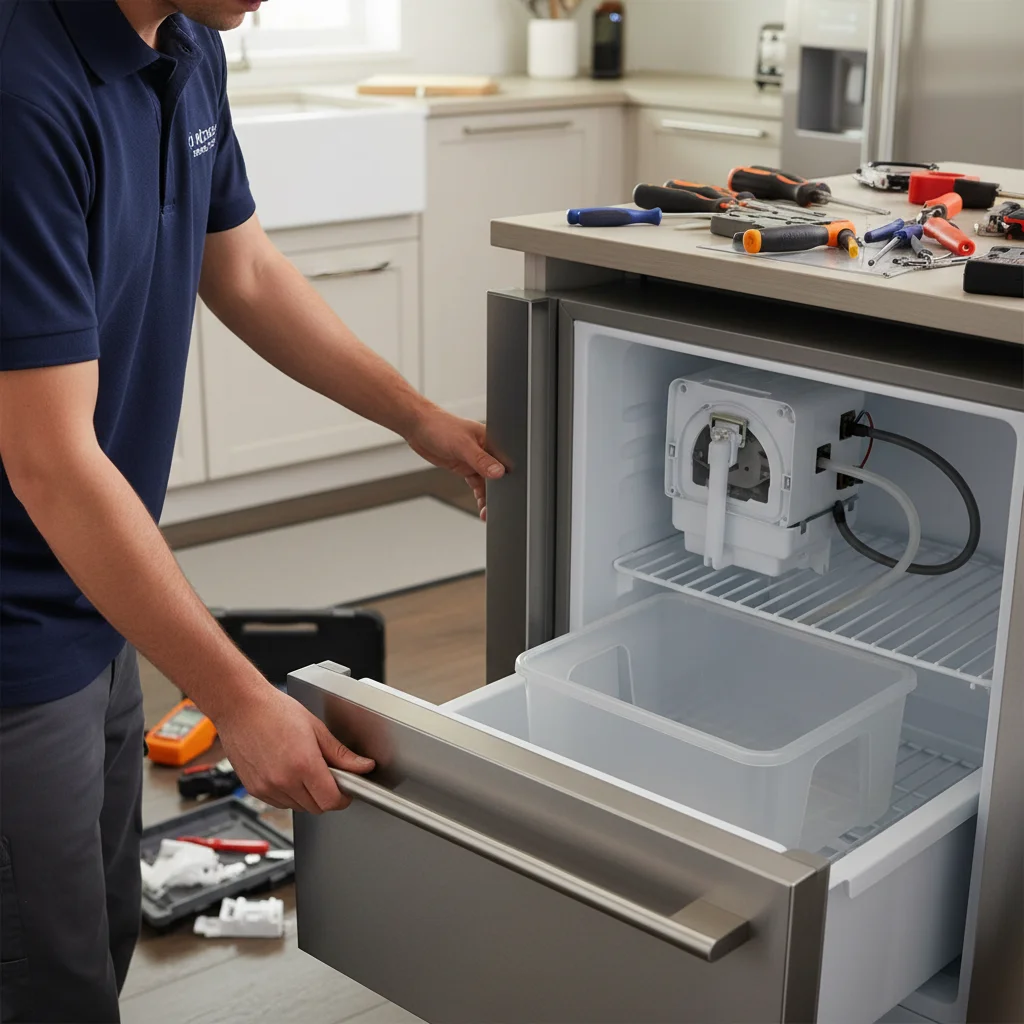
You reach for the ice bin to make a cold drink and hear that hollow, plastic scrape. The bin is empty. An ice maker that’s not making ice is one of those small appliance failures that feels surprisingly frustrating, especially on a warm San Diego day.
The good news is that you can often pinpoint the cause yourself in about 15 minutes. Most ice maker problems boil down to one of three issues. We’ll walk you through a quick checklist to diagnose what’s wrong before you decide to call for a repair.
The three reasons most ice makers stop: water, temperature, mechanism
When we get a call for an ice maker not making ice, the techs in our network mentally run through a process of elimination. It almost always comes down to a problem in one of three areas:
- Water: The ice maker isn’t getting any water, or not enough, to make cubes. This is the most common issue and often the easiest to fix.
- Temperature: The freezer isn’t cold enough. Your ice maker has a built-in thermostat that prevents it from cycling if the freezer is too warm to freeze the water solid.
- Mechanism: The physical or electrical components of the ice maker module itself have failed. This could be a motor, a sensor, or a switch.
Think of it as a hierarchy. You can’t diagnose a mechanical failure if the unit has no water or isn’t cold enough to work in the first place. By checking these three things in order, you can systematically find the root cause of your empty ice bin. We’ll start with the easiest and most frequent culprit: the water supply.
Water line and inlet valve: the easy 5-minute check
An ice maker can’t make ice without water. This seems obvious, but a surprising number of failures are due to a simple interruption in the water supply. Before you suspect a complicated mechanical failure, spend five minutes checking these points.
First, the simplest check of all: the feeler arm. This is the metal or plastic arm that rests on the ice in the bin. When the ice level gets high enough, it pushes the arm up, shutting off production. If someone accidentally bumped it into the “off” (up) position, your ice maker will stop. Make sure the feeler arm is in the down position.
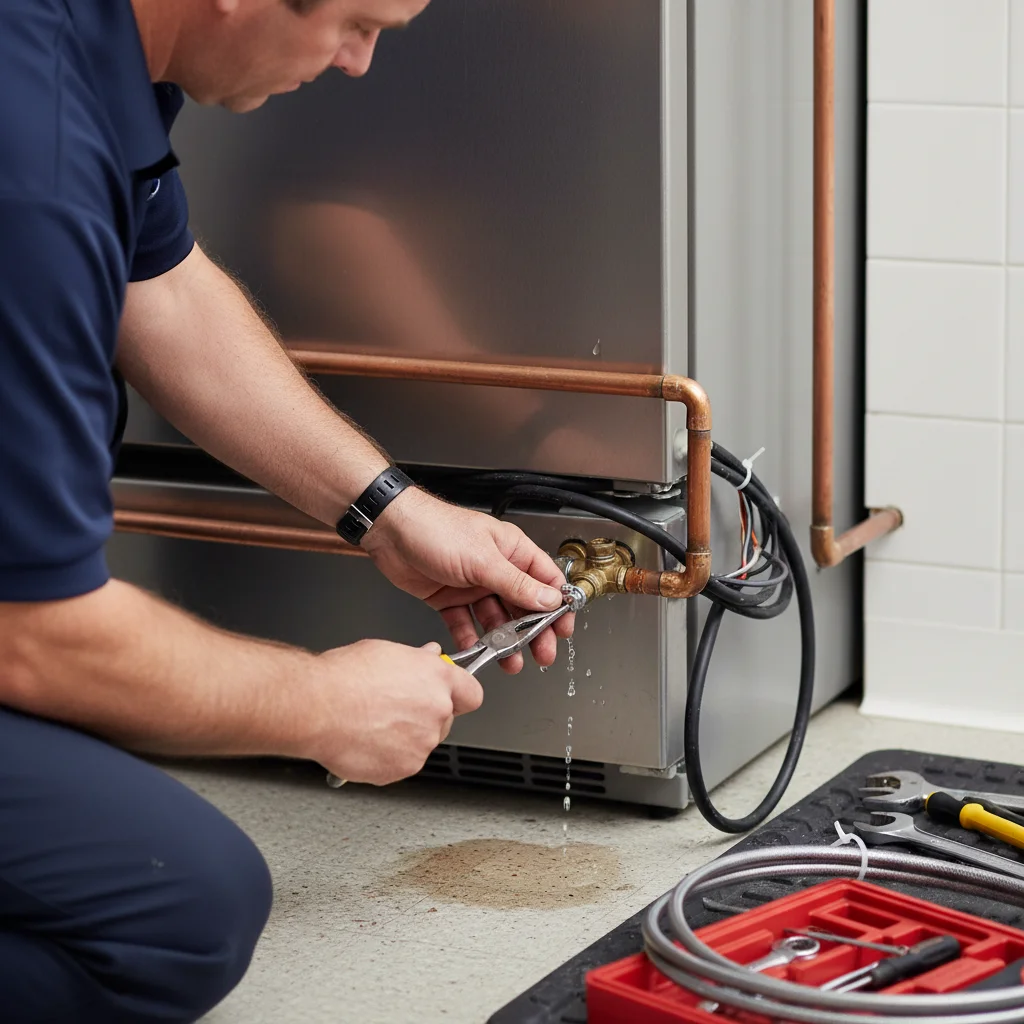
Next, carefully pull your refrigerator away from the wall to inspect the water line. Look for any sharp kinks or pinches in the thin plastic or copper tube that runs from the wall to your fridge. A kink can completely stop the water flow.
While you’re back there, locate the water shutoff valve. There’s usually a small one connected to the line right behind the fridge and a larger one (often a “saddle valve”) connected to your home’s main copper pipe. Ensure both are fully open. Sometimes they get bumped closed during cleaning.
Finally, consider your refrigerator’s water filter. If it’s old and clogged with sediment, it can restrict water flow to the point where the ice maker can’t fill its mold. If you haven’t changed the filter in over six months, that could be your problem.
Here in San Diego County, we deal with notoriously hard water. This high mineral content can cause calcium and magnesium buildup inside the water inlet valve on the back of your fridge. This valve is a small, electrically-controlled gate that opens to let water into the ice maker. When it gets clogged with scale, it can fail to open, starving your ice maker of water. This is a very common failure point and a prime example of why professional refrigerator repair is often needed for even small components.
Freezer temperature: why anything above 10°F kills production
If you’ve confirmed that water is flowing to the refrigerator, the next step is to check the freezer’s temperature. Your ice maker is designed with a safety feature: it won’t try to harvest cubes until its internal thermostat senses that the mold is cold enough to have frozen the water solid.
Most freezers should be set to 0°F (-18°C) for optimal food preservation and ice production. If your freezer’s temperature climbs above 10-15°F, the ice maker’s thermostat will prevent it from completing a cycle. The water might sit in the mold, but the machine won’t eject the cubes or refill with more water.
Don’t just trust the digital display on the front of your fridge. Place an appliance thermometer directly in the freezer for a few hours to get an accurate reading. If you find the temperature is too high, you no longer have an ice maker problem; you have a cooling problem.
This could be caused by several factors:
- Dirty Condenser Coils: These coils on the back or bottom of the fridge release heat. If they’re caked in dust and pet hair, they can’t do their job, and the freezer temperature will rise.
- Faulty Door Gasket: A torn or brittle door seal allows warm air to leak into the freezer, making the cooling system work overtime and struggle to maintain temperature.
- Overloaded Freezer: Packing the freezer too tightly can block air vents, preventing cold air from circulating properly.
- Failing Components: The issue could also be more serious, like a malfunctioning evaporator fan, a faulty defrost system, or a failing compressor.
If you suspect a cooling issue, a great next step is to run through our fridge-not-cooling-checklist for more detailed troubleshooting.
The ice maker module itself, when it’s the part, not the setup
You’ve confirmed you have good water pressure and your freezer is at a frosty 0°F, but the ice bin is still empty. Now it’s time to consider the ice maker assembly itself. This module is a self-contained unit with a motor, gears, and sensors that work together to fill, freeze, and eject ice cubes. When one of these components fails, the whole process stops.
Common mechanical failures include:
- Burnt-out Motor: The motor that powers the ejector arms can simply wear out over time. You might hear a faint humming or no sound at all when it’s supposed to be cycling.
- Stripped Gears: Most ice makers use plastic gears to turn the ejector arms. Over years of use, these can strip, causing a clicking or grinding noise without any movement.
- Failed Heating Element: To release the cubes, a small heating element briefly warms the mold. If this element fails, the cubes stay stuck, and the cycle can’t complete.
- Faulty Thermostat: The internal thermostat that tells the unit when the water is frozen can fail, preventing the harvest cycle from ever starting.
You can try to force a harvest cycle to test the mechanism. On many models, there’s a small button or switch you can press. On others, you might need to pour a small amount of water directly into the mold and wait several hours to see if it ejects the cubes. If it makes no sound or movement when you try to force a cycle, it’s a strong sign that the module itself has failed.
Replacing the entire ice maker assembly is often the most practical solution. While it seems straightforward, matching the correct part number and dealing with the wiring harness can be tricky. This is a classic case where calling for professional ice maker repair saves you time and the risk of ordering the wrong component.
Whirlpool, Samsung, LG, GE: brand quirks worth knowing
While the basic principles are the same, different brands have their own common failure points. Thousands of ice maker calls across San Diego have taught the techs in our network what to look for on specific models.
- Samsung: Many Samsung refrigerators, especially French door models, are known for the ice maker compartment freezing over. Ice and frost build up around the unit, blocking sensors and preventing the ejector arms from moving. This is often caused by poor sealing that lets moist air in. Defrosting the entire unit can be a temporary fix, but a permanent solution sometimes requires an updated part kit.
- LG: LG ice makers can be prone to motor and control board failures. Their popular “craft ice” makers, while fantastic when working, have their own set of complex mechanical issues. If you have an LG and the ice maker is completely dead (no movement, no water fill), the control board is a common suspect.
- Whirlpool (and its affiliates like KitchenAid & Kenmore): These are some of the most common ice makers and are generally reliable. A frequent failure point is the set of optical sensors (an infrared beam) used to detect when the ice bin is full. If one of these sensors fails, the ice maker thinks the bin is always full and will stop producing. A steadily blinking red light on the module is the tell-tale sign of a sensor issue, making Whirlpool ice maker repair a very specific diagnosis.
- GE: On many GE models, the problem isn’t making the ice, but dispensing it. The auger motor that churns the ice out of the bin can fail, or the dispenser chute can get clogged with frost or a jammed cube. You might find a full bin of ice that you simply can’t get out.
When a repair tech makes sense
Going through this diagnostic checklist can solve many common ice maker problems. You might find a kinked water line or realize the feeler arm was in the off position. These are satisfying, no-cost fixes.
However, many of the potential causes require a professional touch. You should consider calling a technician if your troubleshooting points to:
- A clogged or failed water inlet valve.
- Any kind of cooling system problem where the freezer isn’t holding temperature.
- A failed ice maker module that needs to be replaced.
- Complex electronic issues, like the sensor failures common on Whirlpool models or the control board issues on LG units.
A professional technician can accurately diagnose the issue with specialized tools, source the exact OEM part needed for your model, and complete the repair safely and efficiently. It removes the guesswork and the risk of buying the wrong part or causing further damage. For something as essential as a working refrigerator, getting it fixed right the first time provides real peace of mind.
Frequently asked questions
What is the most common reason an ice maker stops making ice?
The water supply is the most common culprit. A kinked water line, a closed shutoff valve, a clogged filter, or a scaled inlet valve can all cut off water flow entirely. Check these before assuming a mechanical failure.
Why does freezer temperature matter for ice production?
The ice maker’s built-in thermostat won’t trigger a harvest cycle if the freezer sits above about 10 to 15 degrees Fahrenheit. If ice production stopped and the freezer feels warmer than usual, the real problem is a cooling issue, not the ice maker itself.
How do I know if my ice maker module has failed?
Force a harvest cycle using the test button on the module. If the unit makes no sound and no movement, the motor, gears, or internal thermostat have likely failed. Whirlpool models often show a blinking red light when the optic sensors go bad.
Does San Diego’s hard water affect ice makers?
Hard water from East County and North County builds calcium and magnesium deposits inside the water inlet valve, slowly choking off flow until ice production slows or stops completely. Replacing the scaled valve and adding a fridge filter helps the new part last longer.
When to call us
If you’ve run through these checks and are still stuck, or if you’ve found the problem but don’t feel comfortable making the repair, we’re here to help. The technicians we match can diagnose and fix any ice maker issue, often in one visit.
Call us at (858) 988-7787 and we’ll match you with a technician.