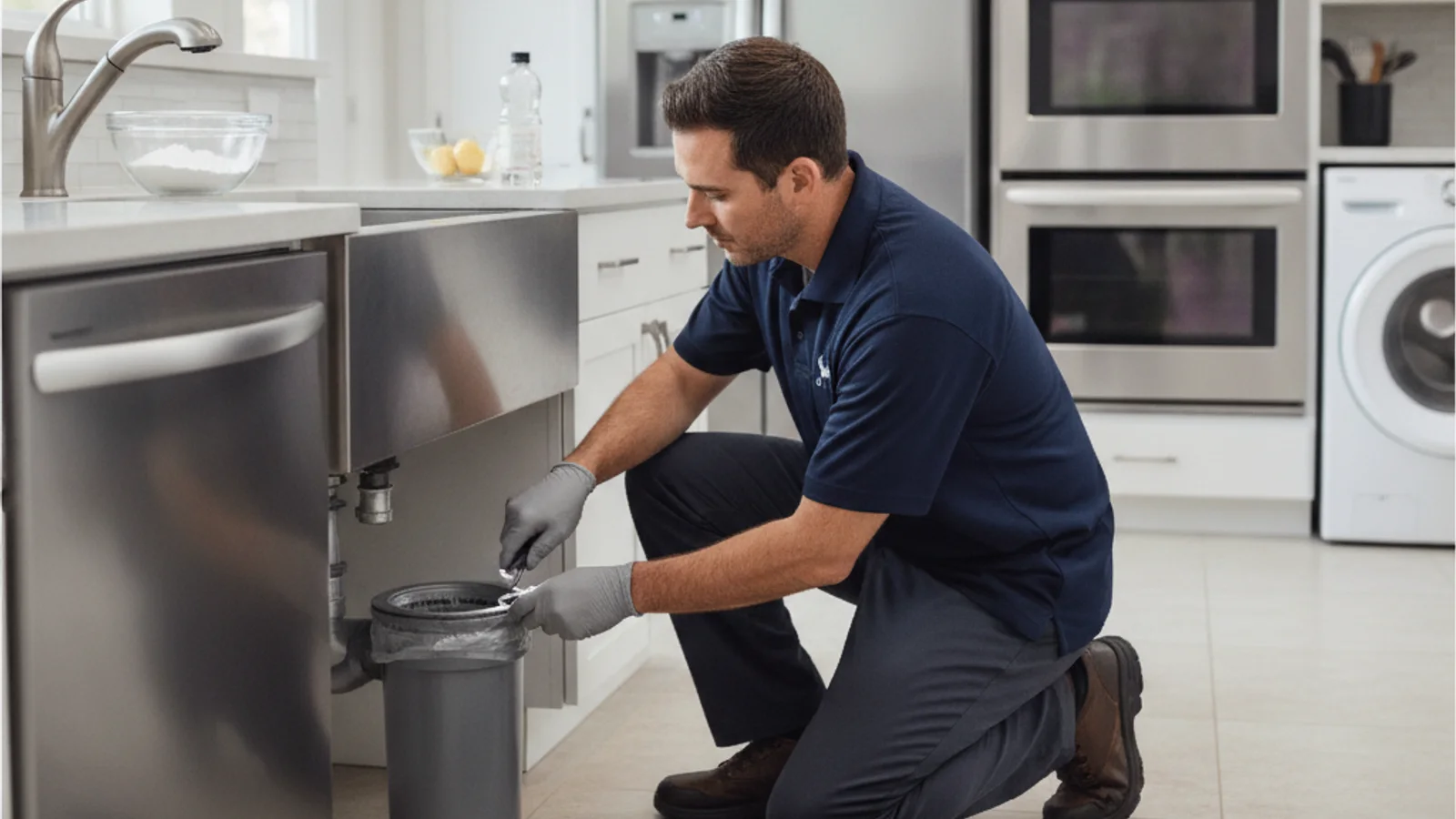
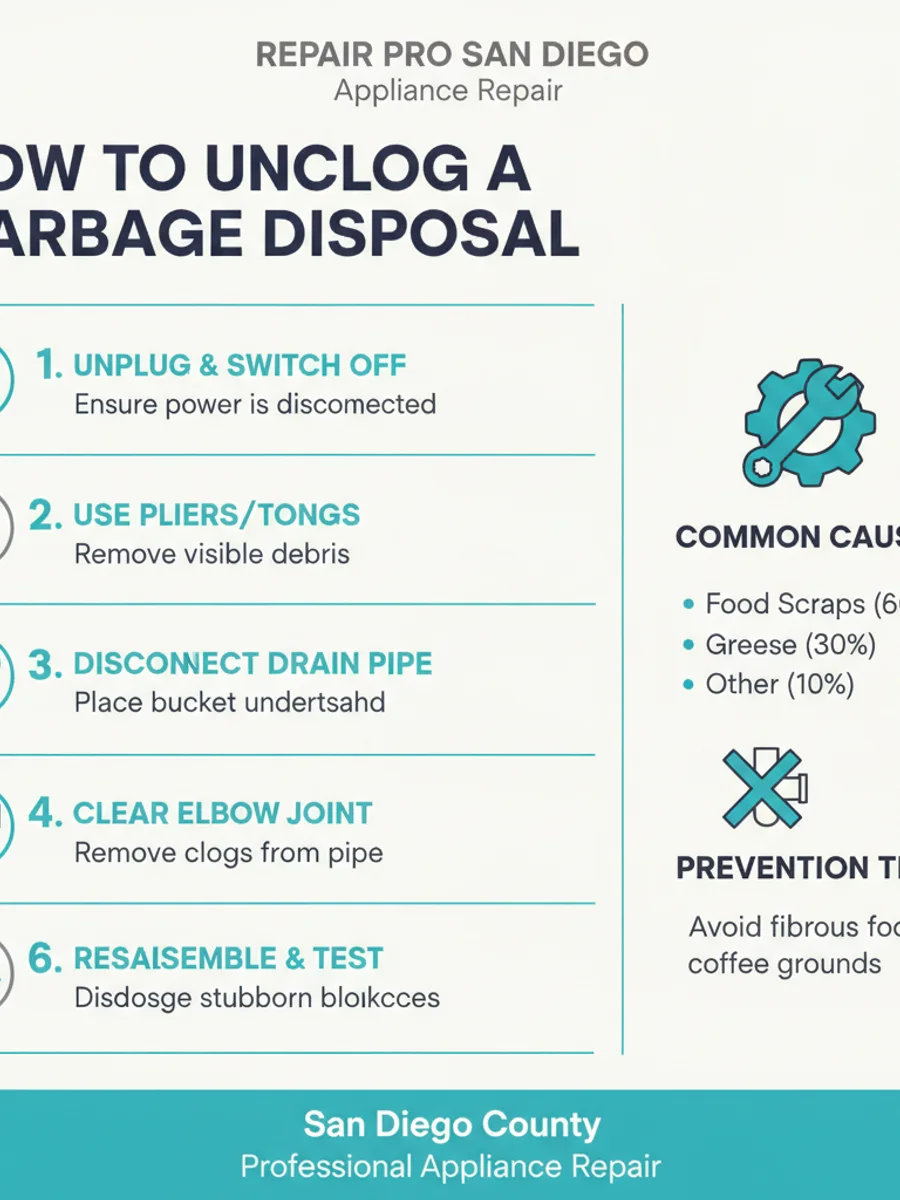
To unclog a garbage disposal: cut power at the switch and the breaker before you touch anything, and never put your hand inside the unit. If the model’s manual shows a hex (Allen) wrench port on the bottom, use the wrench size it names and work it back and forth to free a stuck flywheel. For standing water caused by a drain clog rather than a jam, disconnect the P-trap under the sink and clear it manually. A plunger or a baking-soda-and-vinegar flush can help with grease buildup. Clearing time depends on the clog. This page does not promise a ten-minute fix.
Safety first
Cut the wall switch off, then go to your electrical panel and flip the circuit breaker for the kitchen or disposal circuit to OFF. Do not skip this step. The wall switch can be bumped accidentally, and that turns a minor inconvenience into an emergency. Once the breaker is off, confirm the unit is dead by trying the wall switch, nothing should happen.
Never put your hand into the drain opening. The impellers are not razor-sharp, but they are metal, and the unit can restart unexpectedly if power is still present. Use tongs, pliers, or a wooden handle to reach anything visible in the chamber. A flashlight helps you see what you are dealing with.
Step 1: Free the flywheel with a hex wrench
Most garbage disposal jams happen when food waste locks the flywheel in place. The motor hums but cannot turn, so nothing drains. The fix is built into the unit itself.
Look at the very bottom center of the disposal housing. Many units, including many InSinkErator models, have a hex socket there. The owner’s manual names the wrench size. Do not assume 1/4 inch. If the unit shipped with a wrench, use that. If you have lost it, match the size the manual lists.
- Insert the wrench into the socket.
- Work it clockwise and counterclockwise in short strokes, you are physically rotating the flywheel past the obstruction.
- You will feel resistance, then a release as whatever was lodged clears.
- Shine a flashlight into the drain and use tongs to pull out any food debris or foreign object you can see.
- If the model has a reset button, the manual shows where it is and how it should click in. Do not treat a red bottom button as universal.
Restore power at the breaker, run cold water into the drain, then turn the disposal on. If it still will not run, stop and request a technician.
If the flywheel will not move at all after several attempts, or the motor hums but the unit still will not turn after freeing the wheel, the motor may be failing. That is worth a call rather than further DIY effort. See our garbage disposal repair page for what that service covers.
For more on the reset button specifically, our guide on how to reset a garbage disposal walks through that process in detail.
Step 2: Clear the drain trap for standing-water clogs
If water is standing in your sink but the disposal runs normally, the clog is downstream of the disposal itself, typically in the P-trap. The P-trap is the curved pipe under the sink that connects the disposal outlet to the wall drain.
- Place a bucket under the P-trap before you touch it.
- Loosen the slip nuts on both ends of the curved section by hand or with channel-lock pliers.
- Pull the trap off and let the standing water drain into the bucket.
- Look inside the trap, you will likely find a dense plug of grease, food particles, or both. Clear it with a bottle brush or rinse it outside.
- Inspect the drain line going into the wall as well. A straightened wire hanger can dislodge a soft blockage a few inches in.
- Reassemble the trap, tighten the slip nuts snugly (do not over-tighten plastic fittings), and run water to confirm it drains freely.
Step 3: Plunger and baking soda for grease clogs
If the disposal runs and the P-trap is clear but the sink still drains slowly, grease has likely coated the inside of the drain line over months of use. Two approaches work well here.
Plunger method. Fill the sink basin with two to three inches of water, cover the other drain (if you have a double sink) with a wet rag to maintain suction, and plunge with firm, steady strokes for about thirty seconds. The pressure change dislodges grease films from the pipe walls.
Baking soda and vinegar flush. Pour half a cup of baking soda down the drain, then follow with half a cup of white vinegar. Let it fizz for five minutes. Flush with a full kettle of very hot (not boiling) water. Repeat once if drainage is still sluggish. This is a good monthly maintenance habit if your household produces a lot of cooking grease.
Avoid commercial drain cleaners like Drano in a disposal. See the FAQ section below for why.
What causes garbage disposals to clog
Understanding the cause helps prevent the next one. The most common culprits:
- Grease and cooking fats. They rinse down as liquid but solidify on cool pipe walls and trap everything else.
- Coffee grounds. They do not grind into smaller pieces, they compress into a paste that blocks the drain line.
- Eggshells. A persistent myth says they sharpen the blades. They do not, and the papery membrane wraps around the impellers.
- Fibrous vegetables. Celery, artichoke leaves, and corn husks create stringy masses that tangle the flywheel.
- Pasta and rice. Both continue absorbing water after grinding, expanding into a thick blockage inside the trap.
The best prevention is simple: run cold water for thirty seconds before turning the disposal on, keep it running while you load food scraps, and continue the water for at least fifteen seconds after the grinding stops.
When the problem is not a clog
A few symptoms look like clogs but point to something else:
Motor hums but the flywheel will not move after using the hex wrench. The jam may be caused by a hard object (bone fragment, bottle cap, silverware) lodged deeper in the grinding chamber, or the motor is starting to fail. Do not force it further.
Disposal is completely silent, no hum at all. The thermal overload may have tripped. If the model has a reset button, the manual shows where it is. Then check the circuit breaker. If neither restores power, the wiring or motor needs diagnosis.
Water leaking from the bottom of the unit. That is an internal seal failure, not a clog. Our article on garbage disposal leaking from the bottom explains what that means and why it usually calls for a replacement.
If your disposal in the Rancho Bernardo area hums, stays jammed after the hex-wrench fix, or leaks, get matched with a garbage disposal repair in Rancho Bernardo technician.
When to call a professional
Try the hex-wrench fix (if the manual shows that port) and the P-trap clear first. Call for help when:
- The flywheel will not move and a hard object appears to be stuck in the grinding chamber.
- The disposal hums but fails to start again after the hex-wrench and reset steps.
- You see water under the unit (not from the drain line fittings, but from the housing itself).
- The drain line backs up again within a few days of clearing the trap, which can indicate a blockage further down the line.
Call us at (858) 988-7787 to get matched with a technician. We cover all of San Diego County.
Frequently asked questions
Why is my garbage disposal clogged but not jammed?
The disposal motor may be running fine while the blockage is actually in the drain line, not the grinding chamber. When grease or food particles build up in the P-trap or further down the drain pipe, water backs up even though the disposal spins normally. Disconnect and clear the P-trap under the sink as described above, then check whether drainage improves.
Can you use Drano in a garbage disposal?
No. Do not use Drano or any caustic drain cleaner in a garbage disposal. The chemicals are corrosive to the rubber gaskets and plastic components inside the unit, and they can damage the P-trap fittings as well. They also create a hazardous situation if you need to reach into the drain or disassemble the trap while the chemical is still present. Use a plunger, the baking-soda-and-vinegar method, or manual trap cleaning instead.
What is the hole on the bottom of a garbage disposal for?
That port, when present, accepts the hex wrench size listed in the model’s manual. It lets you manually rotate the flywheel from outside the unit when a jam prevents the motor from turning. Many units ship with a small wrench for this purpose. If you have lost yours, match the size the manual names. Do not assume every brand uses the same size.
How do you unclog a disposal that is full of standing water?
Turn off the disposal and cut power at the breaker. The standing water means the clog is in the drain line, not the grinding chamber. Place a bucket under the P-trap, loosen both slip nuts, and remove the curved pipe section. Clear the blockage inside the trap, reassemble, and run water to confirm the drain is flowing. If the standing water returns quickly after clearing the trap, the blockage may be further down the drain line and a plumber’s snake or professional service will be needed.
How do I prevent my garbage disposal from clogging again?
Run cold water for thirty seconds before, during, and after every use. Avoid putting grease, coffee grounds, eggshells, fibrous vegetables (celery, corn husks), or starchy foods (pasta, rice) down the drain. Once a month, pour baking soda and white vinegar into the drain, let it sit for five minutes, and flush with hot water. These habits keep the drain line clear and extend the life of the unit significantly.