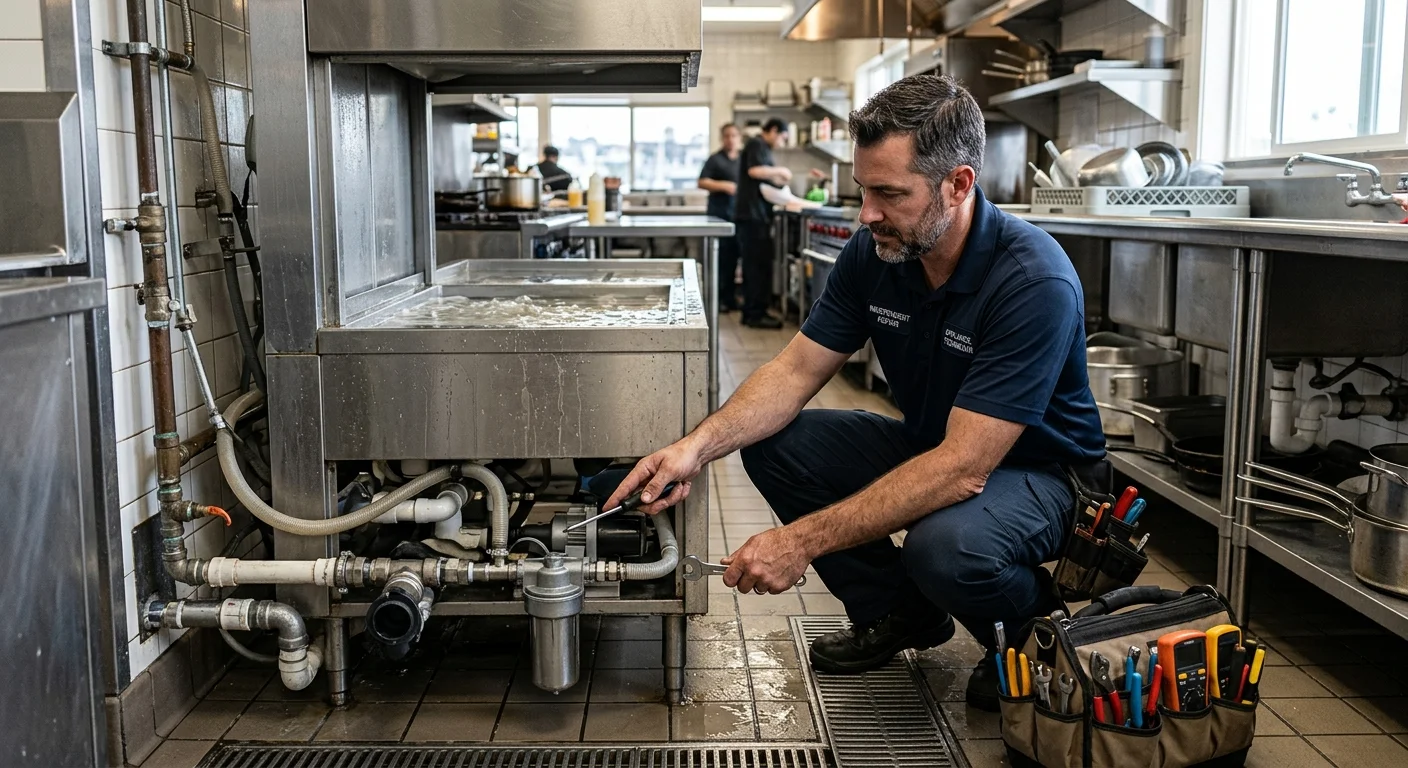
Service wraps with a rack still sitting in cloudy water. That is when Hobart dishwasher repair starts in a San Diego dish pit, not after someone guesses at a pump. Record the model, the water level, and when the drain should have started, then match an independent technician who works commercial warewashers.
Confirm the model and exact no-drain pattern
A restaurant Hobart is not a home dishwasher. The data plate is the first fact you hand a technician. It sits on the door, a side panel, or the back, depending on the family. Write the full model string, the serial, and the voltage. Undercounter, door-type, rack conveyor, and flight machines do not share one drain layout. A note that only says “the Hobart” is not a model.
Match that string to the operator manual Hobart publishes for that machine. Manuals are listed by model family in Hobart’s current document library. Do not assume a door-type machine drains like an undercounter unit. Do not assume a conveyor uses the same valve as a flight machine. If the plate is greasy or faded, photograph it in strong light and give that photo to the technician. The matched tech works from the plate, not from the badge on the door.
Then name the no-drain pattern in plain words. Water never leaves the tank after a cycle. Water leaves slowly and a film remains. Drain starts, then stops mid-cycle. Only one tank on a multi-tank conveyor holds water. Overflow shows up during rinse, not wash. The control stops at a drain step. Copy any display text letter for letter. Do not paraphrase it. Hobart control language changes by generation, and a rewritten code sends a technician after the wrong assembly.
Note whether the machine is still under a manufacturer warranty or a dealer service contract. Repair Pro San Diego is a referral match. It is not a Hobart factory branch. Independent technicians in the network are not claimed here as factory-authorized. If a warranty path still applies, confirm it with Hobart or the dealer of record before anyone opens a panel. A third-party visit can affect coverage. That rule is set by the manufacturer. A blanket version of it is not on file here, so ask Hobart what the live policy is for your serial.
A household dishwasher that will not drain is a different machine, with a different sump and a different hose. Use that guide in a home kitchen. For a restaurant Hobart, stay on the commercial path and keep the plate, the pattern, and the display text together in one note.
What staff can record without opening panels
Do not pull covers. Do not bypass door switches. Kitchen staff can still give a technician a clean picture before anyone arrives.
Write the time of day and how many racks ran since the last screen clean. Describe what is in the tank: clear, cloudy, greasy, or packed with rice, masa, or shells. Say whether scrap screens were emptied at the last turn. Say whether the floor drain or floor sink is backing up on its own. Note if neighboring prep sinks drain slowly at the same time. Record the sound at the drain step: hum, click, or silence. If the operator manual says a drain pump should run on this model, write whether anyone heard it. Note chemicals, the booster, and whether the last cycle still heated and rinsed as usual.
San Diego dish pits load machines hard. Coastal seafood houses send scales and shells. South Bay kitchens send rice, beans, and masa. Hotel banquet lines send starch and napkin lint. Those soils pack scrap screens and sit in sumps. A clogged screen is not proof of a failed pump. It is a note.
Check the path that does not need tools: scrap trays, strainers, and the visible sump grate. Photograph standing water with a utensil in the shot so depth is obvious. Photograph the floor sink. Photograph grease-interceptor access if that lid is in the pit. Write whether the machine dumps into a dedicated floor sink or a shared trench. Gaslamp, Little Italy, and older downtown shells often share laterals. A backup there is a building drain problem. A new pump will not fix it.
If water is on the floor near electrical connections, stop using the machine and keep staff off the wet area. Match a technician. Do not open the control box. That notes sheet is what a commercial visit needs. It is not a repair. Commercial appliance repair for warewashers starts with that record, then a diagnosis on site.
What technicians inspect along the drain path
A matched independent technician works the drain path in order, from soil screens to the building connection. Managers do not need the schematic. They do need the stops, so a visit is not a parts lottery.
Scrap screens and the sump come first. Food soil, lime film, and bar wipes collect there. San Diego tap water leaves mineral on heating surfaces and on drain openings. Scale can narrow a port without a dramatic clog. The technician will say whether the stop is soil, scale, or a failed part.
Next is the drain method the plate actually describes. Some Hobart families pump out. Some dump through a drain valve into a floor sink. Guessing a pump on a gravity machine wastes a night of service. The technician confirms the architecture, then tests that device.
A drain valve or solenoid that does not open leaves a full tank. One that does not close refills poorly and can overflow. The technician checks actuation and debris at the seat. Hoses, check valves, and air gaps get the same pass where the machine uses them. Kinks behind a tight dish table show up in retrofits all over the county.
Then the floor sink, the floor drain, and any grease interceptor serving the pit. A machine can drain perfectly into a blocked interceptor. That is plumbing. A good technician will say so rather than condemn a good pump.
Wiring and the control step that commands drain come last when the machine never even tries to empty. That can be an interlock or a control issue, not a hose.
None of that is a staff panel job. California appliance service dealers register with the Bureau of Household Goods and Services. You can confirm a business registration on the state’s license lookup. Registration status is not a skill test for one technician. It is still the public check the Bureau provides.
National cost guides such as HomeGuide and Angi put most household dishwasher repairs between $100 and $300, with a published span around $75-$600 and a typical figure near $225, as of August 2026. Those pages describe home machines. No authoritative published range for commercial warewasher work is on file here. Commercial cost moves with access, stainless work, pump or valve assemblies, scale, and whether the stop is in the machine or in the interceptor. The matched technician diagnoses first and quotes in writing before work begins.
For other commercial equipment in the same kitchen, use the commercial appliance repair overview for San Diego.
Which San Diego kitchen details affect access
A Hobart in Pacific Beach is not the same install as a Hobart in a Mission Valley hotel. Access decides whether a drain job is a valve and a hose, or a machine that has to be pulled in place.
Gaslamp, Little Italy, and older downtown shells put dish pits in tight rooms. Machines sit under low tables. Drain lines tie into floor sinks against a back wall. Rear clearance is often zero. The technician works from the front and the top. Shared laterals in older buildings back up on a Saturday night. Confirm whether the floor sink is independent of a street-level backup. Petco Park event nights and Gaslamp volume make that check real, not theoretical.
Coastal north county and the beach cities add salt air on hardware, hinges, and exposed fittings. Volume spikes with tourist weekends. A machine that “sometimes drains” after a rush often has packed screens, not a mystery control fault.
South Bay kitchens, including Chula Vista appliance repair territory and National City, run high grease and starch loads. Interceptors work hard. If the pit drain gurgles when the machine dumps, write that in the notes. That is local, and it is not the same as an Encinitas cafe with a short, dedicated floor sink.
Inland and East County dish rooms run hotter, with more mineral film. Scale on a drain port is a maintenance fact. Tell the technician how often screens are cleaned and whether a deliming step is on the opening checklist. Do not invent a hardness number. Your water agency publishes current quality reports if you need the mineral picture.
Hotels and institutions from Harbor Island through Mission Valley often run conveyor or flight machines, long tables, booster heaters, and drains that travel under the table to a distant floor sink. Pulling a conveyor is a different visit than sliding an undercounter unit off a dish table.
Residential dishwasher repair in a condo galley does not map onto these pits. Clearance, drain height, and grease load are set by the restaurant build, not by a home cabinet.
When to request commercial dishwasher repair
Request a commercial match when the machine holds water after a cycle, overflows at the drain step, or the floor sink cannot take the dump. Request it when staff already cleaned screens and the tank still stands. Request it when one conveyor tank drains and the other does not.
Stay off the machine if water is at electrical connections, if the door safety feels wrong, or if you smell overheated wiring. That is a stop, not a workaround with a bus tub.
A household troubleshooting list will miss conveyor valves, table limit switches, and interceptor backups. Use commercial warewasher service for a Hobart in a restaurant, school, or hotel. Repair Pro San Diego matches you with licensed, insured independent technicians who do that work. The brand does not send a fleet, stock Hobart parts, or perform the repair.
If the unit is still in a manufacturer window, confirm that path with Hobart’s current support contacts for your model. Do not assume a third-party visit preserves factory coverage. Ask Hobart or the selling dealer what the live policy is. Recalled consumer products, if any, are checked on the CPSC recall list by model, not by the word Hobart on the door.
A specific wash or rinse temperature for sanitation is not restated here. It lives in the Hobart manual for that model, and in whatever the county inspector of record already uses on your visits. No county ordinance number for warewashing is on file in this brand’s claims ledger, so confirm the live rule with the inspector rather than from a blog.
Common household dishwasher faults (poor cleaning, leaks, standing water) overlap only at the symptom. On a commercial Hobart, standing water is a drain-path problem until the technician proves otherwise: screens, valve, pump, hose, or building drain. Poor cleaning with a tank that empties is a different visit: spray arms, scale, wash pump, and chemistry.
When the notes sheet is ready, request the match. The technician inspects, diagnoses, and quotes in writing before any repair starts.
When to call us
Standing water in a Hobart after the drain step is commercial warewasher work for a licensed, insured independent technician, not a household parts swap. Leave the model, serial, and drain pattern in your message so the match can go to a pro who services restaurant machines. Call (858) 988-7787 to leave a voicemail requesting a match with a local appliance repair pro.