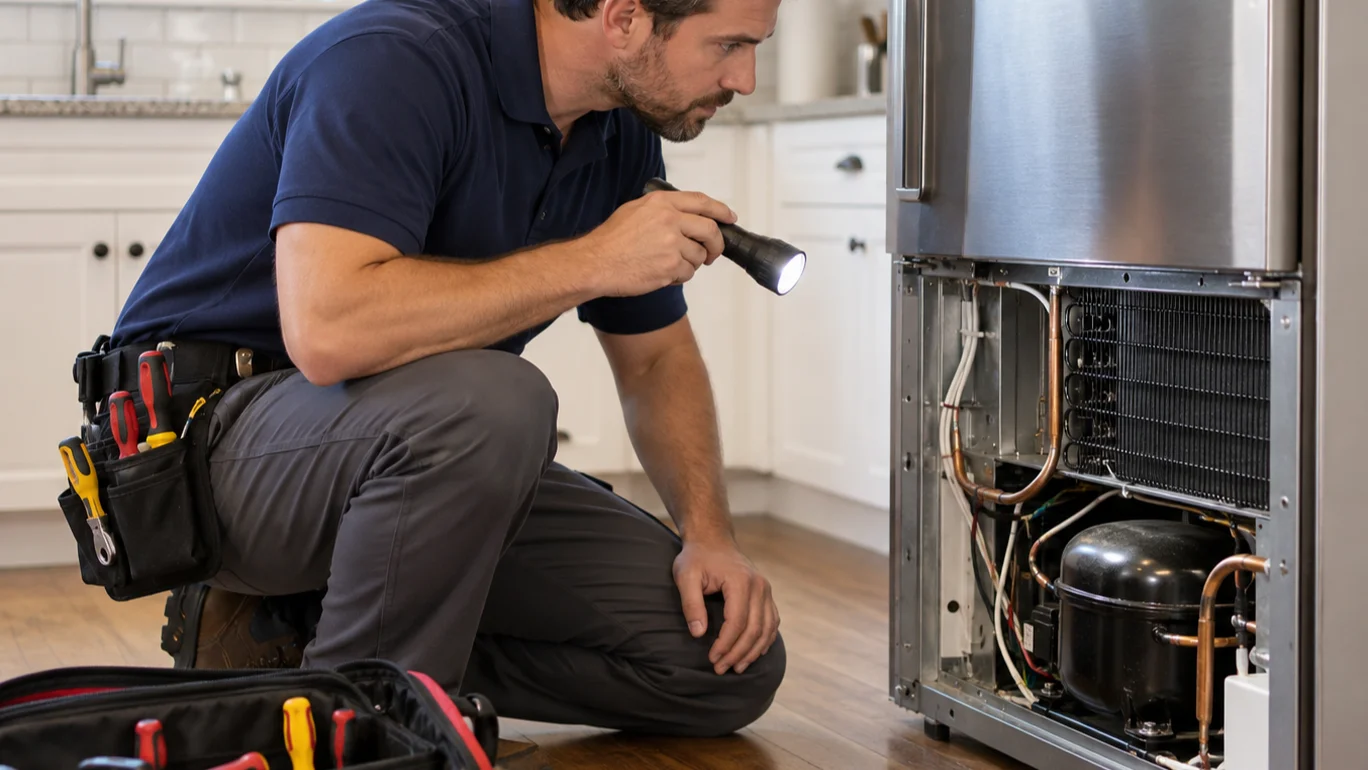
A warm Hisense refrigerator needs a focused check, not random part swapping. Confirm which compartment is warming, record the temperatures, and note what changed before requesting repair.
Confirm the model and exact cooling pattern
Start by confirming that this is a household refrigerator. A Hisense wine cooler has different storage goals and controls. Our separate Hisense wine fridge cooling guide covers that appliance type.
Find the model information on the appliance label and photograph it. Label placement and control layouts vary by model, so don’t rely on instructions for a similar-looking refrigerator. The exact model helps a technician locate the correct service information and parts.
Next, describe the cooling pattern in plain language. Is the fresh-food compartment warm while the freezer remains cold? Are both compartments warming? Is cooling intermittent? Note whether the problem began after a power interruption, control change, door issue, or appliance movement.
Use an appliance thermometer rather than judging temperature by touch. FDA guidance says a refrigerator should remain at or below 40°F. The freezer should remain at or below 0°F. A practical refrigerator target is about 37°F, but the model’s instructions should guide control adjustments.
Record each compartment separately. Include the displayed temperature and the thermometer reading, if available. Also note where the thermometer was placed and when you checked it. Repeated door opening can change what you observe, so keep the notes consistent.
This first snapshot matters. A cold freezer with a warm refrigerator points toward a different diagnostic path than two warm compartments. It doesn’t identify a failed part by itself. It gives the matched technician a useful starting point.
What owners can record without opening panels
You can gather strong diagnostic clues without removing covers or touching wiring. Begin with the model label, control display, and current thermometer readings. Photograph any visible message or code exactly as shown.
Write down when the problem started. Note whether the Hisense fridge stopped cooling suddenly or weakened over several days. Record any clicking, buzzing, rattling, or unusually quiet operation. Don’t assign a cause to the sound. A short recording can preserve what happened between cooling cycles.
Check the visible condition of the power cord and plug without dismantling anything. Note whether interior lights and the control display work. If the appliance lost power, record what else happened in the home. Don’t repeatedly disconnect and reconnect the refrigerator to test it.
Look inside both compartments. Record whether food packages block visible air openings. Note any heavy frost, water, ice buildup, or condensation that you can see without removing panels. Photograph the pattern before clearing anything away.
Food safety takes priority over troubleshooting. The FDA says perishables held above 40°F should be discarded after two hours. That window drops to one hour when the surrounding temperature exceeds 90°F. When you can’t confirm how long food stayed warm, follow current FDA guidance rather than relying on smell or appearance.
For broader owner checks, use the fridge not cooling checklist. Keep your Hisense notes model-specific. They’ll be more useful than a general statement such as “the refrigerator isn’t cold.”
How controls and door closure narrow the complaint
Check the current settings against the manual for your exact model. Hisense control names and available modes can vary. The provided research didn’t confirm one control sequence that applies to every Hisense refrigerator, so avoid copying reset steps from an unrelated model.
Photograph the display before changing anything. If the manual describes modes that reduce or alter cooling, confirm whether one is active. Make one documented change at a time. That keeps the symptom history clear if the refrigerator still needs diagnosis.
Door closure deserves the same careful review. Open and close each door while watching for containers, shelves, or food packages that interfere. Look for gaps between the gasket and cabinet. Check whether the gasket appears folded, loose, dirty, or damaged. Don’t assume a visible gap proves the gasket is the only problem. Door alignment and cabinet position can also affect closure.
Record where moisture or frost appears. A repeated pattern near one door can help distinguish a closure complaint from a broader cooling problem. A warm fresh-food section with a colder freezer may also suggest that cold air isn’t moving as expected. A technician still needs to determine why.
San Diego County conditions add useful context. Tell the technician whether the refrigerator sits in a conditioned kitchen, an inland garage, or another warm space. A home in coastal Oceanside can have different room conditions than a garage in El Cajon. Don’t assume the appliance is approved for that location. Check the model manual for its installation limits.
These observations don’t replace testing. They help separate a control or closure issue from a complaint involving airflow, cooling components, or the sealed system.
What technicians inspect during diagnosis
A refrigerator diagnosis should follow the symptom pattern and model information. The technician may begin with the power supply, user controls, temperature readings, and door closure. From there, testing can cover sensors, fans, airflow paths, frost patterns, defrost components, and the compressor circuit.
The exact sequence depends on what the refrigerator is doing. If the freezer is cold but the refrigerator is warm, the technician may focus on how cold air reaches the fresh-food section. If both compartments are warming, the inspection may shift toward components shared by the entire cooling system. Visible frost, unusual noise, or intermittent operation can change that path.
A sealed-system diagnosis is different from an owner-level check. Technicians who service equipment containing covered refrigerants must hold the appropriate EPA Section 608 certification. Repair Pro San Diego doesn’t perform that work. We match homeowners with licensed and insured independent local appliance technicians, and the matched pro handles diagnosis and repair.
Before authorizing work, ask what testing supports the diagnosis. Also ask whether the proposed repair involves refrigerant access, electrical parts, controls, or mechanical components. The matched technician diagnoses first and quotes in writing before work begins.
California appliance repair businesses must register with the Bureau of Household Goods and Services. You can check a business through the state’s Department of Consumer Affairs license lookup. Registration confirms current registration status, not an individual technician’s skill level.
Repair Pro San Diego doesn’t claim manufacturer authorization. If manufacturer-authorized service matters for your coverage, confirm that status directly with Hisense before approving work.
When to request refrigerator repair
Request refrigerator repair service when temperatures remain unsafe, both compartments warm, or the same cooling problem returns after basic checks. Repair also makes sense when you find repeated frost, unreliable controls, unusual operating sounds, or a door that won’t close correctly.
Have the model information, temperature notes, photos, and symptom timeline ready. Those details help the independent technician prepare for the diagnosis. They don’t guarantee which component has failed, and they shouldn’t be treated as a parts order.
Current Hisense warranty terms for this model couldn’t be confirmed from the supplied material. Check your proof of purchase and the official warranty documents for the appliance. Ask Hisense whether the proposed independent repair could affect remaining coverage.
You can also search the CPSC recall database using the manufacturer and exact model. A similar appearance or product name isn’t enough to establish recall coverage. Match the model details against the official notice.
Our San Diego refrigerator repair guide explains what to prepare before requesting local help. Repair Pro San Diego makes the referral. The independent technician sets their own diagnostic fee, scope, warranty terms, and repair recommendations.
When to call us
Call when your Hisense refrigerator stays warm, the freezer also loses cooling, or diagnosis requires access beyond visible owner checks. We can match you with a licensed and insured independent local appliance repair pro across San Diego County.
Call (858) 988-7787 to leave a voicemail requesting a match with a local appliance repair pro.