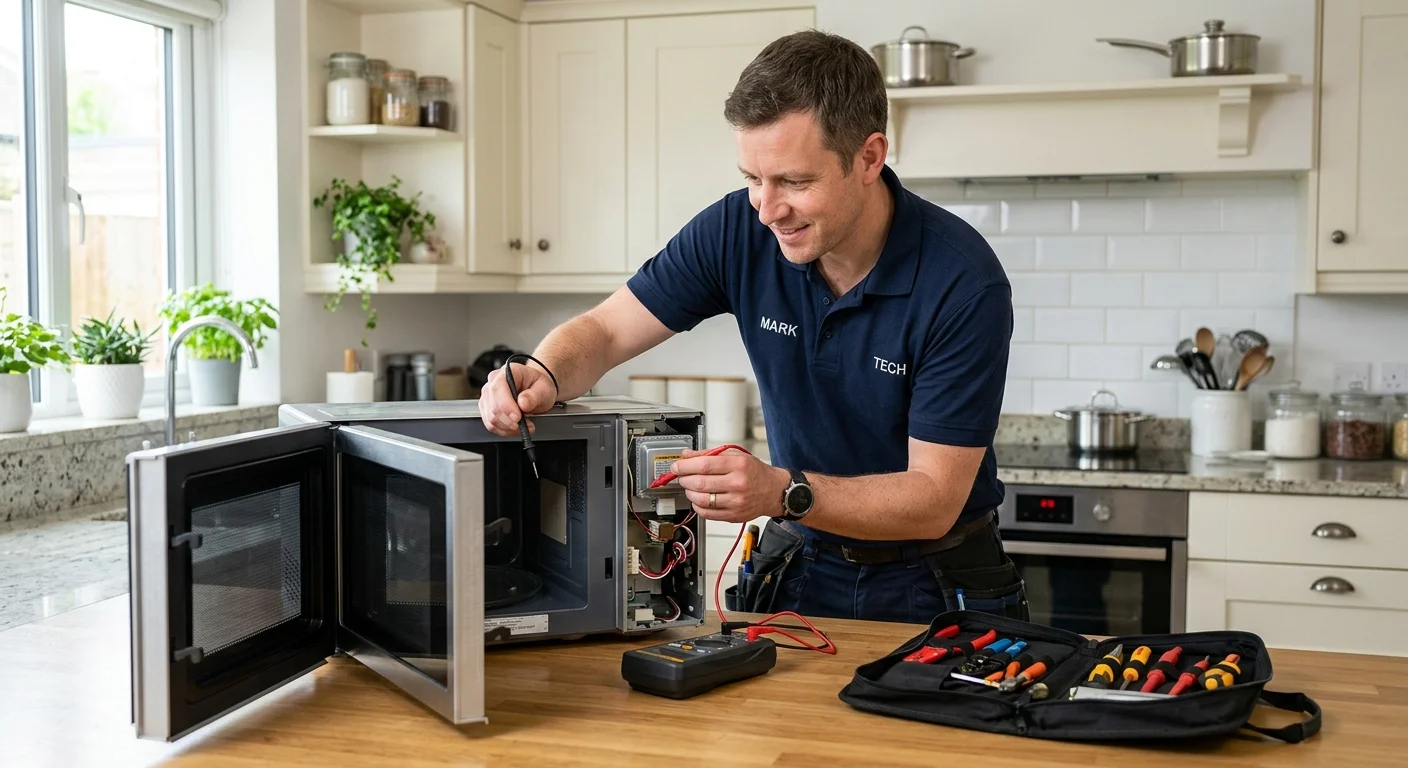
The clock still works. The cavity light comes on. Dinner comes out as cold as it went in. That GE pattern is a no-heat complaint, and it is a different job from a microwave that will not start at all.
Confirm the model and no-heat pattern
Start with the model sticker, not the badge on the door. On most GE, GE Profile, Café, and Monogram microwaves, the full model and serial sit on the frame you see when the door is open, or on the left or right wall of the cavity. Copy every character. GE Appliances support, a parts house, and a matched technician all work from that string. “GE over-the-range” is not a model.
Write the product family next to it. A countertop JES-style unit, an over-the-range hood microwave, a built-in, and a GE Advantium speedcook oven share a brand and not much else. Advantium and some Café speedcook models use extra heat sources. If the nameplate says Advantium, say so in the notes. A tech who thinks they are chasing a standard magnetron job will waste the visit.
Then pin the no-heat pattern in plain words. The useful split is:
- The fan, light, and timer run, and food stays cold from the first second.
- The unit used to heat, and now it only warms the edges.
- Time cook does nothing, but a sensor or popcorn pad still adds some warmth, or the reverse.
- Heat worked yesterday, then vanished after a slam, a spark, or a long cook.
That last line matters in San Diego kitchens where an over-the-range GE sits over a gas range. Grease, steam, and a door that gets bumped by a pan all show up as interlock and latch wear before they show up as a dead control. Tract homes in El Cajon, Escondido, and older Chula Vista streets still carry a lot of those hood units. Newer Carmel Valley and Eastlake kitchens more often hide a built-in Profile or Café. The complaint sounds the same. The cabinet, vent path, and circuit do not.
Skip the generic microwave that is not heating checklist as your whole story. Brand family, install type, and the exact run-but-cold pattern are what turn a vague call into GE microwave repair in San Diego that a tech can actually plan.
If the unit is still under a written GE Appliances warranty, pull that booklet or the model lookup on GE’s site before anyone orders a part. California’s Song-Beverly Consumer Warranty Act (Civil Code sections 1790 through 1795.8) is the state overlay on a manufacturer’s express warranty: service has to start in a reasonable time, and covered repairs are supposed to finish within 30 days unless a delay is outside the maker’s control. Independent work on a still-covered magnetron can collide with that paper. Confirm coverage first.
What owners can observe without opening the cabinet
Leave the outer cover on. Microwave cabinets hide high-voltage parts that can hold a charge after the cord is pulled. GE use-and-care books tell owners not to run the oven with the door off and not to remove that cover. Follow that. A matched tech handles the inside.
You can still collect a useful report from the kitchen.
Try a cup of tap water in the center of the turntable on a 60-second time cook at full power. Stand to the side. Note whether the water is still cool, barely warm, or hot. That single test separates “the pad ran” from “the cavity made heat.” Do not run the oven empty to “see if it sparks.”
Check the obvious control traps on current GE boards. Many models have Control Lock. Some display units also have a demo or showroom mode that lights the panel and runs the turntable without cooking. The button hold is model-specific, so use the booklet for that exact number instead of a generic combo from a forum. Confirm the power level is not sitting on 1 or 0 from the last leftover. A locked pad, a demo mode, or a low power setting can mimic a dead magnetron and cost you a service call you did not need.
Look through the window and into the cavity. Note a burned or blistered waveguide cover on the side wall, scorch marks on the ceiling, a damaged stirrer cover, or food welded to the floor. Those are owner-visible. They do not tell you which high-voltage part failed. They do tell the tech the unit has been arcing.
Unplug the microwave (or switch the dedicated breaker off) for a full minute, then restore power and try one short time cook. Some GE electronic controls wake up from a glitch. If heat returns and then dies again, write that down. A one-time reset is a clue, not a repair.
Check CPSC recall listings against the model and serial you copied. Do not assume a no-heat GE is under a recall. Confirm it. If a recall is listed, follow the remedy on that notice before you pay for a related part.
Coastal installs from Imperial Beach through Encinitas add one more note: salt air and greasy OTR vents. They do not magically kill heat by themselves. They do corrode latches, switches, and plug connections on older hood units. Mention how close the kitchen is to the water, and whether the vent greases up fast.
How door, display, and turntable clues narrow the complaint
A GE that runs with no heat often fails the door circuit, not the cook program. The control can spin the plate and light the lamp while one of the door interlock switches is out of alignment. The high-voltage side never gets the “door closed” signal it needs.
Open and close the door slowly. Feel for a clean latch, a second catch, or a door that springs back a few millimeters. Look at the strike on the cabinet. If you have to press the door in with a hip for the cook cycle to count down, say so. That is a latch and switch job, and it overlaps with a door that will not close. Do not tape the door or bypass a switch. That is how people disable the safety that keeps the oven from running open.
Watch the display for the whole minute of the water test. Write down any code, a flashing colon, a locked pad icon, or a panel that goes blank when you hit Start. Do not guess what a code means from a different brand. GE microwave codes live in that model’s guide. A photo of the panel during the fail is more useful than a memory of “it blinked.”
Watch the turntable. On many GE cavities the glass tray sits on a coupler in the floor. Note whether the tray turns, stalls, or never tries. A still tray with hot water is a coupler or motor side issue, not the no-heat complaint you called about. A spinning tray with cold water points the tech at the high-voltage side or at door interlocks. Either way, you have narrowed the visit.
Listen from a few feet away. A normal GE cook cycle has fan noise and a low cook hum. A hard buzz, a click-click from the door stack, or a sharp tick from the cavity is worth a sentence in your notes. Smell for hot plastic or ozone. Stop the cycle if you see sparks. Unplug it. Do not keep testing.
Over-the-range units in Pacific Beach, Mission Valley, and downtown condos often share a crowded 15-amp kitchen circuit with a toaster or coffee maker. If the display dimmed, a breaker tripped, or lights flickered when you hit Start, write that down too. A weak receptacle will not always look like a magnetron failure, but it can sit underneath one.
What technicians inspect after a no-heat report
Repair Pro San Diego matches you with an independent, insured local appliance technician. The brand does not open the cabinet, stock GE magnetrons, or quote a house price list. The matched pro diagnoses, then puts the repair in writing before work starts.
After they confirm your water-test notes, they typically work through the door switch stack, the thermal cutouts on the magnetron and cavity, the control’s cook relay, and the high-voltage group: magnetron, diode, capacitor, and transformer. Those parts live behind the cover. There is no owner version of that test. Anyone offering a “how to ohm your GE capacitor” walkthrough is asking you to work on a circuit that can hold a dangerous charge.
On over-the-range GE hoods they also check the mounting, the vent path, and the plug at the cabinet. A unit that was rehung after a range swap in a Clairemont or El Cajon remodel sometimes sits just out of square. That misaligns the door, which takes out heat while the clock still looks fine.
Line voltage at the receptacle is part of the same visit, especially in older East County and South Bay kitchens. A microwave that browns the display and never cooks may be starving for power. That is an electrical finding, not a GE-brand quirk, and it still belongs in the no-heat report.
Ask the technician about their diagnostic fee and whether it is credited toward the repair. National cost guides such as Angi, checked for this site in August 2026, put most microwave repairs around $100-$200, with a typical figure near $175 and a published span of $50-$500. The same guides put magnetron work around $100-$300 (Fixr, same check, published $150-$350 with labor). Those are national guide ranges, not a San Diego price list and not a quote from this brand. Age of the unit, over-the-range access, genuine GE parts versus aftermarket, and whether the door stack and the magnetron both need work are what move a job.
California appliance repair businesses register with the Bureau of Household Goods and Services. You can confirm a shop’s registration on the state’s license lookup. Registration is not a skills exam. It is still the public record for the business that invoices you.
If you already have a broader microwave repair visit scheduled for a second unit, keep the GE no-heat notes on their own sheet. Mixing a Whirlpool countertop and a GE hood on one verbal report is how the wrong part gets ordered.
When to request GE microwave repair
Request the visit when the water test stays cold, when you see arcing or a burned waveguide cover, when the door needs a shove to run, or when Control Lock and demo mode are already ruled out. A GE microwave repair service call is also the right move after a spark event. Keep cooking on a damaged cavity and you can turn a magnetron job into a cabinet replacement.
Stay with repair when the cabinet, door, and keypad are intact, parts are still sold for that model, and the matched tech can show you the failed item. Over-the-range GE units in San Diego often stay worth fixing because the hood cutout, vent, and cabinet doors are built around that size. A cheap countertop spare can cover leftovers. It does not replace the vent or the built-in look.
Lean toward replacement talk when the tech finds a burned waveguide, a damaged door, and a dead high-voltage part on the same visit, or when GE no longer supplies the board for that serial. There is no verified government “percent of a new unit” cutoff for that choice, and this site does not invent one. Ask for the failed part names and a written quote. Then decide.
If the microwave is the only cooking backup in a condo without a full oven, say that when you request the match. It does not change physics. It does change which loaner workflow you want to ask the tech about. It still does not create an arrival window. This brand does not promise one.
For a county-wide picture of who handles hood units, built-ins, and countertop GE sets, use the San Diego microwave repair guide next to this symptom page. This page stays on one complaint: a GE that runs, lights, or turns the plate, and still leaves the food cold.
When to call us
When a GE microwave runs through a full minute and the water stays cold, or the door, panel, or cavity shows damage, stop using it and request a match with a licensed local appliance repair pro. Call (858) 988-7787 to leave a voicemail requesting a match with a local appliance repair pro. The matched technician diagnoses the unit and quotes the repair in writing before any work begins.