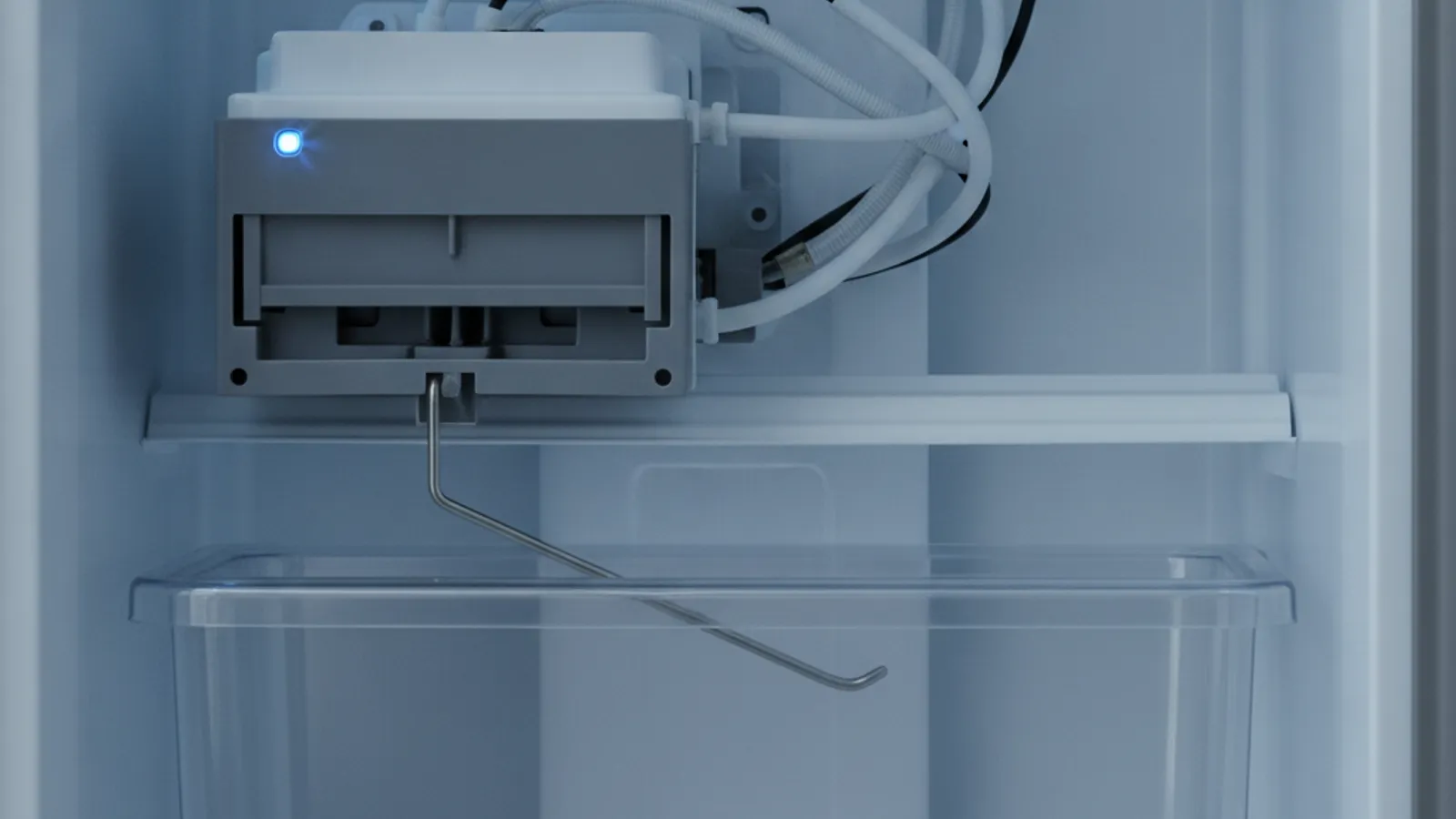
A GE ice maker that stops working needs the freezer temperature, the filter seating, and any visible ice stoppage recorded first. Do not jump test points or check live voltage. FDA guidance holds a freezer at or below 0°F. If the freezer cannot hold that, you have a cooling problem, not only an ice-maker problem.
Know which GE icemaker you have
GE has used a few designs over the years, and the fix depends on which one sits in your freezer.
The older style is the modular icemaker with a metal feeler arm. The newer French-door style may use an optical or motorized harvest. Confirm the design in the model document. Do not open the module cover or touch test points. Keep hands out of the ice bin while it can cycle.
The newer style shows up in GE French-door models, either in the freezer drawer or built into the fridge door. These use an optical or motorized harvest instead of a swinging arm, but the underlying causes are the same.
Both rely on three things working together: cold enough freezer, clean water flow, and a module that cycles on schedule. Break any one and the ice stops.
Confirm the freezer temperature first
A GE icemaker needs a freezer that can hold at or below 0°F, the FDA freezer holding target. Check the setting and give it time after any change. If the freezer cannot hold temperature, that is a cooling repair. Once the freezer is cold and ice still will not come, move on.
Check the water filter first
GE refrigerators run incoming water through a replaceable filter. A clogged or poorly seated filter can starve the icemaker. Use a genuine GE filter if that is what the model specifies, and confirm it seats fully.
Filter interval belongs in the GE document for that model, not a universal six-month rule. San Diego tap water hardness varies. Mineral scale is a question for the technician, not a measured county failure timing.
Look for a frozen fill tube
The fill tube is the small plastic line that delivers water to the icemaker mold. On GE units it sits at the back of the freezer and freezes up when a slow leak or a bad valve lets water sit and refreeze.
When the tube ices over, the next fill cycle has nowhere to go, so the mold stays empty. You’ll sometimes find a small slug of ice plugging the tube end.
If ice is visible in the fill opening, stop there. Do not chip it. Thaw steps belong in the exact GE manual. Do not pull the fridge to chase the valve.
Test the water inlet valve
The water inlet valve is an electric solenoid at the back of the fridge that opens to let water through on each fill. When it fails, it either won’t open at all or won’t seal shut, which causes that repeat fill-tube freeze.
A valve that won’t open means no water reaches the icemaker even when the filter is fine and the freezer is cold. A valve that won’t fully close drips, and that drip is what refreezes the tube.
A failed inlet valve can block fill or drip and refreeze the tube. Testing voltage at the valve, pulling the fridge, and working live connections belong to the technician. Do not do those yourself.
Run the GE icemaker test and check the module
If water reaches the unit and ice still will not form or drop, the module may be involved. Forced-harvest jumper tests and cover-off test points are not owner steps. Reset buttons, if any, exist only where that GE model’s document shows them. Do not treat a harvest jump as shared across GE makers.
DIY versus calling a pro
You can confirm freezer temperature against the FDA 0°F holding target, check genuine-filter seating, and record visible ice stoppage. Do not pull the fridge, jump harvest terminals, or test voltage. Repair Pro San Diego does not stock GE parts or promise a one-visit repair. The matched technician diagnoses and quotes in writing. See ice maker not making ice.
Frequently asked questions
Why is my GE ice maker not making ice?
Check freezer temperature against 0°F, filter seating, and visible ice in the fill path first. Do not assume the module failed.
How do I reset a GE ice maker?
Only if the GE manual for that exact model shows a reset. Older modular units are not jumped at the test points by the owner.
How long does a GE ice maker take to make ice after a reset?
Give it a full 24 hours. The freezer has to refreeze the fill water and the icemaker cycles slowly, so an empty bin won’t refill in an hour or two even when everything’s working.
When to call us
If you’ve checked filter seating, freezer temperature, and visible ice and the maker still will not produce, stop. Valve and module work belong to the matched technician. See GE appliance repair in San Diego and ice maker repair. Call (858) 988-7787 to leave a voicemail requesting a match.