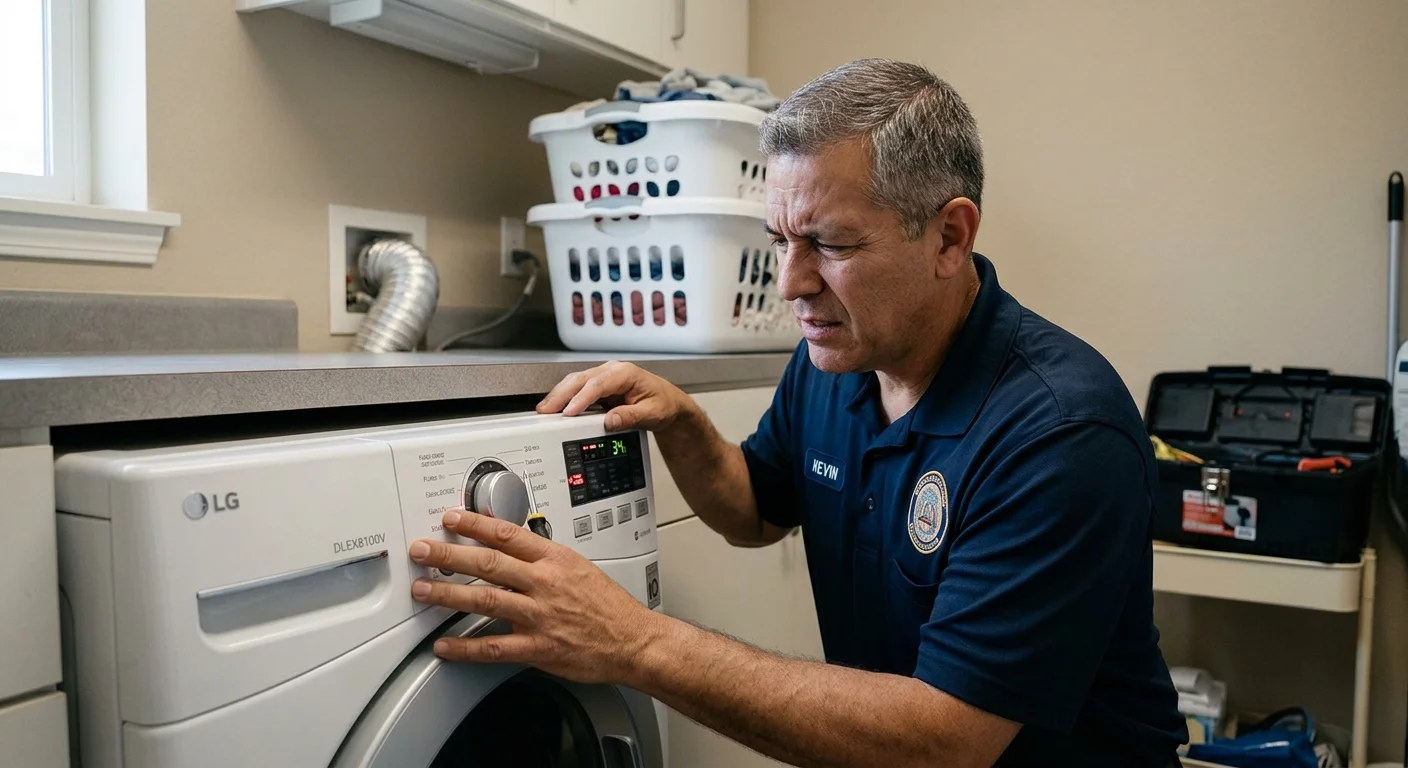
When your LG dryer stops working correctly, it throws a wrench into your whole laundry routine. Whether it is refusing to heat, making strange noises, or simply not turning on, a faulty dryer can quickly become a major inconvenience. Before you panic, many common LG dryer problems have straightforward causes.
At Repair Pro San Diego, we understand these issues inside and out. We are here to help you troubleshoot what is going wrong and explain when it is time to call in the professionals.
Is your LG dryer not heating? Here’s why
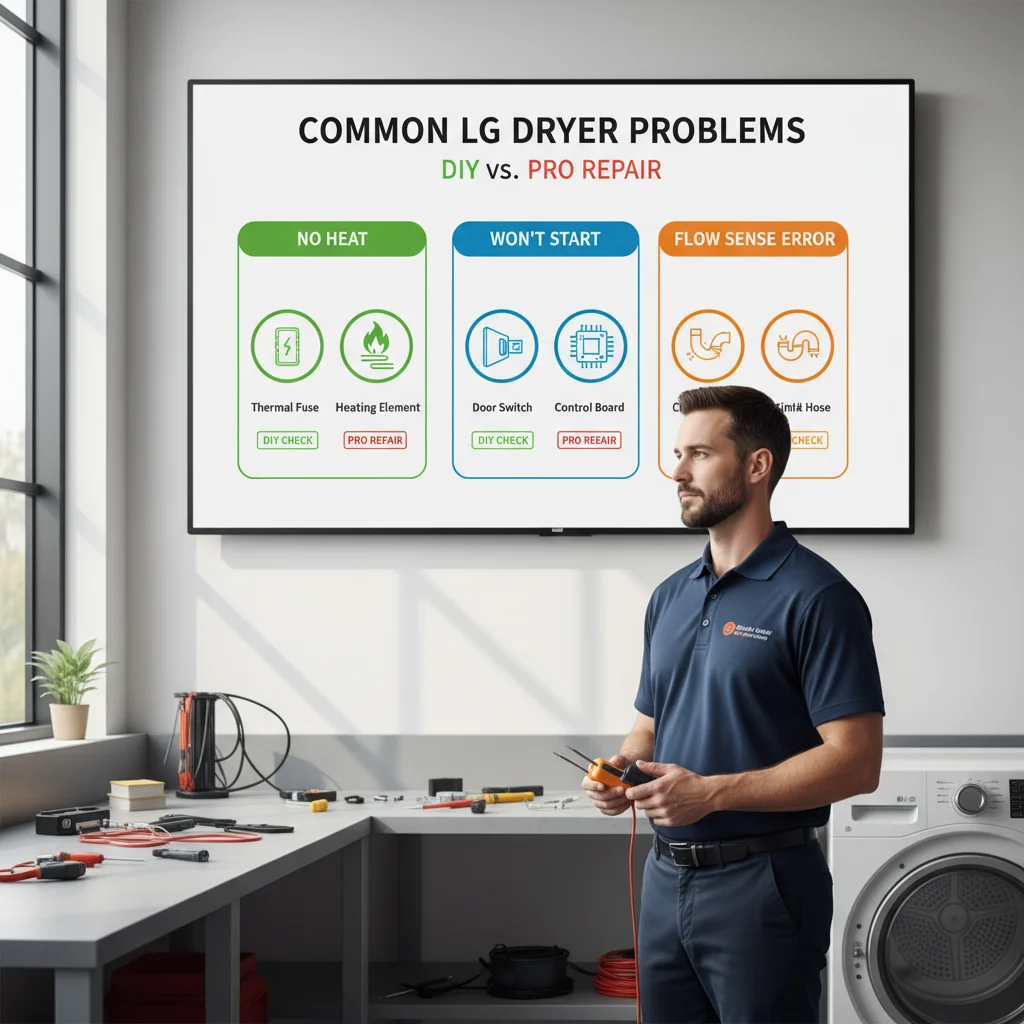
One of the most frustrating dryer problems is when it tumbles clothes but fails to produce any heat. You expect warm, dry laundry, not a pile of damp garments. Several components could be responsible for an LG dryer not heating. Understanding these can help you narrow down the issue.
Thermal fuse failure
The thermal fuse is a safety device designed to blow if the dryer overheats. Once it blows, it cuts off power to the heating circuit. This is a common culprit. If your dryer runs but does not heat, a blown thermal fuse is a strong possibility. It is not repairable and requires replacement. Before replacing, it is wise to check your dryer vents for blockages. A clogged vent often causes the dryer to overheat in the first place, leading to the fuse failure. If you just replace the fuse without addressing the vent, it will likely blow again.
Faulty heating element
The heating element is what actually generates the heat in your dryer. Over time, it can burn out. If the element fails, your dryer will tumble but stay cold. You can often test the heating element with a multimeter for continuity. If it shows no continuity, it is broken and needs replacement. This is a more involved repair than a thermal fuse, often requiring access to the dryer’s internals.
Broken thermistor or thermostat
Thermistors and thermostats monitor and regulate the dryer’s temperature. If either of these components malfunctions, the dryer might not receive the correct signals to heat up, or it might overheat and then immediately shut off the heat. Testing these components also usually requires a multimeter. Incorrect readings mean they are faulty.
Tripped circuit breaker
Sometimes, the simplest explanation is the right one. A dryer draws a lot of power. If the circuit it is on is overloaded or has a loose connection, the breaker might trip. Check your home’s electrical panel to see if the dryer’s breaker is tripped. Simply resetting it might resolve the issue. If it trips repeatedly, however, you have a deeper electrical problem that a licensed electrician should inspect.
Troubleshooting an LG dryer that won’t start
When your LG dryer does not even hum to life, it can feel like a more serious problem. However, like heating issues, several common culprits can prevent it from starting. Checking these points can save you a service call.
No power supply
First, confirm the dryer is plugged in securely. This sounds obvious, but a loose plug connection happens more often than you would think. Also, check your home’s circuit breaker for the dryer. A tripped breaker will cut all power. Reset it and try again. If the breaker immediately trips again, there is a short circuit or an overload somewhere, and you will need professional help.
Faulty door switch
The door switch is a safety mechanism that prevents the dryer from running when the door is open. If this switch is faulty or broken, the dryer’s control board will think the door is always open, even when it is firmly shut. You can test the door switch for continuity with a multimeter, or sometimes visually inspect it for damage. If it is not clicking properly or shows no continuity when closed, it needs replacement.
Defective start button
The start button itself can wear out or become damaged. If you push the start button and nothing happens, try pushing it firmly or wiggling it slightly. If it feels loose or does not engage, it might be the problem. While it is possible to replace a start button, accessing it often involves disassembling part of the control panel, which can be tricky.
Issues with the control board or motor
If you have checked the power, door switch, and start button and the dryer still will not start, the problem could be more complex. A faulty main control board or a dead motor are serious issues. The control board acts as the brain of your dryer, sending signals to all components. If it malfunctions, the dryer might not respond to commands. Similarly, if the motor has failed, the drum cannot spin, and the dryer will not start. Diagnosing these requires expertise and specialized tools. For such issues, you will likely need professional LG appliance repair.
What does the ‘Flow Sense’ warning mean?
The LG ‘Flow Sense’ system is a smart feature designed to monitor the airflow through your dryer’s exhaust duct. It helps ensure efficient drying and alerts you to potential safety hazards. When the ‘Flow Sense’ indicator lights up, or you see an error code related to it, it means the dryer is detecting restricted airflow.
Clogged dryer vent
The most common cause of a ‘Flow Sense’ warning is a clogged dryer vent. Lint, debris, and even small articles of clothing can accumulate in the ductwork over time. This reduces airflow, makes your dryer work harder, increases drying times, and creates a fire hazard. Cleaning your dryer vent system regularly matters a lot. You can often clean the accessible parts yourself, like the lint trap and the first few feet of the duct directly behind the dryer. However, for longer or more complex duct runs, especially those going through walls or the roof, a professional vent cleaning service is recommended.
Kinked or crushed exhaust hose
Sometimes, the flexible exhaust hose connecting your dryer to the wall vent can get kinked or crushed, especially if the dryer is pushed too close to the wall. This immediately restricts airflow. Pull your dryer away from the wall and visually inspect the hose. Make sure it is straight and free of any obstructions or sharp bends. Replace any damaged sections.
Improper vent installation
Less common, but still a possibility, is improper vent installation. If the vent system has too many bends, is too long, or uses the wrong type of material (like flexible vinyl instead of rigid metal), it can inherently restrict airflow. If you have recently moved or had new ductwork installed and the ‘Flow Sense’ warning appears, this might be the issue. Rectifying improper installation often requires professional assistance to ensure compliance with safety codes. Proper dryer repair in San Diego often starts with ensuring proper installation to prevent future problems.
Fixing loud noises and tumbling issues
An LG dryer that is rattling, squealing, thumping, or simply not tumbling smoothly is announcing a mechanical problem. These noises are often indicators of worn-out parts that need attention before they cause further damage.
Worn drum rollers
The dryer drum spins on a set of rollers, typically four, that support its weight. Over time, these rollers can wear out, develop flat spots, or even break. When this happens, the drum does not spin smoothly, leading to thumping or rattling noises. If you open the dryer door and rotate the drum by hand, you might feel resistance or hear the noise more clearly. Replacing drum rollers is a moderately complex repair that involves accessing the dryer’s interior and often the drum itself.
Damaged idler pulley
The idler pulley maintains tension on the drive belt, which turns the dryer drum. If the idler pulley becomes worn or its bearing fails, it can create a high-pitched squealing noise as the dryer operates. Sometimes, the noise is intermittent at first. A failing idler pulley can also eventually lead to the drive belt slipping or breaking. This component is usually accessible after removing the top or front panel of the dryer.
Broken drive belt
The drive belt is a long, thin belt that wraps around the dryer drum, idler pulley, and motor pulley. If it breaks, the drum will not tumble at all. You will hear the motor running, but the drum will remain stationary. A worn drive belt can also sometimes slip, causing intermittent tumbling or squealing before it eventually breaks. Replacing a drive belt is a common dryer repair, but it requires disassembling the dryer to gain access to the drum and pulleys.
Loose blower wheel
The blower wheel, also known as the fan, circulates air through the dryer. If it becomes loose, damaged, or has lint trapped in its blades, it can create a loud thumping, rattling, or vibrating noise. Sometimes, small items like coins or buttons can get past the lint filter and into the blower housing. Disconnecting the dryer from power and checking the blower wheel for obstructions or looseness might be possible for a handy homeowner. If the wheel itself is damaged, it requires replacement.
When to call a San Diego tech for LG dryer repair
While some dryer issues allow for DIY troubleshooting, many problems with LG dryers require the expertise of a certified professional. Knowing when to call us can save you time, stress, and potential further damage to your appliance.
If your troubleshooting efforts do not resolve the problem, or if you suspect a more complex issue like a faulty control board, a failing motor, or an electrical short, it is time to call in the experts. Components like heating elements, thermal fuses, and drive belts require careful installation to ensure safety and proper operation. Missteps can lead to poor performance or even fire hazards.
Technicians in our network specialize in full-service dryer repair across San Diego County. They have the tools, knowledge, and experience to accurately diagnose complex LG dryer problems and perform lasting repairs. Techs in our network typically carry common LG parts, so many repairs complete in a single visit.
Frequently asked questions
Why is my LG dryer running but not heating?
A blown thermal fuse is the most common cause. It’s a one-time safety device that trips when the dryer overheats, usually from a clogged vent, and must be replaced. If the fuse tests fine, check the heating element for continuity with a multimeter and inspect the thermistor and cycling thermostat.
What does the LG ‘Flow Sense’ warning mean?
Flow Sense means the dryer is detecting restricted airflow in the exhaust duct. Start by cleaning the lint trap and inspecting the flexible exhaust hose behind the machine for kinks. If the hose is clear, the ductwork running through the wall likely has a lint buildup that needs professional cleaning.
Why won’t my LG dryer start at all?
Check the door switch first. If the door switch is faulty, the control board reads the door as open even when it’s closed, and the dryer won’t run. Also confirm the circuit breaker hasn’t tripped, since a dryer draws enough power to trip a breaker on an overloaded circuit.
What causes a loud squealing noise in an LG dryer?
A worn idler pulley is the usual source of a high-pitched squeal. The idler pulley maintains tension on the drive belt, and its bearing wears out over time. Worn drum rollers cause a thumping or rattling sound and are often replaced at the same time since both require accessing the drum interior.
When to call us
Don’t let a malfunctioning LG dryer disrupt your household any longer. The technicians in our network are ready to get your dryer back in working order. Call us at (858) 988-7787 and we’ll get you matched with a technician.